Marketa Lazarova

A still shot from "Marketa Lazarova," the 1967 classic Czech fim, directed by Frantisek Vlacil.

A still shot from “Marketa Lazarova,” the 1967 classic Czech fim, directed by Frantisek Vlacil.

Are you looking for something to watch during these last couple of weeks before Labor Day? Marketa Lazarova is a classic of Czech filmmaking.

“Frantisek Vlacil’s atmospheric, symbol-charged medieval epic is a wide-screen black-and-white feast for the eyes.”
—J. Hoberman, The Village Voice

One of the crowning achievements of Czech cinema is this epic celluloid hallucination of savagery and mysticism in the Middle Ages. Centered around a violent feud between two 13th-century pagan clans, Marketa Lazarova is a riddle that’s not to be cracked (at least not on first viewing). Featuring a hypnotic dreamscape—hooded figures wandering through stark, barren landscapes and black wolves prowling virgin snow—and set to a thunderous, primordial soundtrack of clanging bells and liturgical chanting, the film’s lustrous, monochrome ’Scope cinematography gleams anew in this freshly struck 35mm print.

You can get it on Netflix, I think, and on Amazon. I saw it at a special BAM screening last spring and it was amazing. It reminded me of The Seventh Seal but it was also a very different movie. I highly recommend it!

A Janus Films release.

Red City Review Announces 5-Star Review!

Come Hell or High Water: Part One: Wellspring by Stephen Morris

5redstars-300x70[1]

In 1356, an entire town turned against one woman. Driven by religious fervor, they proclaimed her a witch and put her to death without a proper trial or formal sentence. But, as Fen’ka inhaled the smoke surrounding her on the stake to which she was affixed, she issued her own verdict – and with it came a punishment that would endure for centuries… until justice, however harsh, was once and for all served. ‘Come Hell or High Water: Part One: Wellspring’ by Stephen Morris carries readers back in time to witness this age-old injustice and follow the consequences, and culmination, of Fen’ka’s curse on the city of Prague. The chapters alternate between this fourteenth century storyline and another, set in 2002, centered on a young girl named Magdalena, whose fascination with the occult and determination to do more with her life have inexorably drawn her into Fen’ka’s post-mortem quest for justice. As Magdalena comes to terms with her otherworldly assignment in one chapter, the ways Fen’ka’s final words came back to haunt the villagers of Prague is explored in the next – and, so on and so forth it goes, masterfully, until the end of this, the first installment in the Come Hell or High Water trilogy.

‘Wellspring’ is an entirely enthralling, incredibly intense novel that seamlessly weaves together elements of history, folklore, popular culture, and religious, spiritual, and occult practices and beliefs – among other things. Author Stephen Morris’ passion for, and commitment to, his cast of characters is evident in his prose, which is fluid, dynamic, and absolutely haunting at times. As eloquently told as it is informative and thought-provoking, ‘Wellspring’ is a title worthy of standing on the shelf alongside acclaimed works such as those in The Vampire Chronicles and Mayfair Witches series penned by the mother of all things occult, Anne Rice. It’s definitely a page-turner and will hold your interest from start to end, though its end isn’t really and ending, but, rather, an invitation to the next book.

RED CITY REVIEWS also hosts an annual book award contest, that includes cash prizes in five different book categories, including Science Fiction/Fantasy. The Red City Review Book Awards offers a grand prize of $500, that also includes other great prizes that will help promote the winning book so that it receives the attention it deserves. Finalists will be announced October 10, 2014.

Narcissus

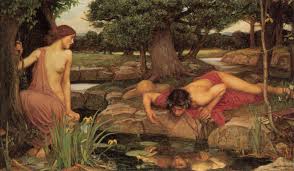
Echo and Narcissus (1903), a Pre-Raphaelite interpretation by John William Waterhouse

Echo and Narcissus (1903), a Pre-Raphaelite interpretation by John William Waterhouse

Despite there being no clear evidence that the flower’s name derives directly from the Greek myth of Narcissus, who drowned while gazing at his own reflection in the water, the two are firmly linked in popular culture and the flower taken as a symbol of vanity. Another Greek myth finds Persephone, daughter of the goddess Demeter, lured to her doom in the Underworld by the god Hades while picking a narcissus flower.

In ancient China, a legend about a poor but good man holds he was brought many cups of gold and wealth by this flower. Since the flower blooms in early spring, it has also become a symbol of Chinese New Year. Narcissus bulb carving and cultivation is even an art akin to Japanese bonsai. If the narcissus blooms on Chinese New Year, it is said to bring extra wealth and good fortune throughout the year. Its sweet fragrances are highly revered in Chinese culture.

In classical Persian literature, the narcissus is a symbol of beautiful eyes, together with other flowers that equal a beautiful face with a spring garden, such as roses for cheeks and violets for shining dark hair.

The narcissus, otherwise known as daffodil, is the national flower of Wales, where it is traditional to wear a daffodil or a leek on Saint David’s Day (March 1). In Welsh the daffodil is known as “Peter’s Leek”, cenhinen Bedr or cenin Pedr). You can read more about daffodil and spring here.