Samhain 2015

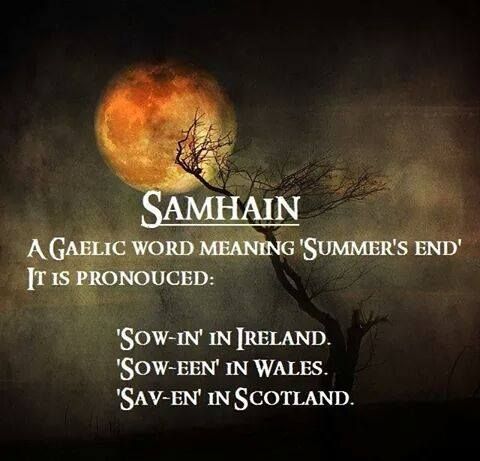
Samhain pronunciation

“Winter is coming!” Samhain, the Celtic festival more commonly known as “Hallowe’en,” was considered the first day of winter in the Middle Ages and Renaissance. Marking the day halfway between the autumnal equinox and the Winter Solstice, Samhain marked the beginning of the sun’s descent into darkness and the world’s embrace by the growing cold. Both these trends would be reversed at the Winter Solstice, marking the “midpoint” of the Winter season.

Like Beltane, on April 30-May 1, Samhain was seen as a time when the ‘door’ to the Otherworld opened enough for the souls of the dead, and other beings such as fairies, to come into our world. The souls of the dead were said to revisit their homes on Samhain. Lewis Spence described it as a “feast of the dead” and “festival of the fairies”. However, harmful spirits and fairies were also thought to be active at Samhain. People took steps to allay or ward-off these harmful spirits/fairies, which is thought to have influenced today’s Halloween customs. The practice of lighting bonfires during Hallowmas may have been a Christianized one, as the Celts lit bonfires during Samhain as well.

Big stores of Hallowe’en costumes and decorations have opened all over Manhattan. I will get out my hooded cape that I usually wear during the last week of October. I think that November 1 is also the day that we give up Daylight Savings Time this year and “fall back” an hour. The huge NYC Marathon will also be run on November 1 this year. How will YOU be marking this year’s descent into darkness at the end of October?

Wendigo

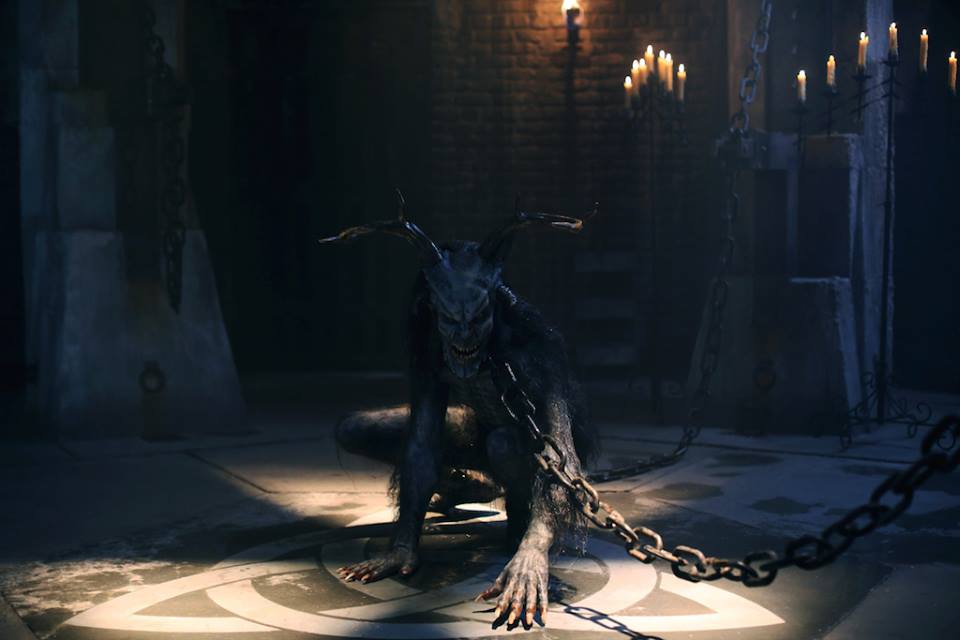
A wendigo, as he appeared in Season Two, episode 6 of SLEEPY HOLLOW (which first aired on October 27, 2014).

A wendigo, as he appeared in Season Two, episode 6 of SLEEPY HOLLOW (which first aired on October 27, 2014).

Many people have a day off this week to celebrate the arrival of Christopher Columbus in the New World on October 12, 1492. When I was young, school was closed on October 12 each year; now the schools and the government are closed on the second Monday of October to make a 3-day weekend and many are calling for a re-designation of “Columbus Day” as “Indigenous Peoples Day.” Others like to point out that many others — such as the Vikings or the Chinese — had arrived in the New World many centuries before Columbus did. However you choose to designate the occasion, it was clearly a turning point in world history. It also seems appropriate to muse on a monster of Native American folklore who has appeared frequently in urban fantasy literature: the ever-popular wendigo.

A wendigo is a half-beast creature appearing in the legends of the Algonquian peoples along the Atlantic Coast and Great Lakes Region of both the United States and Canada. It is particularly associated with cannibalism. The Algonquian believed those who indulged in eating human flesh were at particular risk; the legend appears to have reinforced the taboo against the practice of cannibalism. It is often described in Algonquian mythology as a balance of nature. Basil Johnston, an Ojibwe teacher and scholar from Ontario, gives one description of how wendigos were viewed:

“The wendigo was gaunt to the point of emaciation, its desiccated skin pulled tautly over its bones. With its bones pushing out against its skin, its complexion the ash gray of death, and its eyes pushed back deep into their sockets, the wendigo looked like a gaunt skeleton recently disinterred from the grave. What lips it had were tattered and bloody [….] Unclean and suffering from suppurations of the flesh, the wendigo gave off a strange and eerie odor of decay and decomposition, of death and corruption.”

I first met the wendigo (who has since also appeared on television and in movies) in the novel Stray Souls, the first in the Magicals Anonymous series by Kate Griffin. I cannot recommend any of Kate Griffin’s books too highly! I don’t want to give away too much of the plot of Stray Souls so I will only say that a wendigo appears in it and is quite a fascinating character, since he is known primarily as a creature in Native American folklore even though he appears in the streets of London in Griffin’s book. She describes the wendigo, “whose laugh was a hunting cry and whose face was a split in a fanged grin of ecstacy,” as he attacks Sharon Li and her stalwart crew:

“…he seemed to expand beyond the confines of his clothes. The tatty remnants of his shirt warped around him as claw and bone and flesh outgrew his human disguise. Flesh sank back into bone; skin spread out to billow around him like a warrior’s flag; fingers stretched into claws, and teeth expanded out of a black, mawing mouth. His eyes turned boiling red, nose flattened, ears stretched, and as his knees clicked backwards and talons ripped out through the constraint of his leather shoes, [he] rolled his neck from side to side and hissed: ‘So be good to me!’ ”

The wendigo also seems to be related to the “naagloshi”, a Native American shapeshifter who is called a Skinwalker in English, in Turn Coat (#11 of the Dresden Files novels by Jim Butcher):

“…for a second the creature was visible as an immensely tall, lean, shaggy, vaguely humanoid thing with matted yellow hair and overlong forelimbs tipped in long, almost delicate claws…. The skinwalker followed her motion, surging forward, its body broadening and thickening into the form of something like a great bear with oversized jaws and vicious fangs. It overbore her by sheer mass, slapping and raking with its clawed paws, snapping with its steely jaws.”

How to spend your day off this week? Run, do not walk, to the nearest copy of either Stray Souls or Turn Coat!
Lunar Eclipses and Wolves — O, my!

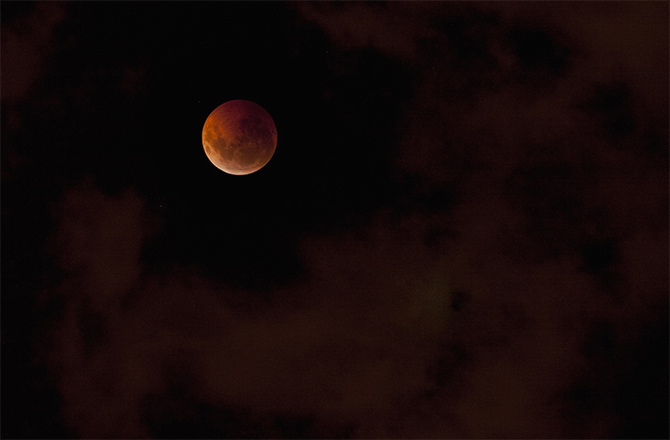
A photo of the blood moon last week.

A photo of the blood moon last week.

Last week was the “blood moon” eclipse, when the super moon (it looked larger due to its proximity to the earth, as it was at the point in its orbit that brings it closest to the earth and the earth’s shadow gives the full moon a red glow). It was difficult to see from many parts of New York because of the cloudy weather that night but many other areas had clear views. Such an event (the last one was in 1982 and it will not be repeated again until the year 2033) caused a lot of excitement and moon-watching parties but in older days it would have been a cause of alarm.

In the Norse eddas, a monster named Managarmr, the Moon Hound, swallows up the moon and stains the skies with blood during Ragnarok, the end of the world. According to the Gylfaginning (the opening portion of the poetic eddas), Managarmr is also known as Hati Hróðvitnisson, and is the son of Fenrir, the grey wolf, and a giantess.

In the Old Testament, the prophets warned that the moon would be dyed with blood at the end of the world and in the Book of Revelation the moon is also predicted to shine as red as blood: “And I beheld when he had opened the sixth seal, and, lo, there was a great earthquake; and the sun became black as sackcloth of hair, and the moon became as blood” (Revelation 6:12). This sixth seal that was broken open to release earthquakes and eclipses is followed by the opening of the famous “seventh seal,” the subject of Ingmar Bergman’s movie.

One of the Brothers Grimm reported that “In a lighted candle, if a piece of the wick gets half detached and makes it burn away too fast, [common folk] say ‘a wolf (as well as a thief) is in the candle’; this too is like the wolf devouring the sun or moon.” It seems that the wolf eating the candlelight was related to the wolf eating the moonlight and that one could certainly be linked to the other.

Maybe we can do an experiment to see if we can cause an eclipse with a candle like that? I can see a story developing here; can’t you?

Speaking of “bad moons,” you should see the BAD MOON ON THE RISE series here! There is a new fantasy-horror-thriller review posted each day of October. Some great new ideas for your reading thrills-and-chills!