
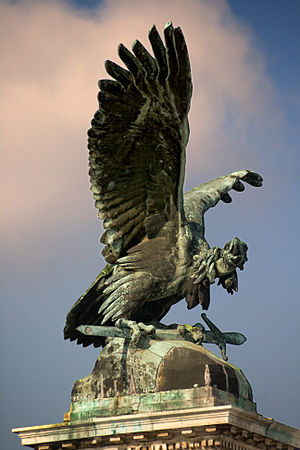
Turul Birds in Budapest!

A turul bird in Budapest.

A turul bird in Budapest.

The last time I was in Budapest, I was struck by the statues of the turul birds that adorn the Liberty Bridge there. They are a striking set of images.

The turul bird is the most important bird in the origin myth of the Magyars (Hungarian people). It is a divine messenger, and perches on top of the tree of life along with the other spirits of unborn children in the form of birds. The turul became a symbol of power, strength, and nobility. The most common motifs of the ninth and the early tenth centuries — the griffin, wolf and hind — seldom figure in later Hungarian iconography and heraldic symbolism; however the hawk or turul were preserved for longer as a device belonging to the ruling house.

The Turul is probably based on a large falcon, and the origin of the word is most likely Turkic: “togrıl” or “turgul” means a medium to large bird of prey of the family Accipitridae. In Hungarian the word sólyom means falcon, and there are three ancient words describing different kinds of falcons: kerecsen (saker falcon), zongor [Turkish sungur = gyrfalcon] and turul.

I will be in Budapest for the next two weeks, participating in conferences on both fairy tales and the supernatural. Then off to Germany to see my daughter and her family. But I will keep posting here and hopefully posting photos on Facebook!


St. David of Wales — and his leeks!

Children wearing their St David's Day leeks on March 1, 1957.

Children wearing their St David’s Day leeks on March 1, 1957.

Many Welsh people wear one or both of the National symbols of Wales to celebrate St. David: the daffodil (a generic Welsh symbol) or the leek (Saint David’s personal symbol) on March 1. The association of leeks with St. David arises from an occasion when a troop of Welsh soldiers were able to distinguish each other from a troop of the English enemy dressed in similar fashion by wearing leeks. Leek soup is also a popular dish on March 1.

The word leek comes from the Anglo-Saxon name for the plant, leac. The leek, like its relatives the onion and garlic, has been known as a food plant for thousands of years. Over 1,200 years before Christ, the Israelites in the Sinai wilderness longed for the leeks, onions, garlic, meat and other foods they had known in Egypt (Numbers 11:4-6).

The emperor Nero ate great quantities of leeks under the delusion that they improved his voice.

Beginning in antiquity, soldiers of many centuries believed that carrying a leek in battle would assure safety and victory; this was probably why St. David told the Welsh soldiers to wear it.

Who was St. David of Wales? He is said to have been the primary evangelizer of Wales and as a member of Welsh royalty, he founded a Celtic monastic community at Glyn Rhosyn (“The Vale of Roses”) on the western headland of Pembrokeshire at the spot where St David’s Cathedral stands today. David’s fame as a teacher and ascetic spread throughout the Celtic world. The date of Saint David’s death is recorded as 1 March, but the year is uncertain – possibly 588.

Saint David was recognised as a national patron saint at the height of Welsh resistance to the Normans. Saint David’s Day was celebrated by Welsh diaspora from the late Middle Ages. Indeed, the 17th-century diarist Samuel Pepys noted how Welsh celebrations in London for Saint David’s Day would spark wider counter-celebrations amongst their English neighbors: life-sized effigies of Welshmen were symbolically lynched, and by the 18th century the custom had arisen of confectioners producing “taffies”—gingerbread figures baked in the shape of a Welshman riding a goat—on Saint David’s Day.

In 1485, Henry VII of England, whose ancestry was partly Welsh, became King of England after victory at the Battle of Bosworth Field; Henry was the first monarch of the House of Tudor and this dynasty added a Welsh dragon to the royal coat of arms, a reference to the monarch’s origins.

Forty?!?!

Our class photo just before graduation. Can you make out a familiar face in the fourth row from the top, center?  :-)

Our class photo just before graduation. Can you make out a familiar face in the fourth row from the top, center? 🙂

FORTY years?!?! Really? I recently received a notice on Facebook that my high school classmates are organizing the 40th reunion of our Class of ’76 from Rainier Beach High School in Seattle! Can it really have been that long ago? While it may not seem quite like yesterday, it certainly doesn’t seem like 40 years ago! But I recently saw a list of other significant 40s circulate on several FB pages as well:

*Muhammad was forty years old when he first received the revelation delivered by the archangel Gabriel.

*Rain fell for “forty days and forty nights” during the Flood. (Genesis 7:4)

*Spies explored the land of Israel for “forty days.” (Numbers 13:25)

*The Hebrew people lived in the Sinai desert for “forty years”. This period of years represents the time it takes for a new generation to arise. (Numbers 32:13)

*Moses’ life is divided into three 40-year segments, separated by his growing to adulthood, fleeing from Egypt, and his return to lead his people out. (Acts 7:23,30,36)

*Several Jewish leaders and kings are said to have ruled for “forty years”, that is, a generation. Examples include Eli (1 Samuel 4:18), Saul (Acts 13:21), David (2 Samuel 5:4), and Solomon (1 Kings 11:42).

*Goliath challenged the Israelites twice a day for forty days before David defeated him. (1 Samuel 17:16)

*Moses spent three consecutive periods of “forty days and forty nights” on Mount Sinai

*One of the prerequisites for a man to study Kabbalah is that he is forty years old.

*Before his temptation, Jesus fasted “forty days and forty nights” in the Judean desert. (Matthew 4:2, Mark 1:13, Luke 4:2)

*Forty days was the period from the resurrection of Jesus to the ascension of Jesus. (Acts 1:3.

*In modern Christian practice, Lent consists of the 40 days preceding Easter. In much of Western Christianity, Sundays are excluded from the count; in Eastern Christianity, Sundays are included.

With all these significant 40s in mind, I guess a 40th class reunion isn’t so ominous after all!