July 12, 1801: Two Strikes? Vampires home free!

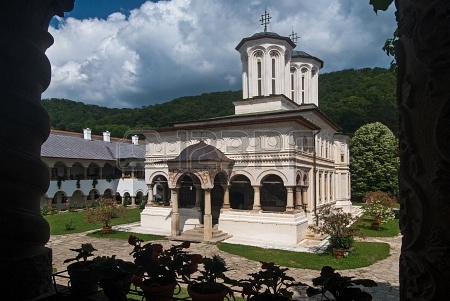
The Monastery of Horezu, a UNESCO World Heritage site in Wallachia, Romania

The Monastery of Horezu, a UNESCO World Heritage site in Wallachia, Romania

Wallachia, the region of southern Romania which borders the more famous region of Transylvania to the north, was an independent principality until 1859, when it united with Moldavia to form the basis of the modern state of Romania. Transylvania joined 59 years later (1918) to form the new Kingdom of Romania. Vlad the Impaler, often thought to have inspired Bram Stoker’s Dracula, was actually the ruler of Wallachia (not Transylvania).

In 1801, before its unification with Moldavia, farmers and rural peasants still believed fervently in vampires even though modern science was beginning to dispel belief in vampires among the aristocracy. One of the more common ways farmers had in Wallachia to dispatch a vampire was to exhume the body and decapitate the corpse. If the vampire seemed to still attack the living after that, then the body was exhumed again and the body was either turned face-down or a wooden stake driven through it. If the attacks still seemed to continue, the body would be dug up a third time and burned (which was a difficult undertaking because dead bodies are so moist and therefore the last resort of vampire dispatchers — you can read about the fascinating science involved in burning dead bodies in Vampires, Burial, and Death: Folklore and Reality by Paul Barber).

It was the continued exhumation of corpses which came to the attention of the Wallachian authorities. On July 1, 1801 the authorities in Wallachia proclaimed that a corpse could not be exhumed more than TWICE in Wallachian territory if it was suspected of being a vampire!

Blood was not only important to the vampires the Wallachian farmers were trying to destroy. The stunningly beautiful Curtea de Arges Monastery was built by a ruler of Wallachia in 1512. But the walls kept crumbling because of a problem with the foundations. The architect and construction workers resorted to an ancient practice to reinforce the foundations: they sprinkled the blood of a newborn baby on the foundations and the walls stopped crumbling. (Another version of the story says how the pregnant wife of the architect was sealed alive inside the walls in order to stop them from crumbling.)
Doppelgängers and Dolly the Sheep

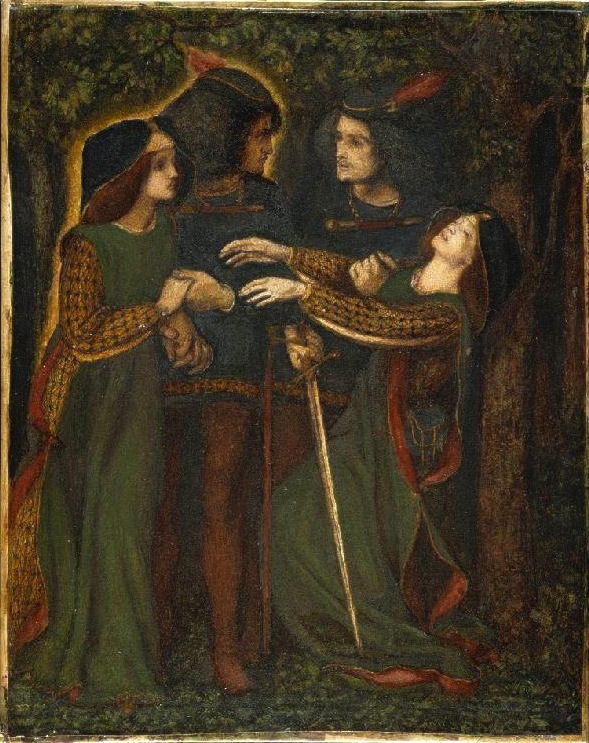
Dante Gabriel Rossetti, “How They Met Themselves,” watercolor, 1864

The first cloning of an animal by scientists was revealed on July 5, 1996 by the Roslin Institute in Scotland when DOLLY THE SHEEP was cloned from tissue taken from a 6 year old ewe’s udder.

But the idea of such a copy or perfect duplicate of a person, often known as a doppelgänger, is an ancient one in folklore and mythology. Ancient Egyptians believed that a “spirit double” could be formed by magicians and that this new entity would share all the same memories of the original. In Greek mythology, Narcissus fell in love with his own reflection and died. German and Norse folklore thought that if your double was seen, this meant that you were about to die. Discovering your double was NOT a good thing! Meeting yourself going the other direction can lead only to destruction.

Rosetti’s watercolor, How They Met Themselves, illustrates the notion that meeting yourself means that you are about to die. In the painting, a pair of lovers meet themselves and the original woman faints with shock. (In real life, the woman who posed for this character died about two years after this painting was finished.) In his later life, Rossetti filled his home with mirrors so that he and his guests were constantly encountering themselves going the other way.

In Irish folklore so popular with the pre-Raphealites, a “fetch” is a supernatural double or an apparition of a living person. Meeting a fetch is regarded as an omen, usually of impending death.

The origin of the Irish word for the duplicate person is obscure. It may derive from the verb “fetch,” as in the compound “fetch-life”, evidently referring to a psychopomp who “fetches” the souls of the dying, which is attested in Richard Stanyhurst’s 1583 translation of the Aeneid. Alternately, the word may derive from fæcce, which is glossed for mære, a spirit associated with death and nightmares.

I remember that when newspapers announced Dolly’s existence, many people claimed that the cloned sheep was a nightmare-come-to-life and was a harbinger of many other Frankenstein-like horrors about to be unleashed onto the world. Those predictions have thankfully proved false–so far!

Dreams and Visions of the Night

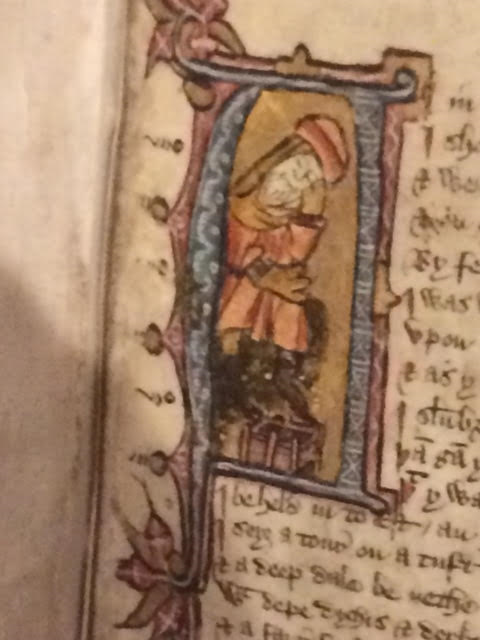
“Piers Plowman,” considered by many to be one of the greatest works of medieval English literature, tells the story of a series of dreams experienced by Piers (Peter) the Plowman. This image is the only known depiction of Piers and shows him dreaming; the manuscript comes from the late 1300s and belongs to Corpus Christi College, Oxford.

Dreams and visions while sleeping have long fascinated us. Modern psychologists use dreams to help us unlock the mysteries of our inner emotional life: what frightens us, what do we yearn for, how do we see ourselves in relation to those around us, who is important to us and why. To ancient and medieval people, dreams were glimpses into the future and ways to travel far without leaving the comfort of our beds.

In Stranger Magic: Charmed States and the Arabian Nights, Marina Warner tells us that “Oneiromancy, or divination through dreams, was a practice throughout the ancient world and cultivated in Egypt: Joseph interprets dreams in both the Old Testament (Genesis 40-41) and the Koran (Sura 12).” Many features of dreams–suddenness and vividness, fragmentation, episodic structures, displacements in time and space, instability of bodies–are common throughout fairy tales and legends of all people.

In stories such as the Arabian Nights, fairy tales, or Piers Plowman, dreams can reveal something true that is happening now or is about to happen. Dream experiences can actually take place and dreamers can awake with a new ring or some token that convinces them that the dream experience actually happened.

The interaction and interrelationship of reality and dreams is explored in modern films as well as legends or tales. Marina Warner suggests that both The Matrix (1999) and Inception (2010) depict one dream world inside another “until the notion of verifiable reality disappears into an abyss of multiple reflections.”

We sing with children, “Row, row, row your boat… life is but a dream,” but dreams can illuminate aspects of our lives that would remain otherwise dark, unexplored, unacknowledged–and therefore all the more powerful over us. I know that if I focus on the emotional content of my dreams — rather than the surface elements that are not always recognizable — that I can appreciate and come to grips with something my sleeping mind is struggling to grapple with. By dreaming and by acknowledging our dreams we can be free of those dark forces and choose our own paths forward.

NOTE: I just had a great conversation about writing with Rachel Hardcastle on her podcast. See it here.