Spiritual Milk

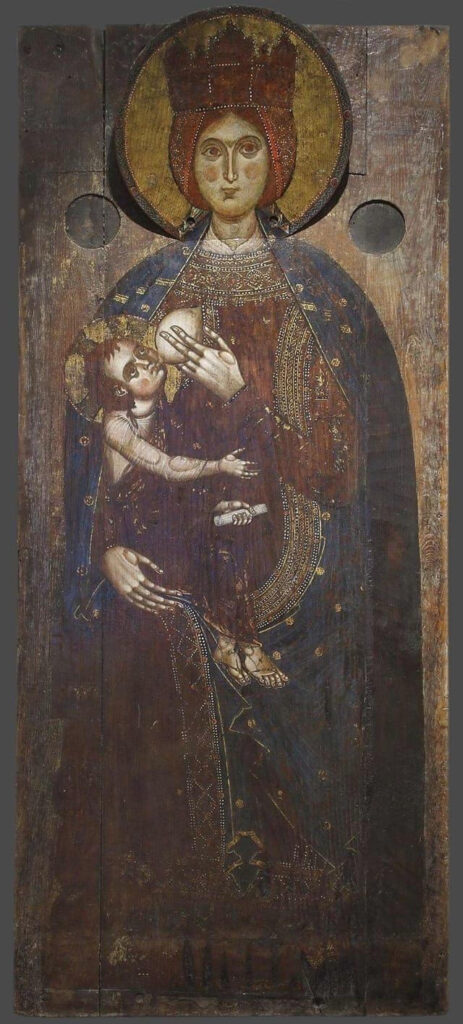
Madonna di San Gugliemo, 12th century (Sienna, Italy). This depiction of the “Madonna Lactans” (Nursing Madonna) is a eucharistic image as much as it is an image of a mother caring for her child. Read more about this type of image here and see more examples here.

And I, brothers and sisters, was able to speak to you not as spiritual people but only as carnal people, as infants in Christ. I gave you milk to drink, not substantial food, because you were not yet capable, nor are you capable until now, for you are fleshy people. (1 Cor. 3:1-3)

In the ancient world, milk-blood-semen were all thought to be the same liquid but warmed to differing temperatures by different internal organs. Blood was the coldest of these and the basic, most natural form of this liquid. Milk was blood, warmed and made frothy in a woman’s breasts. Semen was blood, made even warmer and frothier in a man’s testes. According to this biological idea, when a mother was nursing her child, she was feeding the baby with her own blood.

Because blood and milk were identical, the correspondence of the Virgin’s milk and Christ’s blood was important to early and medieval Christians. The Virgin’s blood becomes milk in her breasts; she nurses Christ, feeding him her warm and frothy blood; he drinks this frothy blood, which becomes the blood in his own veins. Medieval images of the Nursing Madonna (Madonna lactans) are fundamentally eucharistic images, celebrating the identity of the Virgin’s milk with Christ’s blood; she feeds him with her body which becomes his Body and he feeds the Church with his Body and Blood in the Eucharist.

There is no more vivid and elaborate exposition of 1 Corinthians 3 in early Christian literature than that found in Clement’s Paedagogus 1.6…. By combining Galatians 3:28 and 1 Corinthians 3, Clement sets the foundation for his argument that all Christians are already spiritual…and, as a result, milk-drinking infants cannot be viewed as equivalent to “carnal” Christians. Rather, milk is the food of all Christians who “seek our mother, the church.”

John David Penniman, Raised on Christian Milk

Not only did a mother’s milk (blood) provide sustenance to her baby, the infant received religious and ethnic formation as well by ingesting his/her mother’s identity via the milk-blood. This is why receiving Holy Communion was so important: to receive Christ’s blood was to be shaped and formed by his identity, according to St. Gregory of Nyssa.

Discover more about this fascinating subject in Raised on Christian Milk: Food and the Formation of the Soul in Early Christianity by John David Penniman (Yale University Press, 2017).
Demonstrative Proof

And I came to you, brothers and sisters, not with the advantage of rhetoric and wisdom …. not with persuasive words of wisdom but in the demonstrative proof of the Spirit and power. (1 Corinthians 2:1, 4)

St. Paul reminds the Corinthians that he did not preach to them and among them with fancy words and Greek philosophy but simply, relying on the Spirit of God to demonstrate the power and truth of his words. His sermons wouldn’t win an oratory prize, he says. But his sermons did win their hearts.

A third-generation Christian bishop, Irenaeus of Lyons, wrote a Demonstration of Apostolic Preaching to accomplish the same thing that St. Paul was aiming for: teaching or reminding new converts the basic Christian understanding of the world and how to relate to it from a Christian perspective. His other famous work, Against Heresies, refutes the teachings of several different heretical sects that claimed to be Christian; in both works, St. Irenaeus establishes fundamental principles of theology and biblical interpretation that still guide Christian readers and thinkers.

Irenaeus was born in Smyrna. He was taught the Faith by St. Polycarp, who had been taught by the Apostle John. In the Demonstration, St. Irenaeus reviews salvation history in the Old Testament and then cites several Old Testament prophecies about the Messiah, explaining how Christ fulfilled them. St. Irenaeus writes

This, beloved, is the preaching of the truth, and this is the manner of our redemption, and this is the way of life, which the prophets proclaimed, and Christ established, and the apostles delivered, and the Church in all the world hands on to her children. This must we keep with all certainty, with a sound will and pleasing to God, with good works and right-willed disposition.

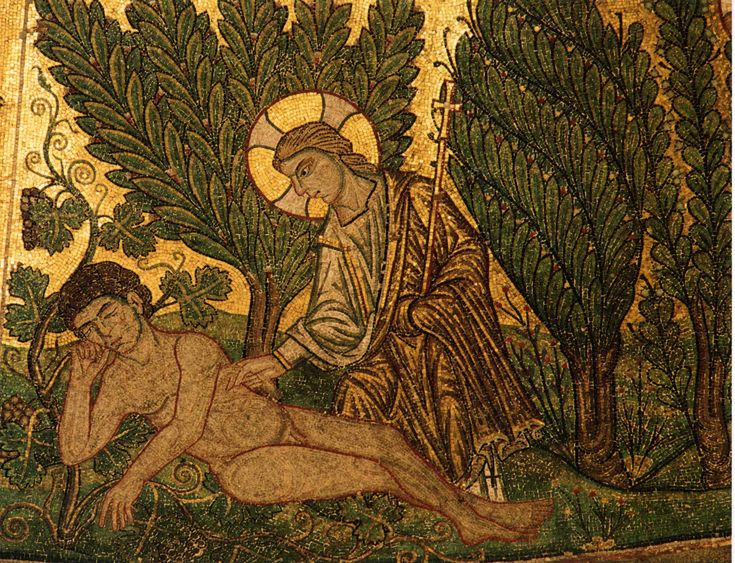
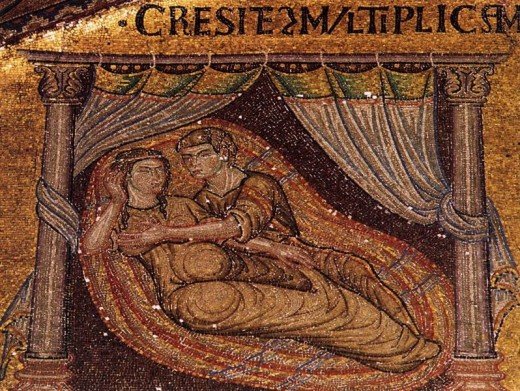
One of St. Irenaeus’ most interesting ideas is that of “recapitulation,” in which he teaches that Christ and his mother summarize and set right everything that went wrong with Adam and Eve; he points out that Christ is the Second (Last) Adam and Mary is the Second Eve:

For in what other way could we have partaken in the adoption of sons, unless we had received from him [God the Father] fellowship with himself through the Son? Unless his Word, having been made flesh, had entered into fellowship with us?

For this reason, he also passed through every stage of life, restoring fellowship with God to all [stages of life]….

The human race fell into bondage to death by means of a virgin, so is it rescued by a virgin; virginal disobedience having been balanced in the opposite scale by virginal obedience. For in the same way the sin of the first created man received amendment by the correction of the First-begotten, and the coming of the serpent is conquered by the harmlessness of the dove, those bonds being unloosed by which we had been fast bound to death.

St. Paul and St. Irenaeus both want to demonstrate how God has acted in the past to save his people and how God continues to act in the lives of his chosen. Those who have experienced God’s acts of deliverance are called to demonstrate this by responding appropriately. Most of the rest of the first letter to the Corinthians is about what this demonstrative response to God appropriately looks like.

“Was Paul Crucified for You?”

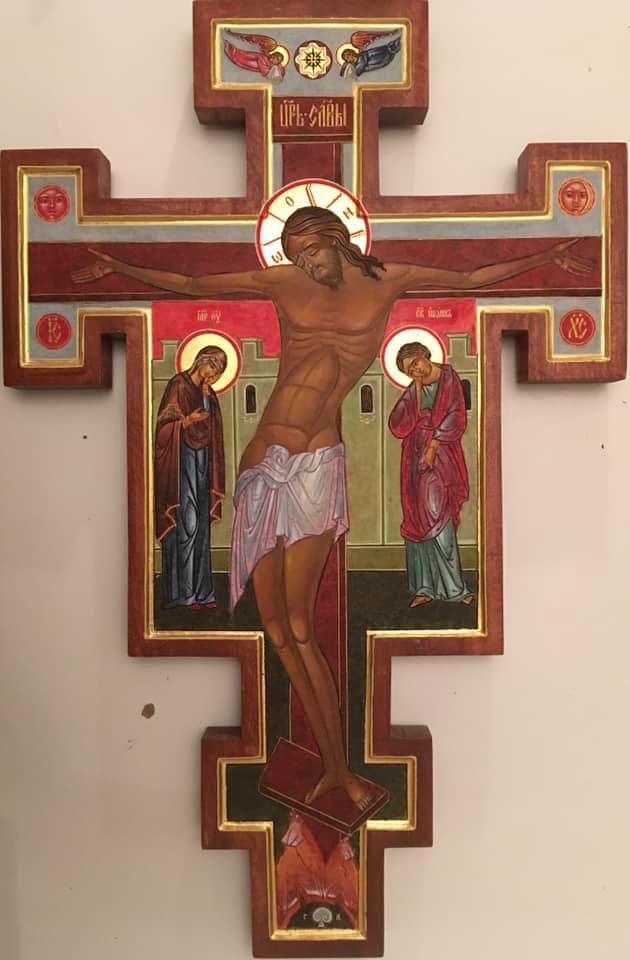
A Byzantine style icon of Christ crucified, with Adam’s grave in the hill beneath the Cross as St. John the Divine and the Mother of God stand on each side of Christ. The sun, moon, and angels are aghast at what they see happening on Golgotha. Christ’s eyes are closed, his body slumped against the Cross, and the footrest beam twisted diagonally which all indicate that Christ is already dead.

…each of you says, “I am of Paul,” or “I am of Apollos,” or “I am of Cephas,” or “I am of Christ.” Is Christ divided? Was Paul crucified for you? Or were you baptized in the name of Paul? (I Cor. 1:12-13)

The parish in Corinth was torn apart by various factions, each claiming to be faithful to a different Christian teacher who was prominent or famous in one way or another. How did these factions differ? What did they teach that put them in opposition to each other?

The names of the teachers that each faction claimed to be faithful to are probably familiar. “Cephas” was the Apostle Peter. Apollos was a well-educated Jewish man from Alexandria (Egypt) who was “mighty in the Scriptures” (Acts 18:24) who knew something of Christ but was really taught everything he knew about Christianity by Priscilla at Ephesus (Acts 18:26); he was eventually made the first bishop of Crete (Titus 3:13).

We know that Peter and Paul had intense disagreements about how much of Jewish practice should be embraced by Gentile converts to Christianity. Priscilla and Apollos were dear co-workers with the Apostle Paul; how much could they have disagreed with each other?

If we read the New Testament carefully, we discover that there was not a simple dichotomy between “Jewish Christianity” vs. “Gentile Christianity.” There seem to have been four distinct styles of Christianity with four differing sets of what should be expected from Gentile converts.

Group One insisted that Gentile converts observe the whole Mosaic Law, including circumcision. The missionary work of this group (the “false brothers” of Galatians 2:4) was deeply antagonistic towards St. Paul.

Group Two did not insist on circumcision but did require Gentile converts to keep certain practices of the Mosaic Law (esp. kosher food). We see this reflected in the council described in Acts 15. This group looked to the Apostle Peter [Cephas] and St. James, the “brother of the Lord,” as their leaders.

Group Three did not require circumcision or other practices of the Mosaic Law (kosher food) but did see them as having a certain ongoing value, nevertheless. This seems to have been the group most reflective of the Apostle Paul’s own attitude.

Group Four did not require circumcision or other practices of the Mosaic Law (kosher food) and saw no abiding significance or value in Jewish cult or feast days. These views were more radical than those of the Apostle Paul and seem to be reflected in the sermon of St. Stephen (Acts 7), who insisted that God does not dwell in the Temple and refers to Mosaic Law as “your law” and “their law.”

The factions in Corinth seem to reflect these basic distinctions. As St. Paul discusses the problems in Corinth, we see how the factions are rooted in these differing attitudes toward Jewish practice and expectations of Gentile converts to the Church.

For more about these differing groups of “Jewish Christianity” see Antioch and Rome: New Testament Cradles of Catholic Christianity by Raymond E. Brown and John P. Meier. (Paulist Press. 1983, 2004)