Love is Not Jealous

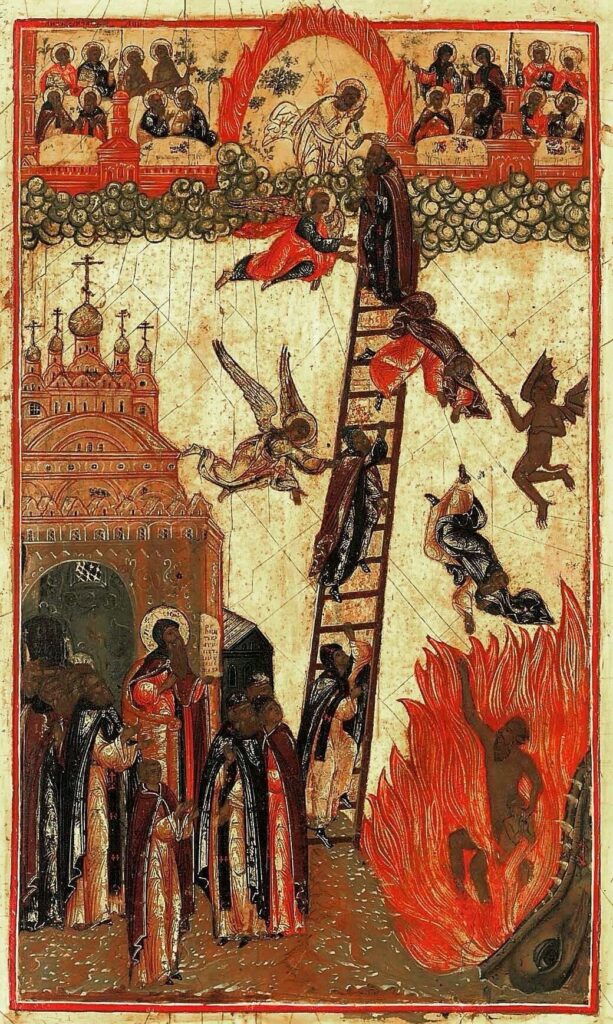
This icon shows monks climbing the ladder of virtues toward Christ and the saints. Most fall to their doom because they give in to temptations rather than heeding their guardian angels and struggling against sin. The monks reach the top of the ladder when they focus on love and Who it is that they are climbing toward.


Love waits patiently, it is kind; love is not jealous, love is not conceited, nor is it inflated… nor does it seek its own interests… it bears everything, believes everything, hopes everything, endures everything. (1 Cor. 13:4-7)

This chapter which describes love is perhaps the chapter heard most often because it is read at weddings so often. St. Paul describes love in phrases that are short and simple, just as Plato describes love in a series of short sentences although Plato uses eros rather than agape as the word for “love.” Plato’s praise of love is part of an after-dinner speech in the Symposium and other authors who praised love after that usually made it part of an after-dinner speech as well. St. Paul’s praise of love is also in the context of an after-dinner reflection (cf. 1 Cor. 11:17-34).

Much of what St. Paul writes in 1 Cor 13 also appears in Romans 12. Both chapters are describing what love looks like and how people behave who love one another.

“Love is not jealous.” That is especially important in a parish like Corinth that is torn apart by jealousy. The parishioners are jealous of each other’s spiritual gifts and abilities. They refuse to talk together or eat together. “Conceited” people brag about themselves and their gifts and their abilities, just as the Corinthians bragged.

The Ladder of Divine Ascent (a guide to monastic life but with much applicability to Christians who are not monastics) suggests that jealousy is the result of avarice (Step 17) or pride (Step 23). Avarice always wants, wants, want. It wants more. In Corinth, this creates jealousy because people wanted more spiritual gifts, they wanted what they saw other people had and felt jealous that they did not have these gifts as well. Pride gives birth to jealousy because if I am proud, I want the most and the biggest and most spectacular of the spiritual gifts; pride leads to jealousy if someone has what the proud person wants.

If the parishioners in Corinth claim to practice love, they have to first stop bragging about themselves and being jealous of each other.

The greater the love of God that the saints possess, the more they endure all things for him.

St. Augustine of Hippo, On Patience, 17

Older translations of the New Testament often used “charity” to translate agape.

A man with charity fears nothing for charity casts out fear. When fear is banished and cast out, charity endures all things, bears all things. One who bears all things through love cannot fear martyrdom.

St. Ambrose of Milan, Letter 49

Love (our behavior now), faith (in God and Christ now), and hope (about the General Resurrection, the Kingdom of God, and the Second Coming of Christ) support and complement each other. They define authentic Christian life.
Are All Apostles? Are All Prophets?

You are the Body of Christ, each member being a part God has arranged in the Church…. Are all apostles? Are all prophets? Are all teachers? …. Avidly desire the greater gifts. (1 Cor. 12:27-30)

The gifts of the Holy Spirit have been hotly contested issues among the Christians in Corinth. Some people are proud that they have certain gifts–especially “tongues”–and look down their noses at other people who do not manifest these gifts. Some people are shut out of the community because they seem to be less “spiritual” than others. But the apostle insists that “tongues” is the least important of all the spiritual gifts and that–in any case–all the spiritual gifts are needed for the Body of Christ to function properly.

The gifts are not as easy to number and classify as some might think, either. To say that someone is a “prophet” does not tell us exactly how this person ministers to the community.

There are two types of prophets: those who predict the future and those who interpret the Scriptures…. There are also ‘prophets’ who are teachers, who teach children or young people.

St. Ambrosiaster, Commentary on St. Paul’s Epistles

St. Ambrosiaster points out that the apostles in each community, i.e. the bishop of a community, is also a prophet who must interpret the Scriptures. Being able to practice one spiritual gift does not exclude a person from other gifts at the same time.

Although the offices of prophet and apostle were similar or overlapped in some ways, they were also distinct. St. Ambrosiaster seems to presume the prophets were sedentary members of the community, staying in one place. On the other hand, in Syria authentic prophets were presumed to always be on-the-move and never stayed long in any one place. In fact, that was how a parish could distinguish between true and false prophets: the Didache (a handbook for local parishes from the same time as the New Testament) says that a true prophet would never stay in any one place for more than three days.

Not only are the gifts given for the well-being of any one particular community or parish. The gifts are given for the well-being of the Church as a whole.

The Corinthian church was not the whole body by itself but was part of a worldwide community of faith. Therefore the Corinthians ought to be at peace with the Church in every other place, if it is a true member of the body.

St. John Chrysostom, Homily 32 on the Epistles of St. Paul

Although the gifts might be given to the parish in Corinth, they had to be practiced in a way that did not only benefit the parish in Corinth but the other parishes in every city. Nowadays, we might say that the parish on East 17th Street had to realize that the gifts of the people in that parish were also to benefit the people in the parish on West 25th Street, as well as the people in parishes across the country.

While all the members of the community have differing gifts and everyone has a role to play in their local parish as well as in the larger Church as a whole, there is one gift that everyone in every parish is called to embrace and practice. The greatest of the spiritual gifts that St. Paul wants everyone in each parish to strive for is love.

Can the Eye Say to the Hand, “I Don’t Need You”?

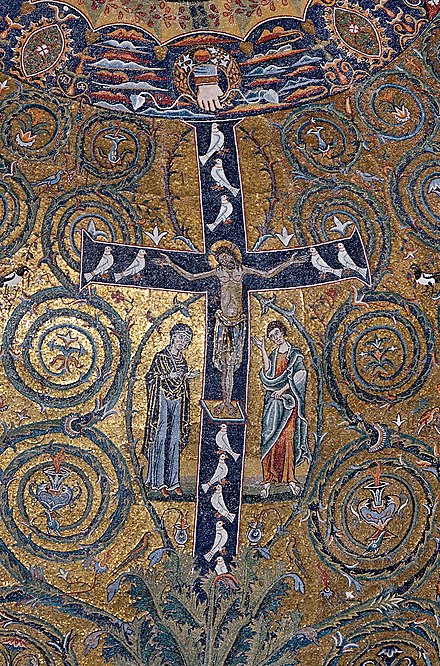
The depiction of the hand of God stood in the presence of God himself, as in this hand of God the Father seen above the Cross, clutching a wreath of victory, San Clemente, Rome, AD 1140–43. Read here for more about the Hand of God in ancient-medieval Jewish and Christian art.


For just as the body is one and has many members and all the members of the body, although many, are one body, so also is Christ…. If the foot says, “Because I am not a hand, I am not of the body,” is it for this reason less a part of the body? (1 Cor. 12:12-15)

St. Paul was not the only one to talk about the Church as if it were a body. St. Jerome wrote

The Church has real eyes: its teachers and leaders who see the mysteries of God in the sacred Scriptures…. The Church has feet: those who make official journeys of all kinds. The foot runs that the hand may find the work it should do. The eye does not scorn the hand, nor do the eyes, hands, and feet scorn the belly as if it were idle and unemployed.

Homily 85 on the Gospel According to St. Matthew

I think the best example of body imagery is what St. Augustine wrote:

Aren’t the hairs of your head certainly of less value than your other members? What is cheaper and more despicable and lowly than the hairs of your head? Yet if the barber gives you a bad haircut, you become angry at him for doing a bad job and cutting your hair unevenly. But you are not as concerned about the unity of the members of the Church as you are about the hairs on your head.

On the Usefulness of Fasting 6

How new was all this body imagery? Philosophers who were writing at the same time as St. Paul also used body imagery as a way to talk about society. Seneca wrote:

What if the hands should desire to harm the feet or the eyes the hands? As all the members of the body are in harmony with one another because it is to the advantage of the whole that individual members be unharmed….

On Anger, 2.31.7

A Roman fable told the story of hands, mouth, and teeth rebelling against the stomach, with the result that the whole body is harmed. (Livy, History of Rome 2.32.7-33.1) Other fables and philosophers compared political unrest to disease or self-harm (such as cutting).

Jewish writers like Josephus and Philo also used body imagery. “As in the body, all the members get sick if the principal members are inflamed….” and the high priest asks for blessings in order “that every age and every part of the nation be regarded as a single body, united in one and the same fellowship, making peace and good order their aim.”

A few decades after St. Paul wrote, St. Clement of Rome also write to the Corinthians. St. Clement also used body imagery to appeal to the Corinthians to embrace harmony and set aside discord.

Let us take our body as an example. The head without the feet is nothing; likewise the feet without the head are nothing: even the smallest limbs of our body are necessary and useful for the whole body; but all the members conspire and unite in subjection, that the whole body may be saved.”

1 Clement 37

I highly recommend Raymond Collins’ commentary on First Corinthians in the Sacra Pagina series.