
Veronica and the Shroud

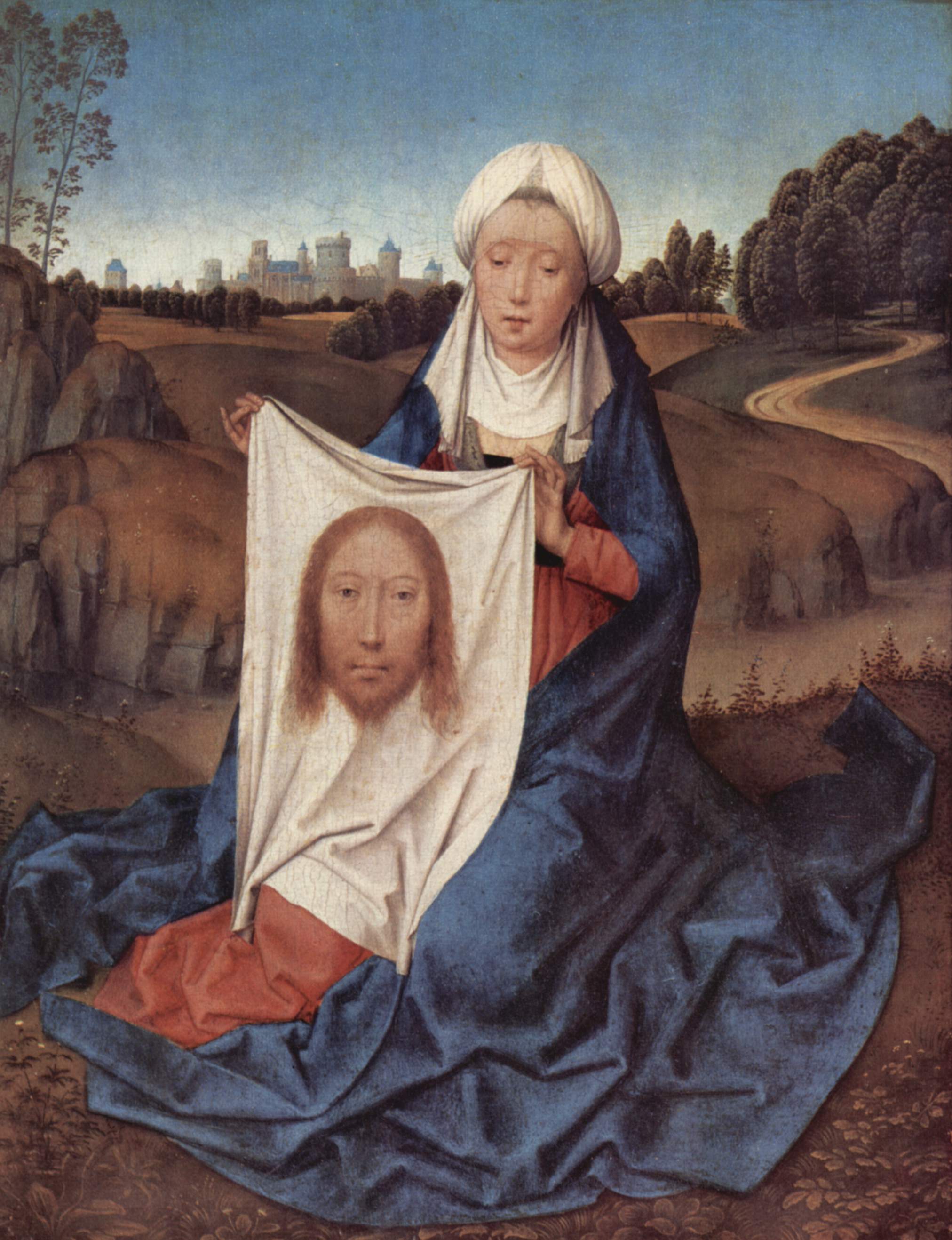
Veronica holding her veil, by Hans Memling (c. 1470)

Veronica holding her veil, by Hans Memling (c. 1470)

According to legend, a woman named Veronica (who is commemorated on July 12) was among the crowds lining the streets of Jerusalem as Jesus carried the cross on his way to be crucified on Golgotha. Feeling pity for him, she stepped forward and wiped the sweat and blood from his face with her veil. Later that evening, she is said to have discovered the image of Christ’s face imprinted on her veil.

Many people think this story is a variation on the story of the Shroud of Turin, said to be the shroud in which Jesus was buried. It was also said to have been imprinted with the image of Jesus’ body in the moment just before his Resurrection. Because of the way the Shroud was traditionally folded when put on display, only the face was visible. This resulted in an image much like the one reputed to have been imprinted on Veronica’s veil. Many also point out that the woman’s name, “Veronica,” is in fact Latin for “true image” or “true/authentic icon” and is more a statement about the cloth than about her historical identity.

The story of the Icon-Made-Without-Hands is also about a Byzantine cloth on which Jesus himself imprinted his face to send to the king of Edessa so that the ailing king might be healed. Again, this “true icon” is said by many to be another version of the same story and that all 3 versions are probably based on the historical kernel that there was indeed a cloth image of Jesus that was venerated by the Church during its early centuries as an authentic, miraculous reproduction of Christ that was thought to work miracles.

This textile image plays an important role in two books that I highly recommend:

The Fifth Gospel by Ian Caldwell is a thriller set in the Vatican in which a long-lost gospel text, a contentious relic [i.e. the Shroud of Turin], and a dying pope’s final wish converge to send two brothers—both Vatican priests—on an intellectual quest to untangle Christianity’s greatest historical mystery.

Death Masks by Jim Butcher is one of his EXCELLENT Harry Dresden series in which Harry, Chicago’s only practising professional wizard, is caught in a duel with the Red Court of Vampires’ champion, who must kill Harry to end the war between vampires and wizards …Professional hit men using Harry for target practice …The missing Shroud of Turin …A handless and headless corpse the Chicago police need identified …

Both are excellent summertime reading — especially in connection with July 12, the feast of Veronica and her veil!

Dancing Plague

Dorothy's ruby slippers are the most famous red shoes in history.

Dorothy’s ruby slippers are the most famous red shoes in history.

In the searing July heat of 1518, Frau Troffea stepped into the streets of Strasbourg and began to dance. Bathed in sweat, she continued to dance. Overcome with exhaustion, she stopped, and then resumed her solitary jig a few hours later. Over the next two months, roughly four hundred people succumbed to the same agonizing compulsion. At its peak, the epidemic claimed the lives of fifteen men, women, and children a day. Possibly 100 people danced to their deaths in one of the most bizarre and terrifying plagues in history.

Eventually, 2 cures were found for the plague: making an offering at a local shrine to St. Vitus, long thought the patron of those afflicted with “St. Vitus’ Dance” (epilepsy), or wearing red shoes. Or donating a pair of red shoes to the shrine. Although many pairs of magical footwear appear in fairy tales (the seven-league boots, the silver slippers in Baum’s original Wonderful Wizard of Oz, the slippers Cinderella wore to the ball, the slippers of bread dough a wealthy Czech woman wore to her damnation), the red shoes have both healed uncontrollable dancing and damned their owner to uncontrollable dancing (as in Anderson’s story of the Red Shoes).

Red was an especially expensive dye to obtain or use; red clothes were the prerogative of the wealthy and the ostentatious. Red (associated with blood, fire, life, and sex) is also used to mark those who misbehave sexually as well as the saints (“washed in the blood of the Lamb”). In Slavic languages, the same word can mean both “red” and “beautiful” so instead of calling it “Red Square” outside the Kremlin, a better translation might be “Beautiful Square.”

TO read Elizabeth King’s fascinating essay about magical shoes in fairy tales, click here.

TO read more about the fascinating Dancing Plague, click here and here.

Vidovdan

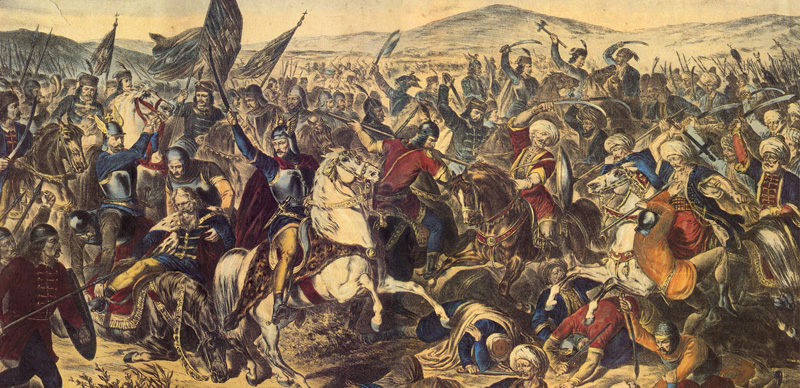
St. Vitus' Day (Vidovdan) marks the Ottoman defeat of the Serbians at Kosovo in 1389.

St. Vitus’ Day (Vidovdan) marks the Ottoman defeat of the Serbians at Kosovo in 1389.

St. Vitus, a Christian in Sicily who was killed for his faith in A.D. 303, is commemorated each year in mid-June. He is most often associated with epileptics or those who have seizures for other reasons, because he looked as if he was having a seizure as a lion killed him and tore his body to shreds. He is also said to protect against lightning strikes, animal attacks and oversleeping. He is the patron of the cathedral in Prague.

He is also important in the history of Serbia. It was on his feast day (known as “Vidovdan” in Serbian) that the Serbian army, led by Prince Lazar, was defeated by the Ottoman army led by Sultan Murad in the field of Kosovo. The defeat at Kosovo on Vidovdan came to be considered the defining moment of Serbian national consciousness as it was the first time that several of the Serbian clans set aside their local disputes and came together for a common purpose (under the leadership of Prince Lazar). The anniversary of the defeat at Kosovo is particularly important to Serbian history, tradition, and national identity. The date is ingrained in the Serb consciousness, and is the date on which South Slav nationalist Gavrilo Princip assassinated Archduke Franz Ferdinand, setting off a chain of events that led to the outbreak of World War I.

Reliable historical accounts of the battle are scarce. The bulk of both armies were wiped out in the battle; both Lazar and Murad lost their lives in it. Although Ottomans managed to annihilate the Serbian army, they also suffered high casualties which delayed their progress. Serbs were left with too few men to effectively defend their lands, while the Turks had many more troops in the east. Consequently, one after the other, the Serbian principalities that were not already Ottoman vassals became so in the following years.

One of my best friends in seminary, a third generation Serbian-American, said once, “Only the Serbians would make a national holiday out of their worst-ever military defeat!”