
Rowan and Other Celtic Trees

A rowan tree, which the Norse said the first woman was made from and the Celts said protects against witchcraft.

I have been doing research recently for a new novel, Earth to Earth, Ashes to Ashes which will involve the dearg-due again. (Readers first met this character in the Come Hell or High Water trilogy; she is featured on the cover of Part 2: Rising.) I have discovered some fascinating tales about pigs and acorns as well as cauldrons of salmon stew–a perennial favorite!

I have also discovered a lot about trees in European folklore or mythology in general and in Celtic folklore in particular. Greek mythology tells of how Hebe the goddess of youth, dispensed rejuvenating ambrosia to the gods from her magical chalice. When, through carelessness, she lost this cup to demons, the gods sent an eagle to recover the cup. The feathers and drops of blood which the eagle shed in the ensuing fight with the demons fell to earth, where each of them turned into a rowan tree. Hence the rowan derived the shape of its leaves from the eagle’s feathers and the appearance of its berries from the droplets of blood. The Norse said that the first woman was carved from the trunk of a rowan tree just as the first man was carved from the trunk of an ash tree. The Celts had many, MANY stories about rowan trees but I will keep the details of those to myself–so as not to spoil the plot twists that might develop in Earth to Earth.

Oak trees were also important. The Druids frequently worshipped and practised their rites in oak groves (the word Druid was probably a Gaelic derivation of their word for oak, Duir, and meant “men of the oaks”). Mistletoe, probably the Druids’ most potent and magical plant, frequently grew on oak trees and its presence was believed to indicate the hand of God having placed it there in a lightning strike.

Yew trees were also held sacred in pre-Christian times. Folk no doubt observed the tree’s qualities of longevity and regeneration (drooping branches of old yew trees can root and form new trunks where they touch the ground) and the yew came to symbolise death and resurrection in Celtic culture. The Celts were also familiar with the toxicity of the tree’s needles, which can prove fatal, and which may have further contributed to its connections with death. Shakespeare too was familiar with these qualities when he had Macbeth concoct a poisonous brew which included “slips of yew, silvered in the moon’s eclipse”.
“I want a… Goldfinch?!…for Christmas”

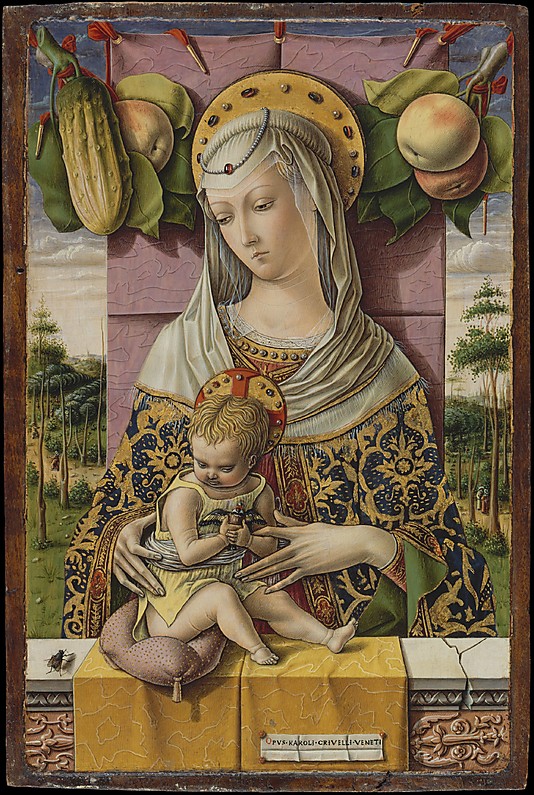
Madonna and Child, by Carlo Crivelli (1480); note the goldfinch in the Christ Child's grasp

Madonna and Child, by Carlo Crivelli (1480); note the goldfinch in the Christ Child’s grasp

Very often in traditional depictions of the Virgin and Christ Child, there is a goldfinch in the baby’s grasp. Why?

The most simple reason might be that in the 14th century it was common for young children to keep tame birds as pets. Christ’s holding a bird allows a parent or a child to recognize his human nature, to identify with him. Despite the angels and the celestial gold background, the viewer is reminded that God lived and died as a man upon the earth.

But when is traditional Christian art ever simple? Or easy?

The goldfinch appears in depictions of Christ’s birth or during his childhood because it was said that when Christ was carrying the cross to Calvary a small bird – sometimes a goldfinch, sometimes a robin – flew down and plucked one of the thorns from the crown around his head. Some of Christ’s blood splashed onto the bird as it drew the thorn out, and to this day goldfinches and robins have spots of red on their plumage. Since goldfinches are also known to eat and nest among thorns, the goldfinch is often read as a prefiguration of Christ’s Passion.

The bird could also be seen as a symbol of the Resurrection of Christ. A non-Biblical legend popular in the Middle Ages related how the child Jesus, when playing with some clay birds that his friends had given to him, bought them to life. Medieval theologians saw this as an allegory of his own coming back from the dead.

Medieval Europeans also saw the goldfinch as a protector against the plague. Since classical times superstition had credited a mythical bird – the charadrius – with the ability to take on the disease of any man who looked it in the eye. The charadrius was sometimes represented as a goldfinch. Perhaps Christ’s finch offers the worshiper protection against the seemingly unstoppable contagion.

Also, since Ancient Egypt, the human soul had been represented in religious art by a small bird. We see the “Ba” (the soul-bird) on a detail of an Egyptian coffins. A very general reading of the goldfinch might, therefore, remind the viewer that his soul is ‘in the hands’ of God.

Curious about that big cucumber hanging from the apple tree? Hmmm… Read a VERY interesting interpretation of it AND other details of this painting here.

Remember the classic “I Want a Hippopotamus for Christmas“?

P.S. After I published this post I got the news that Shelf Media Group announced their selection of the 100 Notable Books of 2016 and Storm Wolf was one of them!

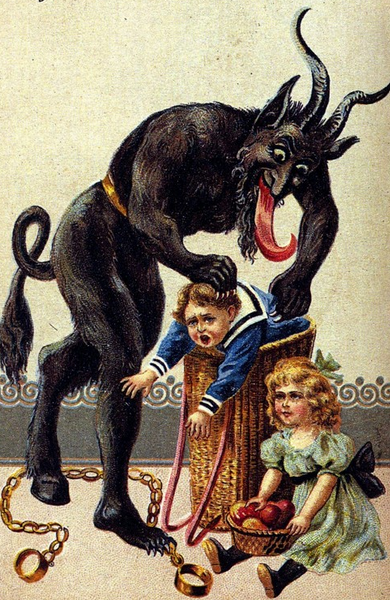
Will you be Meeting the Krampus or Čert?

krampus-stuffing-children-into-basket

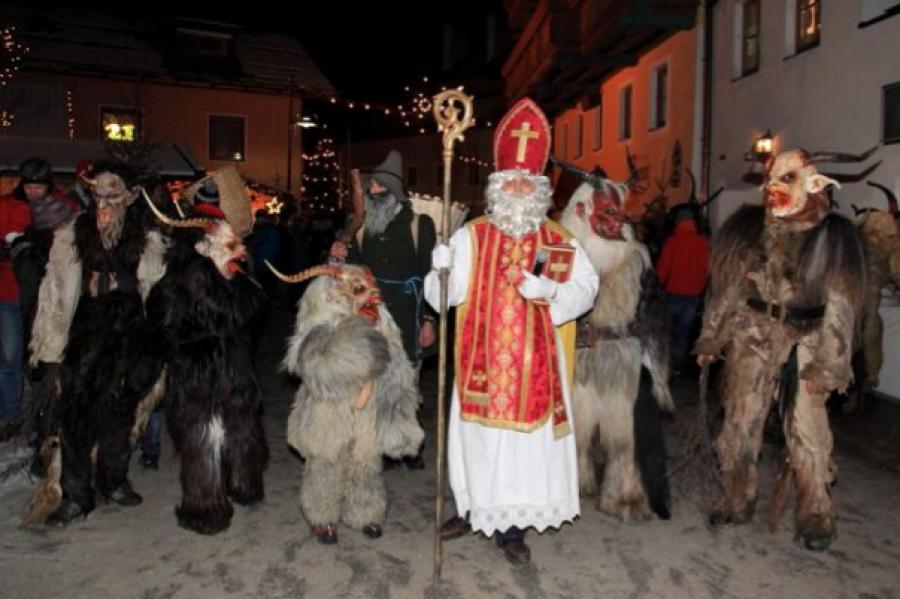
Traditionally on December 5th and 6th, St. Nicholas walks from house to house in the cities and villages of Alpine and Central Europe to admonish and laud young and old. In the Alpine regions, he is accompanied by a Krampus (an evil creature, a devil of sorts), who is going to punish the bad children and adults on St. Nicholas′ command. For the honest children he normally has little presents. In Prague and the Czech-speaking areas of Central Europe, the čert (a clearly demonic character) accompanies St. Nicholas.

In Come Hell or High Water, both St. Nicholas and his čert appear:

“It was commonly supposed [in 1356] that St. Nicholas, as he made his rounds bestowing gifts on children and the needy, was accompanied by both a tar-covered čert, a pitch-black devil, as well as a bright and glorious andel, an angel of light, who each argued for or against the worthiness of the recipient of the saint’s benefactions. The čert was always ready, at the slightest nod from the saint, to carry away the unworthy beggar or misbehaving child and–throughout the year–parents could always warn their children that they might be carried away by the čert….”

St. Nicholas himself is a Christian figure, the fourth century bishop of Myra. As son of a well-situated family, he started to help poor people who lived in deep poverty. He was supposed to have miraculous vigor and so he became patron of the seamen, children and poor people. (See a previous post about St. Nicholas and his care for the poor here.) In most modern versions of the St. Nicholas story, he is accompanied by a monster or servant (the Dutch describe his assistant as Black Peter) who punishes the bad children while Nicholas himself rewards the well-behaved children.

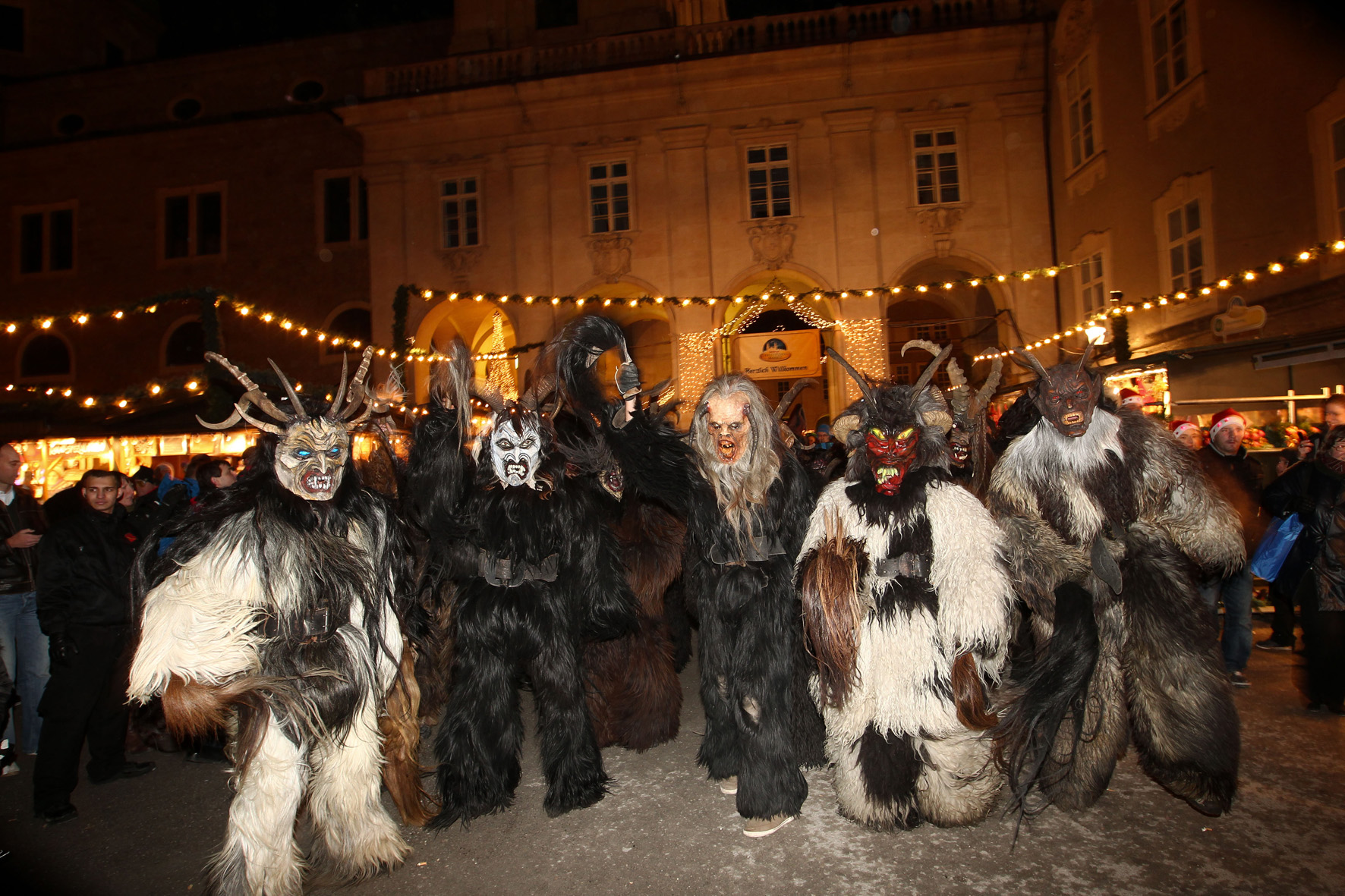
The figure of the Krampus is based on pre-Christian custom. The Krampusse not only punish the bad children but had the function at one time of driving out the winter devils and blizzard sprites. Originally the custom of the Krampus was spread over all of Austria but was forbidden by the Catholic Church during the Inquisition. It was prohibited by death to masquerade as a devil or an evil creature and so this custom only survived in some remote, inaccessible, regions of the Alps from where it slowly spread back across the western parts of Austria again. Today the Krampusse revels are especially popular in Salzburg. As many times as I have been to Salzburg, I have never been there during Krampusse-time; I would dearly love to be there to see the processions and parades of costumed characters in the streets.

St. Nicholas and the Krampus procession in Salzburg (2010); photo by Charlotte Anne Brady.

St. Nicholas and the Krampus procession in Salzburg (2010); photo by Charlotte Anne Brady.

Krampus revels at the Salzburg Christmas Market, 2011; photo by Neumayr/MMV 05.12.2011

Krampus revels at the Salzburg Christmas Market, 2011; photo by Neumayr/MMV 05.12.2011