“Happy birthday–and Cremation–Emperor Domition!”

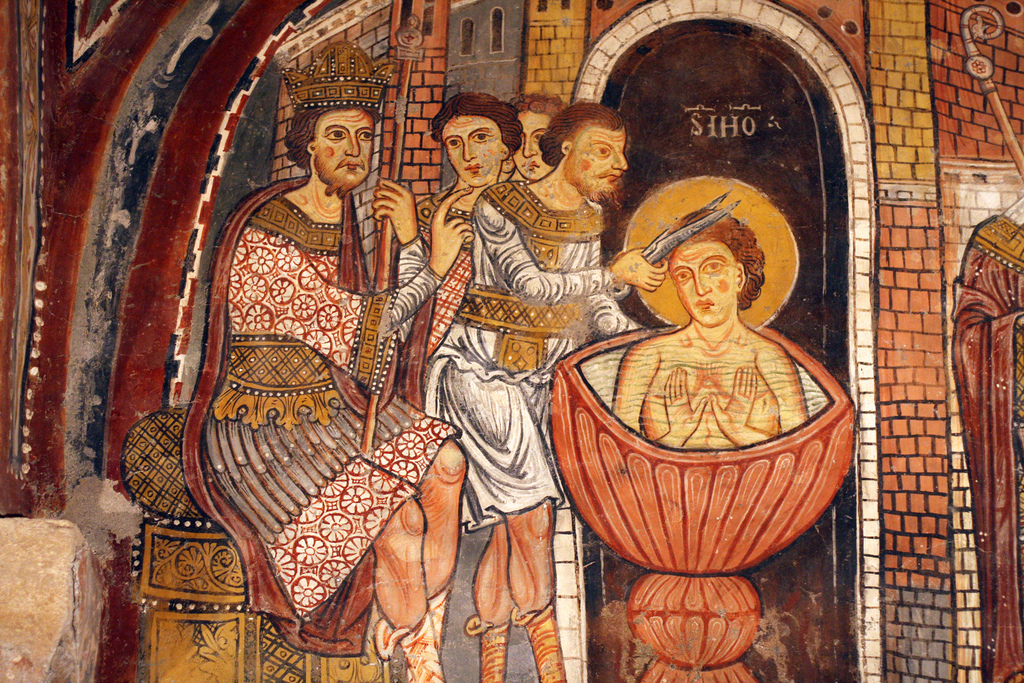
Persecution of St. John the Evangelist by the Emperor Domitian. As described in the Golden Legend, soldiers shave his head and put him in a pot of boiling oil, but he remains unharmed and free of pain. In the background is a representation of the Porta Latina in Rome, where the event was said to take place. Detail of fresco in the Crypt of St. Magnus (1237), Cattedrale di Santa Maria, Anagni, Lazio, Italy.

Domitian (born 24 October AD 51 – died 18 September AD 96) was Roman emperor from 81 to 96. He was the younger brother of Titus and son of Vespasian, his two predecessors on the throne, and the last member of the Flavian dynasty. During his reign, his authoritarian rule put him at sharp odds with the senate, whose powers he drastically curtailed. Domitian’s reign came to an end in 96 when he was assassinated by court officials. After his death, Domitian’s memory was condemned to oblivion by the Roman Senate, while senatorial authors such as Tacitus, Pliny the Younger, and Suetonius propagated the view of Domitian as a cruel and paranoid tyrant. As emperor, he oversaw one of the cruelest periods of persecution of Christians.

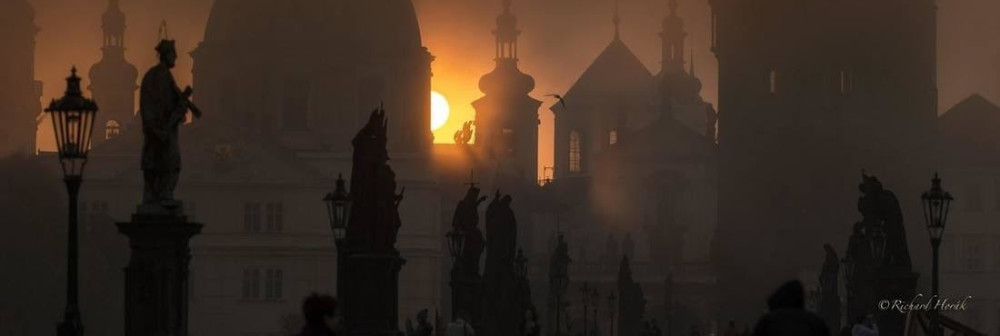
Domitian’s body was carried away on a common bier and unceremoniously cremated by his nurse Phyllis. It is difficult to burn a body; it would have been extremely difficult for one person to cremate a corpse without being noticed, so perhaps the nurse was simply the ringleader of a small group intent on burning the imperial remains. Nero, also murdered because he was unable to bring himself to commit suicide at the last moment, was refused burial and was said to have been cremated by his nurses as well. Burial was refused to Nero and Domitian because the Romans thought unburied corpses prevented the spirit’s entering into eternal rest. Cremation was an older, more honorable way to set the spirit at rest. But in the case of Nero and Domitian, the underworld refused to take them in and their spirits passed into flocks of birds instead. Flocks of crows, starlings, and ravens that still circle around the Piazza del Popolo in Rome, the place where they were clandestinely cremated, are said to contain the restless spirits of the emperors. (The church of Santa Maria del Popolo was built there in the piazza in 1099 in an effort to exorcize the imperial ghosts.)

Great undulating clouds of birds that dip and swirl over the Tiber can seem to take the shape of human bodies or a human arm and hand reaching out toward the people below. It is easy to see how the clouds of smoke ascending from a cremation could be thought to lodge in the flock of birds and then posses the flock.
“Happy Birthday!” to Los Angeles

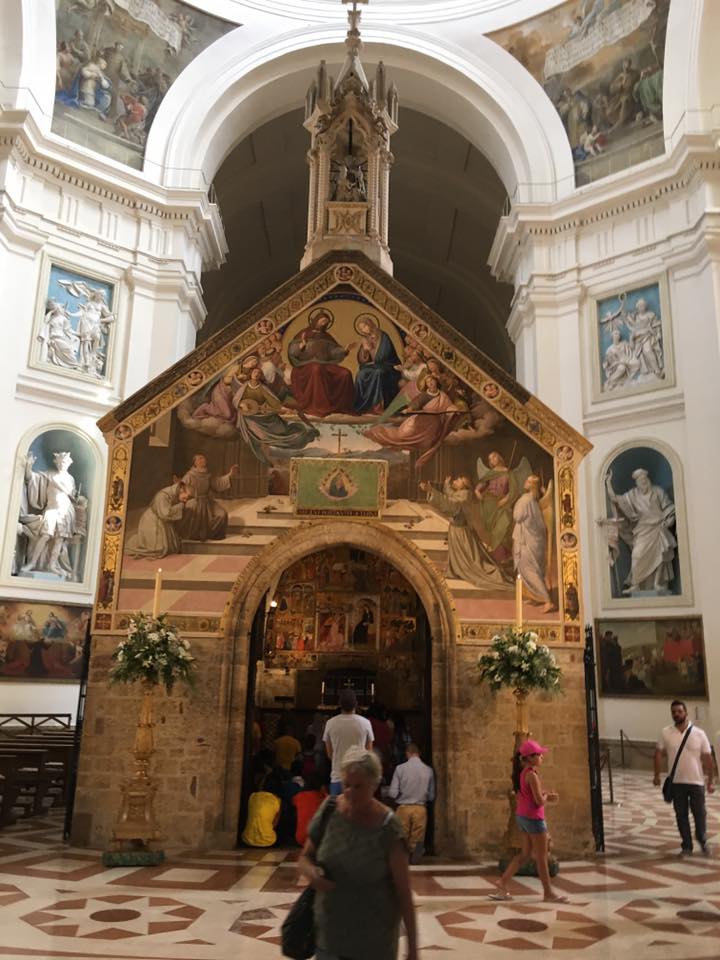
The city of Los Angeles was named for this tiny church of the Porziuncola, inside the larger church of Our Lady of the Angels.

The official date for the founding of the city of Los Angeles is September 4, 1781. The name given by the founders was “El Pueblo de Nuestra Señora de los Angeles de Porciuncula”, or “the town of Our Lady of the Angels of Porciuncula.”

The Porciuncula (“little portion”) is the small church in the fields below the Italian town of Assisi. St. Francis was given this abandoned chapel by Benedictine monks who had been respoonsible for it. Francis and his first group of followers lived in this small church. It was in the Porciuncula that St. Clare of Assisi (founder of the “Poor Clares”) made her vows as a nun to pray for Francis and his missionary work. Francis himself died in the field nearby in AD 1226 and another small chapel was built to mark that spot. The crowds coming to venerate St. Francis overwhelmed the tiny churches and in 1569 the larger church of Our Lady of the Angels was built around the tiny churches to protect them and provide a place for pilgrims to gather.

It is said that whoever prays at the Porciuncula on its feast day (August 2) will have all their sins forgiven. There are several replicas of the Porciuncula in the United States for people who cannot travel to Italy itself to pray at the original site.

The Spanish missionaries who travelled up the coast of California establishing a series of missions dedicated to several different saints (such as St. Monica, St. Barbara, St. Diego, St. Bernadino) were Franciscan friars. The names they chose for the missions were all saints important to the Franciscans for various reasons. Two missions were named for places directly related to the history of the Franciscans themselves.

St. Francis is thus the patron not only of San Francisco itself but of Los Angeles as well.

Great Fire of London

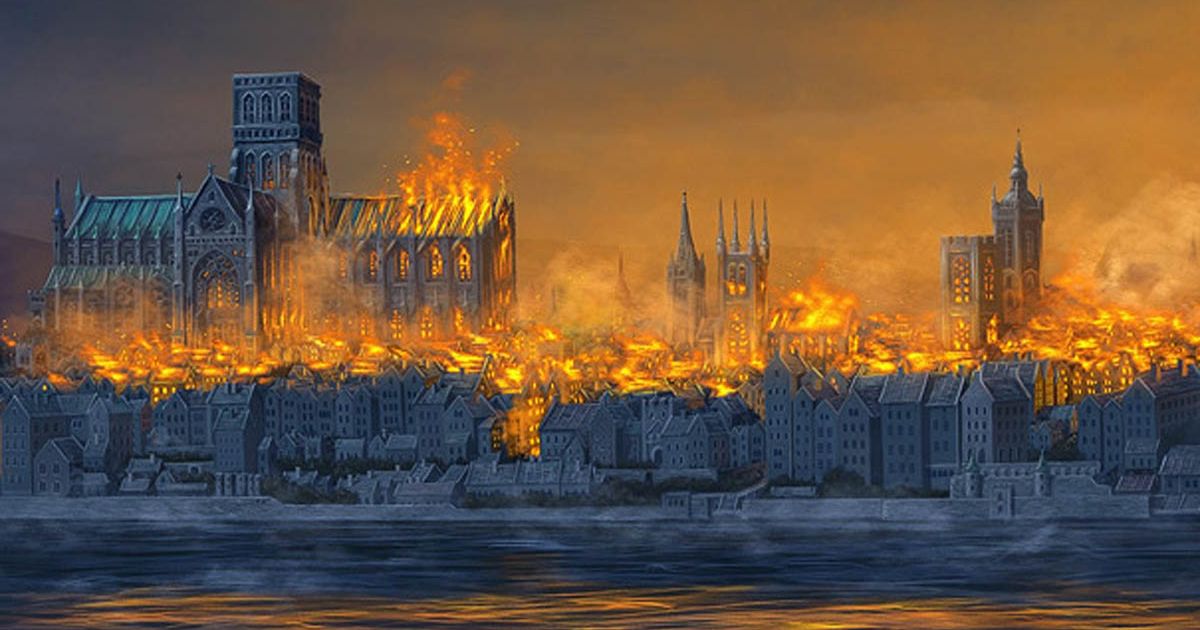
The 1666 Great Fire of London’s 350th anniversary was in 2016 (artistic depiction of the Great Fire in the Daily Mirror Online)

September 2, 1666 – The Great Fire of London began in a bakery in Pudding Lane near the Tower of London. Over the next three days, the fire gutted the medieval City of London inside the old Roman city wall. It consumed 13,200 houses, 87 parish churches, St Paul’s Cathedral, and most of the buildings of the City authorities. It is estimated to have destroyed the homes of 70,000 of the City’s 80,000 inhabitants. Amazingly, only six(!) people are thought to have died in the fire.

The Great Fire started at a bakery (or baker’s house) on Pudding Lane shortly after midnight on Sunday, 2 September and spread rapidly west across the City of London. The major firefighting technique of the time was to create firebreaks by means of demolition; this, however, was critically delayed owing to the indecisiveness of Lord Mayor of London. By the time that large-scale demolitions were ordered on Sunday night, the wind had already fanned the bakery fire into a firestorm that defeated such measures. The fire pushed north on Monday into the heart of the City.

Rather than admit the fire was a tragic accident, many people wanted to blame someone. The homeless population of London, as well as Dutch or French residents, were blamed for either starting the fire or helping to spread it. (Blaming immigrants and the poor is always a popular pastime, I’m afraid!) Mobs looted the shop of a French painter and destroyed it; an English blacksmith walked up to a Frenchman in the street and hit him over the head with an iron bar.

Fire was long considered one of the four basic building blocks of the universe; all matter was thought to arise from various combinations of the four elements of earth, air, fire, and water. Some thought fire was the most basic and fundamental of the elements. Fire was a magical, transformative element as it could melt ice, evaporate water, melt and purify metal or solder metals together, forge useless bits into weapons, or turn almost anything into something else, i.e. dust and ash. In Arabic mythology, the djinn were formed from fire and a soul, just as humans were formed from earth and a soul. Djinn were magical because fire itself was magical.