Time Zones, Time Travel

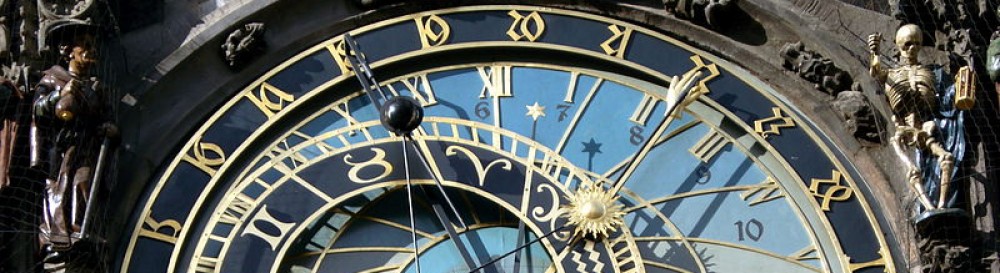
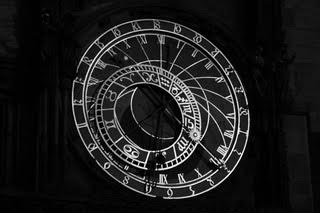
Time itself will end if this clock ever stops–evil and black magic lurk in the shadows of The Astronomical Clock on the Old Town Square of Prague. (photo by Joseph O’Neill, 2016)

Time is a mysterious, ever-flowing stream that seems to pool and eddy and tumble forward more quickly some days than others. Some days, we wish that it would flow backwards–even if only a few moments so that we can get on the subway train that is pulling out of the station as we come down the stairs onto the platform.

Folk tales and fairy tales and science fiction take the manipulation of time for granted. A princess can sleep for 100 years. Rip van Winkle can snooze for a 20 year nap. A hero can walk until seven pairs of iron boots wear out. But Aladdin can travel across Asia in the blink of an eye and Beauty can return to the side of her beast before she has drawn a breath. Once Mr. Spock discovered how to whip the star ship Enterprise around the sun to travel through time, it became a trick to use on multiple occasions–sometimes even with whales swimming in the ship’s hull. And the TARDIS of Dr. Who or the Way-Back machine of Peabody and Sherman are on everyone’s Christmas list at some point!

We also want to look further down the stream of time by dealing out cards or examining the lines on our palms. The position of the stars when we are born might effect something that happens more than 30 years later.

We want to control time and it remains forever elusive and just beyond our reach.

But on November 18, 1883 a Connecticut school teacher, Charles F. Dowd, was able to impose a method of human control over Time. He proposed a uniform time zone plan for the U.S. consisting of four zones. We take these time zones for granted now; television stations indicate what time in which time zones their programs will air and we know without being told that planes from the East Coast are in the air for three hours longer than their landing time on the West Coast indicate. We are actually able to land before we take off, sometimes!
Dracula!

The novel “Dracula” (by Bram Stoker, who was born Nov. 8, 1847) was fairly well-regarded at its publication but not wildly popular. Yet is has become one of the west well-known stories ever told.

Dracula, the creation of Bram Stoker (whose 170th birthday is this week), is perhaps one of the most famous characters ever created. He stalks our nightmares as well as our television and movie screens. He fills our bookcases. We spend days at conferences talking about him. He read about him, over and over and over again.

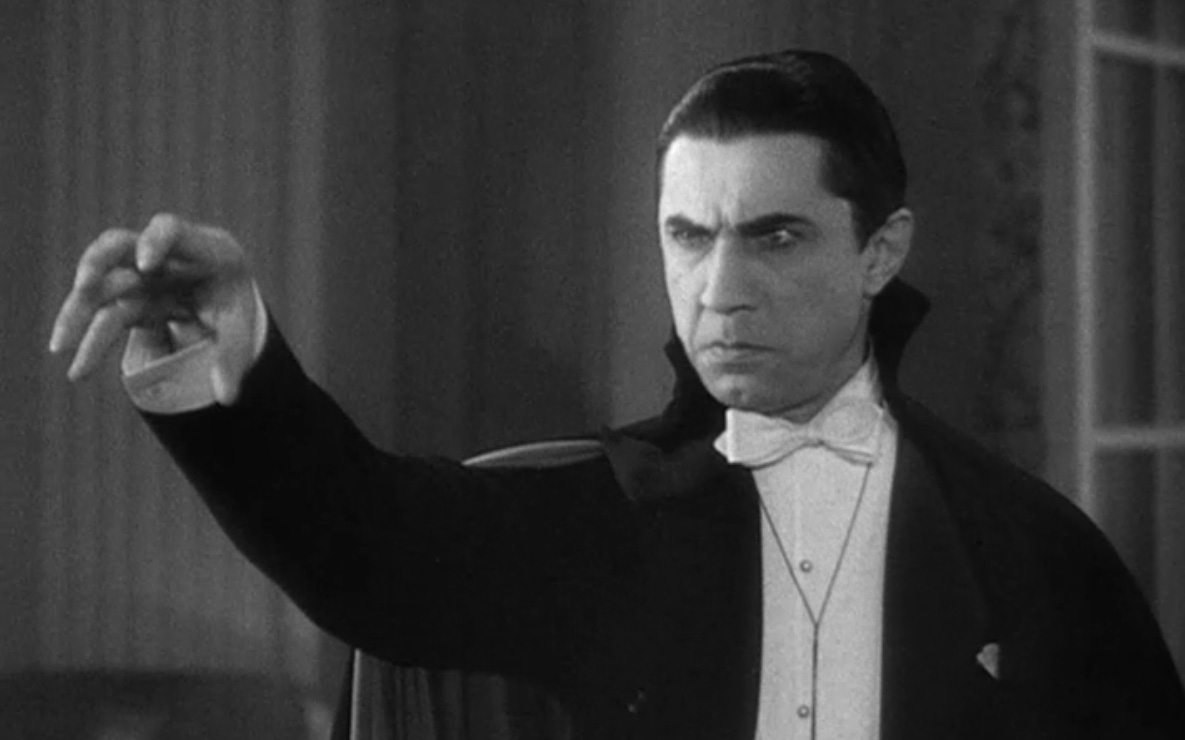
Of course, one reason he became so popular was the way he was portrayed by Bela Lugosi in the movie: “Lugosi possessed all the menace of Stoker’s Dracula but he added a curious charisma. While not traditionally handsome, Lugosi combined an intense screen presence with a deliberate, heavily accented speech to create a Dracula who was almost as mesmerizing as he was repellent. Indeed, he so thoroughly captured this aura of entrancing danger that it has since become difficult to remember Stoker’s original figure, who possesses little of this charm.” (For more about this, click here. Or here.)

Another reason Dracula is so popular is that he can stand in for whatever most terrifies society: he is the dead body who will not stay dead, that comes back to hunt the living; he is the old lord of feudal society stalking the capitalists who have taken control; he is the dark foreigner and immigrant who invades well-do-do white society; he is the personification of disease and epidemic that sweeps across the countryside. He is madness and mental illness that strikes without warning. (Dr. Frankenstein‘s monster has also been a cipher for societal fears over the years as well.)

Whether he is a villain or an anti-hero, Dracula will be with us forever!

I Love You With All My…Kidneys?

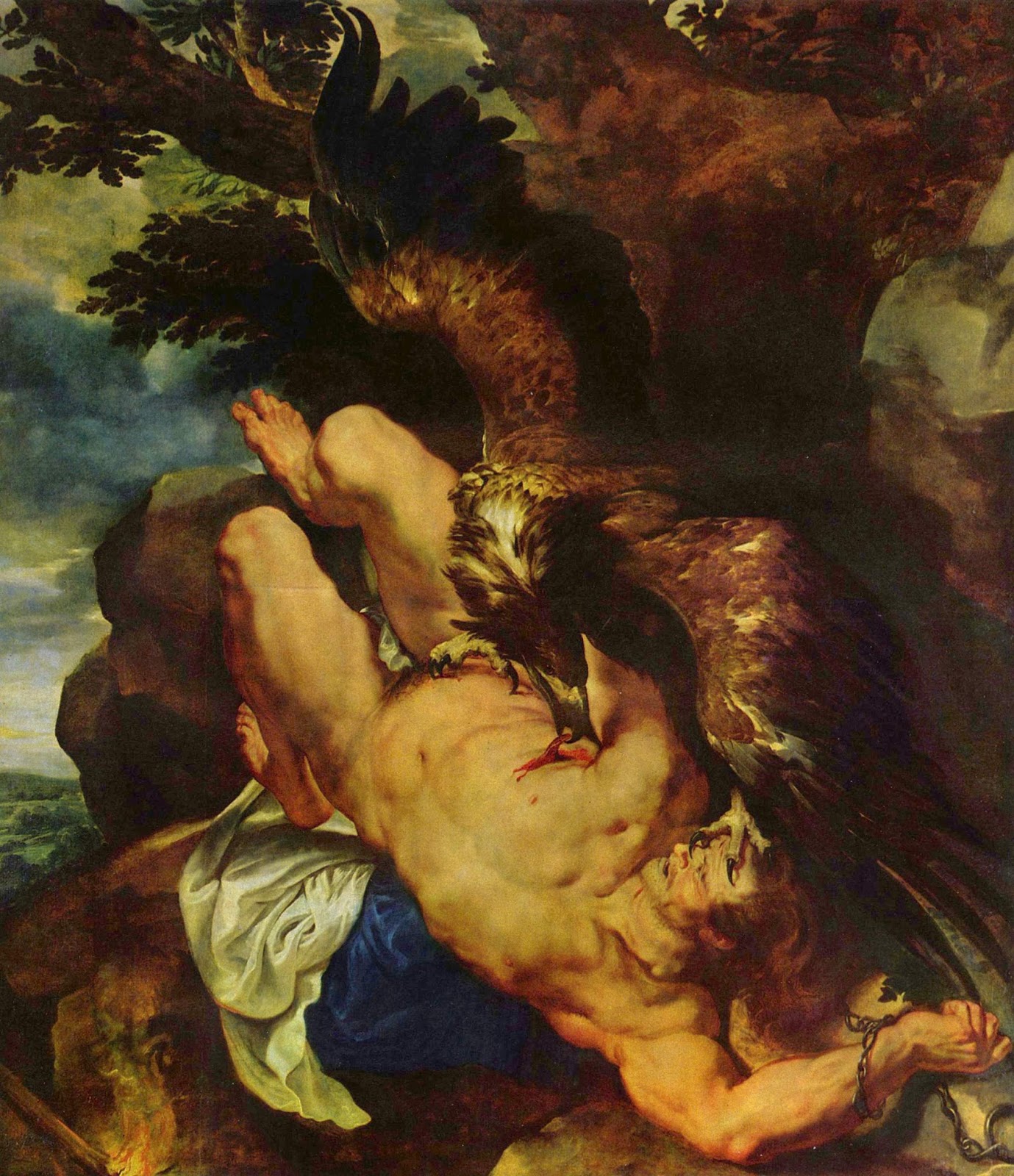
Prometheus, whose liver was gnawed by an eagle, in “Prometheus Bound” by Sir Peter Paul Rubens. The original painting is at Philly’s Museum of Art.

Nowadays, we think of our hearts as the center of our being.

“I love you with all my heart!”

“I give my heart to you!”

“I had a change of heart.”

“We need a heart-to-heart talk.”

“Don’t wear your heart on your sleeve!”

The Egyptians believed that the heart was the source of the soul and of memory, emotions, and personality. They thought that the heart would be weighed during judgement after death. So they preserved the heart during mummification but threw the brain away.

Syrians and the Arabs viewed the liver as the center of inner life. But in Hebrew tradition, kidneys were considered to be the most important internal organs along with the heart. In the Old Testament, the kidneys were associated with the most inner stirrings of emotional life. Kidneys were also viewed as the seat of the secret thoughts of the human; they are used as an omen metaphor, as a metaphor for moral discernment, for reflection and inspiration. There is also reference to the kidneys as the site of divine punishment for misdemeanors, particularly in the book of Job (whose suffering and ailments are legendary). In the first vernacular versions of the Bible in English, the translators elected to use the term “reins” instead of kidneys in differentiating the metaphoric uses of human kidneys from that of their mention as anatomic organs of sacrificial animals burned at the altar. In the Old Testament, the kidneys thus are primarily used as metaphor for the core of the person, for the area of greatest vulnerability.

The UK’s first donor kidney transplant was performed on October 30 at The Royal Infirmary of Edinburgh. Britain’s first kidney transplant was performed by Sir Michael Woodruff. As with the world’s first kidney transplant, the operation takes place between identical twins, reducing the chances of rejection.