Executions

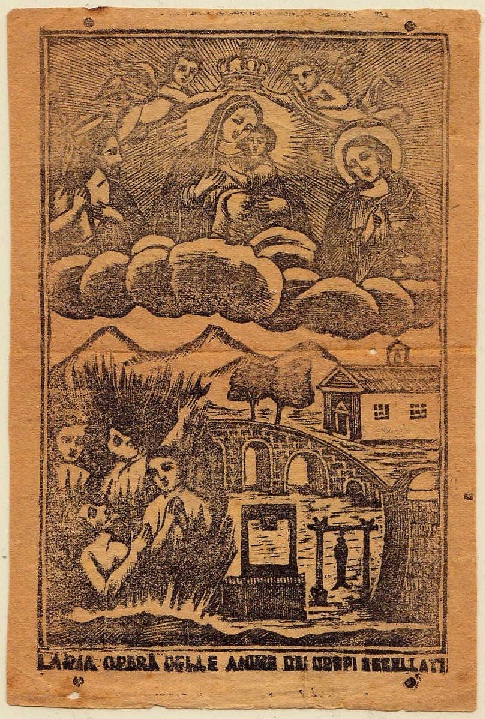
Ancient lithography representing the elements of devotional practices towards the holy souls of the executed in Sicily.

June 29, 1972 – The U.S. Supreme Court ruled (5-4) that capital punishment was a violation of the Eighth Amendment prohibiting “cruel and unusual punishment.” The decision spared the lives of 600 individuals then sitting on death row. Four years later, in another ruling, the Court reversed itself and determined the death penalty was not cruel and unusual punishment. On October 4, 1976, the ban was lifted on the death penalty in cases involving murder.

Executions and the corpses of the executed have always fascinated people. Stories about the corpses fill books of folklore, legends and mythology. A hanged man’s hand was used to cure warts and skin tumors in England. All sorts of body parts were used in magic and medicine and these were taken from the corpses of the executed either by the executioner or by people who came to unearth and exhume the bodies of the executed in graveyards.

Prayers, folklore and customs from Southern Italy testify that even the souls of criminals had their part in the devotional practices of the population. Invoking the holy souls of the executed who dwelled for a long time in Purgatory, people established a compassionate connection between the actual and the heavenly world. The Catholic and political context of places like 19th-century Sicily, where the bandit might be seen as a popular hero who opposed the Bourbon oppressor, strongly connotes the concept of “holy soul”.
Now Available for preorder

“It seemed good to the Holy Spirit and to us,” the apostles declared at the conclusion of their council described in Acts 15. This apostolic council was the first of many councils to come as Christians sought to discern the will of God in the midst of historic challenges.

The faithful continued to struggle to express their new apostolic faith in new words, new languages, new places and new times. Many issues—the interaction of science and faith, divinity and humanity, Church and State—continue to be pertinent today.

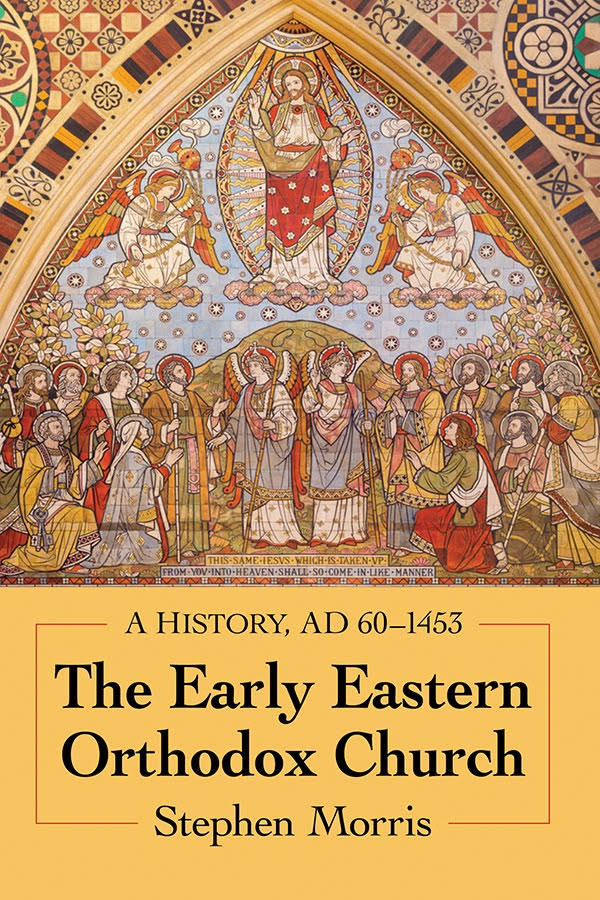
This book (published by McFarland, 2018) tells the story of these struggles from the days of the New Testament to the fall of the city of Constantinople in AD 1453. It focuses on the Christian community in the eastern Mediterranean which eventually became known as the Byzantine Empire. Each chapter examines the personalities and theologies entwined at the heart of conflicts that shaped the medieval world as well as the modern cultures of Greece, the Middle East and Eastern Europe.

A user-friendly text that presumes no prior knowledge, each chapter includes suggestions for further reading if a reader wants to know more about particular periods or personalities.

Order your copy here or on Amazon!

Please be sure to “FOLLOW” me here in order to receive notifications as new books become available.

Lidice

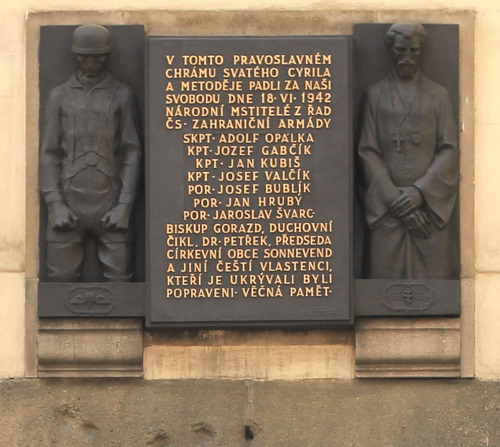
Memorial plaque for Lidice at the Orthodox cathedral of SS. Cyril and Methodius in Prague. A Gestapo report suggested Lidice was the hiding place of the assassins, since several Czech army officers exiled in England were known to have come from there.

June 10, 1942 – In one of the most infamous single acts of World War II in Europe, all 172 men and boys over age 16 in the Czech village of Lidice were shot by Nazis in reprisal for the assassination of SS leader Reinhard Heydrich. The women were deported to Ravensbrück concentration camp where most died. Ninety young children were sent to the concentration camp at Gneisenau, with some later taken to Nazi orphanages if they were German looking. The village was then completely leveled until not a trace remained.

The Nazis destroyed the town by first setting the houses on fire and then razing them to the ground with plastic explosives. They did not stop at that. Instead, they proceeded to destroy the church and even the last resting place – the cemetery. In 1943 all that remained was an empty space. Until the end of the war, the site was marked by notices forbidding entry. The news of the destruction of Lidice spread rapidly around the world.

But the Nazi intention to wipe the little Czech village off the face of the Earth did not succeed. Several towns throughout the world took the name of Lidice in memory of the Czech village that met such a horrific fate. Also, many women born at that time were named Lidice. The once tranquil village Lidice continued to live in the minds of people all over the world and after the war the Czechoslovak government decided to build Lidice again.

You can read the story of the assassination and the reprisals here. A recent movie is an excellent depiction of the historic events.