Circumcision of Christ (Holy Name)

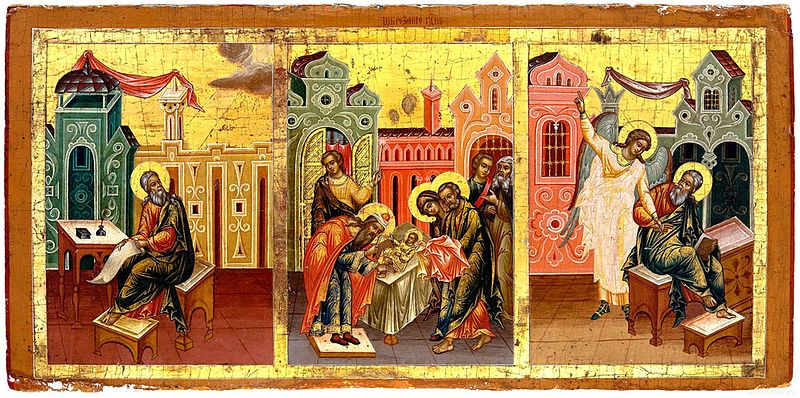
The central panel depicts the circumcision of Christ. The two side panels depict the Gospel writers Luke and Matthew who relate how Jesus was circumcised or given his name on the 8th day after his birth.

The Feast of the Circumcision of Christ is a Christian celebration of the circumcision of Jesus in accordance with Jewish tradition, eight days after his birth, the occasion on which the child was formally given his name. Eight days after Christmas (December 25), Circumcision (nowadays the feast is often called “Holy Name”) is thus celebrated on January 1.

The circumcision of Jesus has traditionally been seen, as explained in the popular 14th-century work the Golden Legend, as the first time the blood of Christ was shed and thus the beginning of the process of the redemption of man, a demonstration that Christ was fully human and of his obedience to Biblical law.

Circumcision was first practiced by Ethiopians and Egyptians, according to Herodotus, and they practiced it mainly for reasons of health (Hist. 2:2, 104). In the Old Testament, God established circumcision as a sign of his covenant with Abraham that would mark his descendants as different from the other peoples of the world. “This covenant, which you shall keep, is between me and you and between your seed after you for their generations. Every male among you shall be circumcised. Circumcise the flesh of your foreskin, and that shall be the mark of the covenant between you and me. And a child, when he is eight days old, shall be circumcised.” (Genesis 17:12)

The Greeks and Romans thought circumcision was a horrible disfigurement of the male body. Many Romans admired Jewish religious practice and thought but refused to actually convert because of the social stigma associated with circumcision. Several of these “God-fearers” appear in the New Testament.

Patristic literature associates the timing of the Circumcision on the eighth day with Resurrection. Seven is the number of completion and fullness as the world was created in seven days and is due to pass through seven ages. But if seven is perfect, then seven-plus-one is super-perfect. Eight, therefore, stands for renewal, regeneration — whence the architectural tradition of eight-sided baptistries. And Christ rose from the dead on the day superseding the Sabbath, on the Eighth Day just as the world’s seven ages will be followed in the eighth age by the General Resurrection. This imagery is attached almost from the beginning to all theological meditation on Christ’s Circumcision. It is the sense of the mystery that the Circumcision on the eighth day prefigures Christ’s Resurrection, and thereby, implicitly, the resurrection of all.
The Manger in the Cave

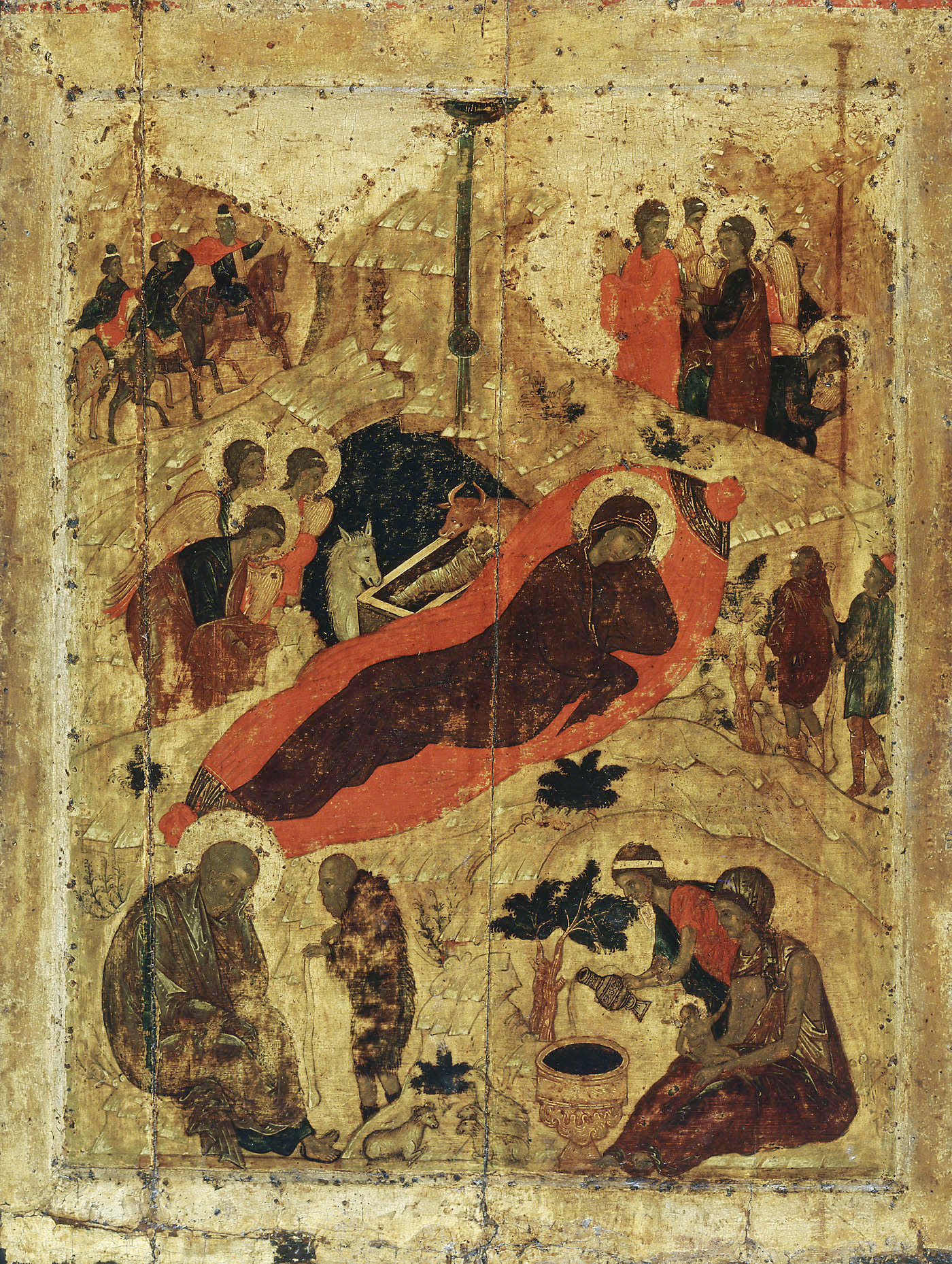
Eastern Orthodox icon of the birth of Christ by St. Andrei Rublev, 15th century. Note that the shepherd speaking with St. Joseph in the lower left is shown in profile, a pose reserved only for this shepherd, the Devil,  and for Judas Iscariot and which indicates their interior wickedness and efforts to hide themselves from God. Also, the cave in which Christ is born is painted with the same absolute black pigment -- unmixed with any other dark colors, which is more usual -- as is the tomb of Christ or the abyss of Hell, into which the Divine Presence has entered.

Eastern Orthodox icon of the birth of Christ by St. Andrei Rublev, 15th century. Note that the shepherd speaking with St. Joseph in the lower left is shown in profile, a pose reserved only for this shepherd, the Devil, and for Judas Iscariot and which indicates their interior wickedness and efforts to hide themselves from God. Also, the cave in which Christ is born is painted with the same absolute black pigment — unmixed with any other dark colors, which is more usual — as is the tomb of Christ or the abyss of Hell, into which the Divine Presence has entered.

We talk about Christ being born in a manger, in a stable and most crèche scenes have the manger inside a straw-roofed hut. But traditional depictions based on ancient models, like the icon above, show the manger inside a cave instead of a straw-roofed hut. The Church of the Nativity in Bethlehem also marks the traditional place of the manger inside a cave beneath the church. Why?

In the Middle East, animals were often stabled in the small caves that dotted the countryside. The inn at Bethlehem that offered a place to Joseph and Mary doubtless had a stable-cave attached. But in western Europe during the 1200s, when it began to be common to erect crèche scenes, the stables there that people were used to seeing were huts. Not caves. So Europeans and Americans expect to see a manger in a hut, not a cave. But the cave was the more likely, original, and actual location of the manger.

A lot of traditional poetry for both Christmas and Good Friday point out that Christ was born and buried in a cave that belonged to someone else, each time protected by a man named Joseph. His swaddling bands, the strips of cloth a baby was wrapped in to keep him/her warm and cozy, look like a the strips of cloth a corpse might be wrapped in. The manger itself looks like a coffin. The celebration of the incarnation and birth of Christ already points to the celebration of his death and resurrection.

In Orthodox icons (such as the one above), the Star of Bethlehem is often depicted not as a bright light but as a dark aureola, a semicircle at the top of the icon, indicating the “divine darkness” or Uncreated Light of Divine grace, with a ray pointing to “the place where the young child lay” (Matt 2:9). Sometimes the faint image of an angel is drawn inside the dark semi-circle, pointing the way for the Magi.

St. Barbara & Lightning Bolts

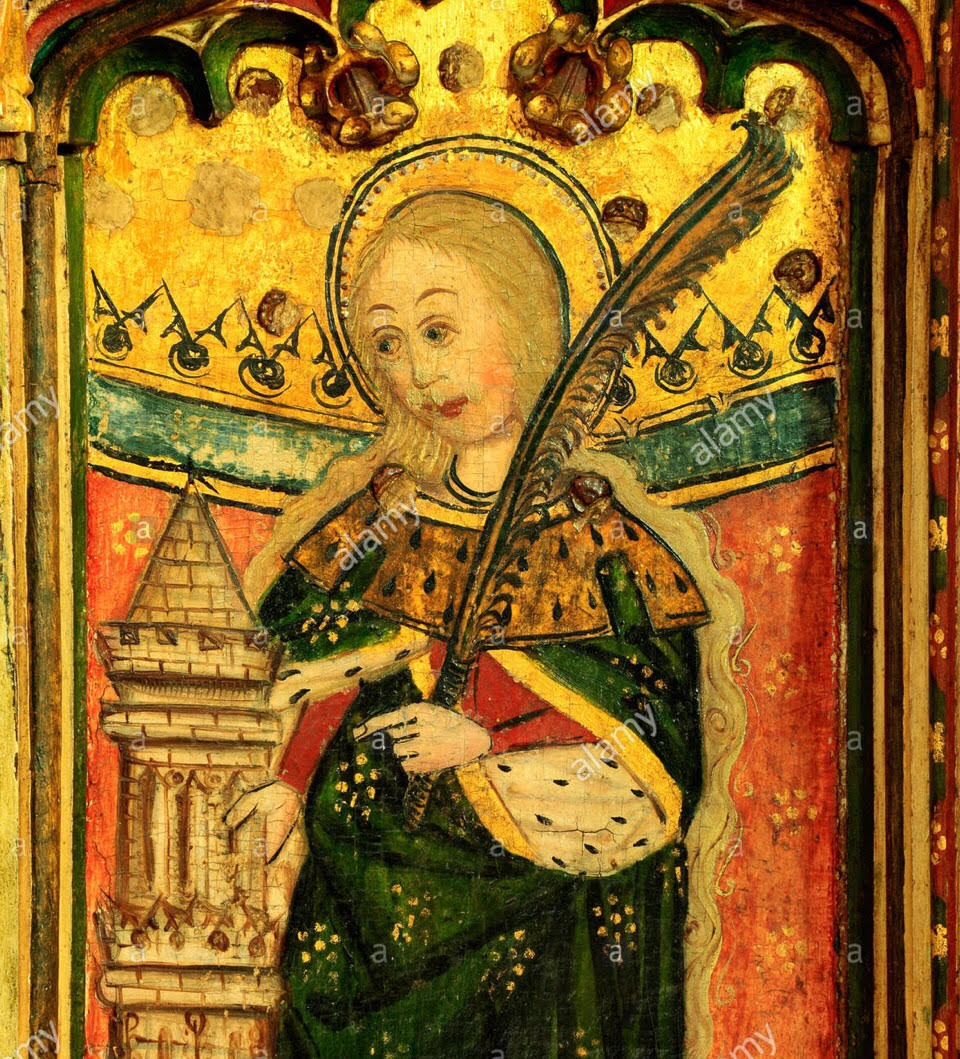
A Rood Screen painting (in Eye, Suffolk) 1480 depicts St. Barbara with her tower and palm branch.

If you die suddenly, without the time to receive Last Rites, then St. Barbara can give you everything you need. This is because Barbara herself was killed suddenly, with no warning, on December 4, AD 306. (Did you see last week’s post about St. Barbara and her branches? Look below.)

Barbara’s father was a rich merchant who built a tower with two windows for her to live in while he was away on business trips. While he was away on one trip, she became a Christian and had a third window installed in the tower as a way to honor the Holy Trinity. When her father came home and discovered that she had converted, he was so angry he drew his sword to kill her, but her prayers created an opening in the tower wall and she was miraculously transported to a mountain gorge, where two shepherds watched their flocks. Her father discovered where she was but was rebuffed by the first shepherd. However, the second shepherd betrayed her. For doing this, he was turned to stone and his flock was changed to locusts.

Dragged before the prefect of the province, who had her cruelly tortured, Barbara held true to her Christian faith. During the night, the dark prison was bathed in light and new miracles occurred. Every morning, her wounds were healed. When the jailors attempted t burn her, the torches would go out. Finally, she was condemned to death by beheading. Her father himself carried out the death-sentence. However, as punishment for this, he was struck by lightning on the way home and his body was consumed by flame.

Because of all these parts of her story, she is often depicted with a palm leaf (the symbol of victory, of martyrdom), with her tower, a lightning bolt, or a chalice (because she can give a dying person everything that a priest could in the Last Rites). She is said to especially watch over firemen, people struck by lightning, or miners and anyone who works with explosives. Within the mining and tunneling industry, as a long-standing tradition, one of the first tasks for each new mine or tunnel project is to make a small shrine to Santa Barbara at the entry to the mine or tunnel. This is often followed with a dedication and a request to Santa Barbara for protection of all who work on the project during the construction period.