Saint Panteleimon and His Liquid Blood

Relics of St. Panteleimon/Panteleon in a German church (municipality Vogtsburg im Kaiserstuhl, Baden-Württemberg), Niederrotweil,
St Pantaleon Church (built 1735–1741).

Saint Panteleimon (known by Pantaleon during his life, he changed his name shortly before his death, meaning “all-compassionate”), is counted in the West among the late-medieval Fourteen Holy Helpers and in the East as one of the Holy Unmercenary Healers. He was a physician and a martyr who was beheaded during the Great Persecution of AD 305. After the Black Death of the mid-14th century in Western Europe, as a patron saint of physicians and midwives, he came to be regarded as one of the fourteen guardian martyrs, the Fourteen Holy Helpers.

Eastern Christian icons of St. Panteleimon show him holding a small box of medicinal herbs which he can feed a patient with a spoon which he holds in his other hand. This makes him look like an Orthodox priest, about to give Holy Communion with a spoon, which underscores the connection between “health” and “salvation;” both words share a common linguistic root. Jesus’ miracles of healing in the Gospels are taken as paradigms of salvation: to be saved is to be spiritually healed and to be healed is to be saved.

When he was beheaded, his relics–including the spilled blood–were collected and preserved. A phial containing some of his blood was long preserved in the Italian city of Ravello. On the feast day of the saint (July 27), the blood is said to become fluid and to bubble.

He was also a popular saint in Venice, and he therefore gave his name to a character in the commedia dell’arte, Pantalone, a silly, wizened old man (Shakespeare’s “lean and slippered Pantaloon”) who was a caricature of Venetians. This character was portrayed as wearing trousers rather than knee breeches, and so became the origin of the name of a type of trouser called “pantaloons,” which was later shortened to “pants”.

You can read a fascinating article about St. Panteleimon and the liquid blood relic here; be sure to scroll down the page a little to find it. There is another blood relic of St. Panteleimon kept at a monastery in Madrid; you can see a television report about it here. You can also read another blog post about other saints with similar blood relics here.
A contemporary Russian icon of Saint Panteleimon, holding his spoon to administer medicine as a priest holds a spoon to share Holy Communion with the faithful.
Deposition of the Sash of the Mother of God & The Visitation

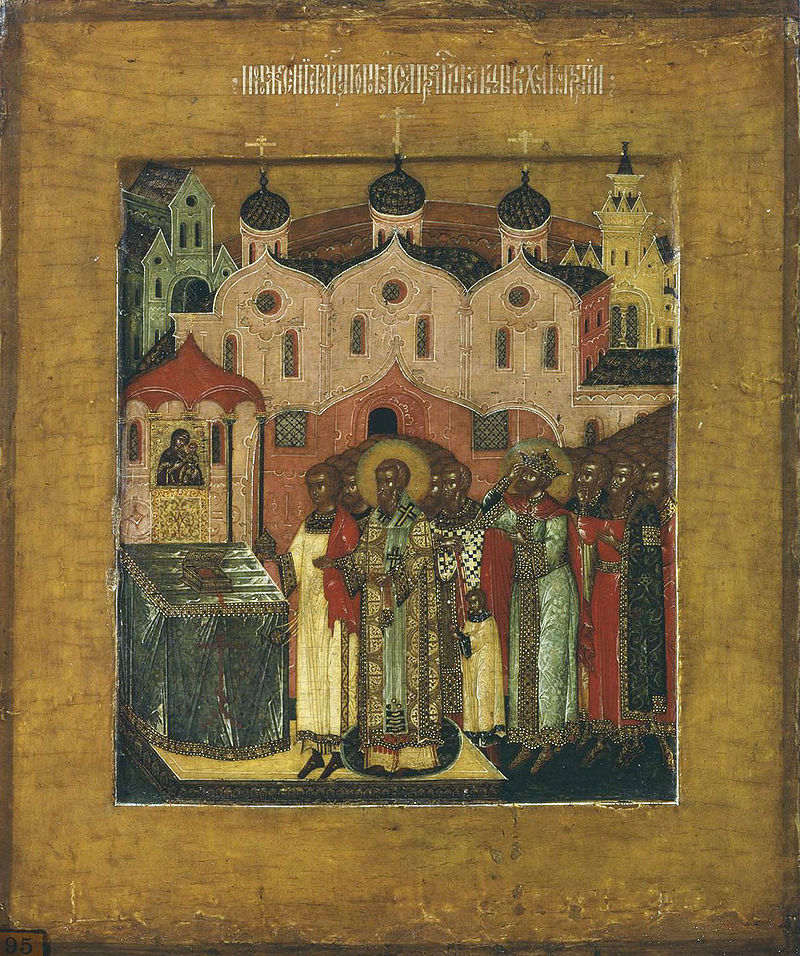
A 17th-century Russian icon of the Deposition of the Sash of the Mother of God.

July 2 has long been a feast day of the Mother of God in both the Eastern and Western Churches although the feasts each had a somewhat different emphasis.

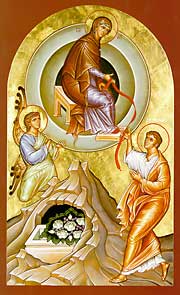
According to legend, the Mother of God died and was buried by the apostles in a tomb in Jerusalem. Three days later, Thomas the Apostle, who had been delayed and unable to attend the funeral, arrived and asked to have one last look at the Virgin Mary. When he and the other apostles arrived at Mary’s Tomb, they found that her body was missing. According to some accounts, the Virgin Mary appeared at that time and gave her belt (also called sash or cincture) to the Apostle Thomas. Another version of the story recounts how the Mother of God gave her sash to one of the women tending her as she was dying and the sash was passed down in that woman’s family from generation to generation.

Traditionally, the sash was reportedly made by the Virgin Mary herself, out of camel hair. Whether it was given to St. Thomas or the woman tending the dying Virgin, the sash was kept at Jerusalem for many years. It was brought to Constantinople in the 5th century, together with the robe of the Virgin Mary. The robe and the sash were both deposited in the Church of St. Mary at Blachernae. The sash was embroidered with gold thread by the Empress Zoe, the wife of Emperor Leo VI, in gratitude for a miraculous cure. The anniversary of this deposition of the sash of the Mother of God at Blachernae is celebrated every year by the Orthodox Church on July 2.

Later, the Emperor John VI Kantakouzenos (1347–1355) donated the sash to the monastery of Vatopedi on Mount Athos, where it remains to this day. (I was given a relic of the sash on Mt. Athos by a good friend of mine; I highly prize it. I have also been given a small stone from Golgotha by a parishioner and a small stone from the tomb of the Mother of God in Jerusalem as an ordination gift.)

July 2 was the traditional date for the Western Church to celebrate the Visitation of the Mother of God and St. Elizabeth, the mother of John the Baptist (Luke 1:39-57). Feeling the presence of his Christ in the womb of Mary, John, in the womb of his mother Elizabeth, jumped with excitement. Elizabeth greeted her cousin Mary as “the Mother of my Lord,” realizing that the baby was not just kicking in her womb for no reason. (Many western Christians moved the Visitation feast to May 31 in 1969.) Keeping the Visitation on July 2, however, strikes me as a fitting way to promote unity between Eastern and Western Christians and to foster goodwill among the adherents of a common, “mere” Christianity.

Read more about the Visitation here and here. You can read more about the Deposition here. See Mere Christianity here.

A contemporary icon depicting the Mother of God giving her sash to St. Thomas the Apostle after her Dormition (Assumption).

Corpus Christi: Wafer vs. Bread

Contemporary hosts made for Holy Communion are often whole wheat and do not appear as glistening white as wafers produced with white flour.

Wafers have been used for Holy Communion by Western Christians since the late 1200s. Before that, unleavened bread–made without yeast–was used. (Western Christians adopted the use of bread without yeast in imitation of the matzah–unleavened bread–used at Passover and the Last Supper in the Gospels. The matzah was not like the crackers now sold in grocery stores; matzah and the unleavened bread used by Western Christians was more like tortilla or gyro bread.) Eastern Christians have always used bread made with yeast.

I remember in the 1970s how people joked, “It takes more faith to believe that a wafer is bread than it does to believe that it becomes the Body of Christ!” This was because the wafers do not look like anything most people think of when you ask them what bread looks like. It turns out this is because wafers are NOT technically bread at all! Both are baked goods made with flour but they are not the same just as cake and crackers are also baked goods made from flour but are not bread. Bread, by definition, is made from dough and must be kneaded and formed by hand; wafer is made from batter and is never touched until after it is baked. The first reference to Western Christians using wafers instead of bread are from the late 1200s and many people objected precisely that wafers were “not real bread.”

People also objected that the wafers were not made by monks as priests as the unleavened bread used at Mass had been. People did not think that layfolk–even nuns–should be baking the bread used for Holy Communion. (It did become common later for nuns to make wafers for churches to buy and this was a way for nuns to support themselves. Since the 1960s, making wafers for Holy Communion has become a big business that you can read about here.)

It is unclear how rapidly wafer-use spread among Western Christians but they became used uniformly across Europe by the late 1600s. Why did wafers become so popular? One reason might be that wafers did not spoil as quickly as real bread, even if it was made without yeast; this made it easier to keep the Blessed Sacrament reserved. Also, some people thought the bread or wafer used for Communion should be glistening white and it is easier to control the color of wafers than bread. Some people thought that the wafers never being touched until after they were baked was emblematic of Christ’s birth from the Virgin Mary; these people favored the use of wafers rather than bread that was touched as it was kneaded and formed.

It became standard to make a large wafer for the priest to elevate for people to reverence at the Elevation and just before Communion; the wafers that would be consumed by the layfolk were much smaller discs that were coin-sized. Preachers suggested that the coin-size wafers should remind people that God was like a vineyard owner who could hire people all day long and would pay all the workers the same coin at the end of the day (Matthew 20:1-16).

Want to know more? There are three books about the different kinds of bread used for Holy Communion:

1. Fractio Panis by Barry Craig (Germany, 2011).
2.
Bread and the Liturgy: The Symbolism of Early Christian and Byzantine Bread Stamps by George Galavaris (Wisconsin, 1970).
3. The Bread of the Eucharist: Early Christian Eucharist and the Azyme Controversy, by Edward Martin (Rome, 1970).

The elevation of the Host in a contemporary celebration of the Solemn Mass by Dominican religious.