“Happy Birthday!” to the BVM

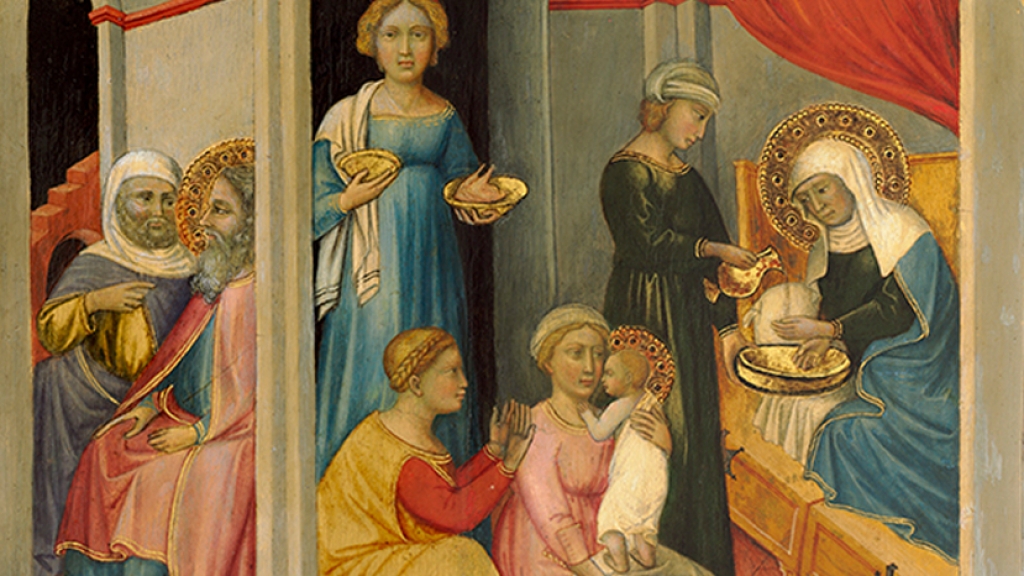
The Nativity of the Virgin by Andrea di Bartolo (1360/70 – 1428). He was an Italian painter, stained glass designer, and illuminator of the Sienese School mainly known for his religious subjects. He was active between 1389–1428 in the area in and around Siena. (This painting hangs in the National Gallery)

A feast in honor of the Blessed Virgin Mary’s birth seems to have been held in Syria and Palestine in the sixth century. This celebration was accepted and adopted by the Roman Church at the end of the seventh century. It spread very slowly through the rest of Europe but by the twelfth century, it was observed throughout both Western and Eastern Europe as one of the major feasts of Mary. It remained a holy day of obligation among Roman Catholics until 1918.

In many places of central and eastern Europe the Feast of Mary’s Nativity is traditionally connected with ancient farming customs and celebrations, much like Thanksgiving Day in the U.S. September 8 itself marks the end of the summer in popular reckoning; September 8 also marks the beginning of “after-summer” and the start of the fall planting season. A blessing of the harvest and of the seed grains for the winter crops is performed in many churches.

In central and northern Europe, according to ancient belief, September 8 is also the day on which the swallows leave for the sunny skies of the South.

In the Alps, the “down-driving” (Abtrieb) begins on September 8. Cattle and sheep are taken from their summer pastures on the high mountain slopes where they have roamed for months, and descend in long caravans to the valleys to take up their winter quarters in the warm stables. The animals at the front of the procession wear elaborate decorations of flowers and ribbons; the rest carry branches of evergreen between their horns and little bells around their necks. The shepherds and other caretakers accompany the procession, dressed in all their finery and decorated with Alpine flowers, yodeling, and cracking whips to provoke a multiple echo from the surrounding mountain cliffs. Arriving at the bottom of the valley in the evening, they find the whole village or town awaiting them in a festive mood. Ample fodder is served to the cattle in the stables, and each family has a banquet that includes the farm hands. In some sections of Austria all the milk obtained on Drive-Down Day is given to the poor in honor of our Lady, together with the meat, bread, and pastries left over from the feast in the evening.

If, however, the farmer who owns the cattle has died during the summer, the “downdriving” is performed without decorations and in silence. Each animal then wears a mourning wreath of purple or black crepe.

In the wine-growing sections of France, September 8 is the day of the grape harvest festival. The owners of vineyards bring their best grapes to church to have them blessed; in Greece, the first grapes are ripe a month earlier so the Greeks bring the grapes into church to be blessed on August 6; the French have the grapes blessed and afterward tie some of them to the hands of the statue of the Virgin. The Feast of Mary’s Nativity is called “Our Lady of the Grape Harvest” in those sections, and a festive meal is held at which the first grapes of the new harvest are consumed.
St. Aidan of Lindisfarne, a Model Pastor

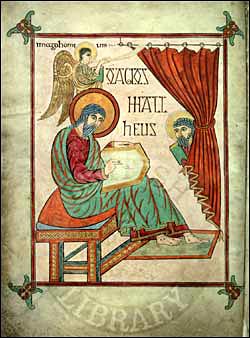
Full-page miniature of the Evangelist Saint Matthew, accompanied by his symbol, a winged man blowing a trumpet and carrying a book; folio 25v of the Lindisfarne Gospels produced about 100 years after St. Aidan founded the monastery.

St. Aidan of Lindisfarne (died 31 August AD 651) was an Irish monk and missionary credited with restoring Christianity to northern England. He founded a monastic cathedral on the island of Lindisfarne and served as its first bishop. He travelled throughout the countryside, spreading the gospel to both the Anglo-Saxon nobility and the socially disenfranchised (including children and slaves).

In the years prior to Aidan’s mission, Christianity, in northern England was being largely displaced by Anglo-Saxon paganism. However, the young king Oswald vowed to bring Christianity back to his people—an opportunity that presented itself in AD 634, when he gained the crown of Northumbria. King Oswald requested that missionaries be sent from the monastery of Iona in Scotland. At first, they sent him a bishop named Cormán, but he alienated many people by his harshness, and returned in failure to Iona reporting that the Northumbrians were too stubborn to be converted. Aidan criticized Cormán’s methods and was soon sent as his replacement. Aidan became bishop in AD 635.

Allying himself with the pious king, Aidan established a monastic community on the island of Lindisfarne, which was close to the royal castle, as the seat of his diocese. An inspired missionary, Aidan would walk from one village to another, politely conversing with the people he saw and slowly interesting them in Christianity:

“He was one to traverse both town and country on foot, never on horseback, unless compelled by some urgent necessity; and wherever in his way he saw any, either rich or poor, he invited them, if infidels, to embrace the mystery of the faith or if they were believers, to strengthen them in the faith, and to stir them up by words and actions to alms and good works. … This [the reading of scriptures and psalms, and meditation upon holy truths] was the daily employment of himself and all that were with him, wheresoever they went; and if it happened, which was but seldom, that he was invited to eat with the king, he went with one or two clerks, and having taken a small repast, made haste to be gone with them, either to read or write. At that time, many religious men and women, stirred up by his example, adopted the custom of fasting on Wednesdays and Fridays, till the ninth hour, throughout the year, except during the fifty days after Easter. He never gave money to the powerful men of the world, but only meat, if he happened to entertain them; and, on the contrary, whatsoever gifts of money he received from the rich, he either distributed them, as has been said, to the use of the poor, or bestowed them in ransoming such as had been wrong fully sold for slaves. Moreover, he afterwards made many of those he had ransomed his disciples, and after having taught and instructed them, advanced them to the order of priesthood.” (Venerable Bede, Ecclesiastical History of the English Nation. Book III: Chapter V)

His pastoral emphasis on prayer, fasting, Christian education and his own personal humility is similar to all the famous pastors such as St. John of Kronstadt and the Cure d’Ars.

There are four wells associated with St. Aidan which are said to work miracles of healing, especially of asthma and skin diseases.

He is known as the Apostle of Northumbria and is recognised as a saint by the Eastern Orthodox Church, the Catholic Church, and the Anglican Communion.

St. John the Baptist Beheaded

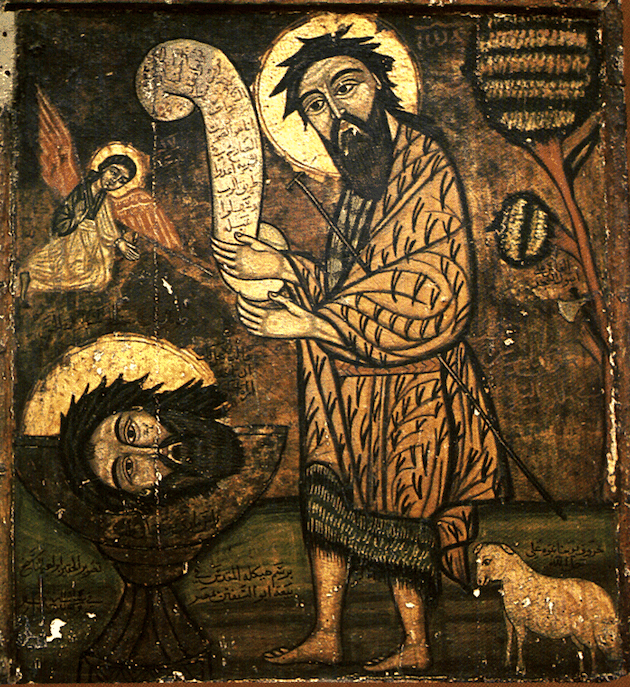
This Coptic icon for the Beheading of St. John the Baptist, shows St. John ‘in clothing of camel’s hair’, with a cross (here in the Coptic Tau (T) form), beholding his own head. The axe at right refers to this line from his own preaching: “And even now the axe is laid to the root of the trees. Therefore every tree which does not bear good fruit is cut down and thrown into the fire.” [Mt 3.10; Lk 3.9]

Western and Eastern Christians commemorate of the Beheading of St. John the Baptist on August 29. However, in Italian folklore the story of the daughter of Herodias became attached to June 23, St John’s Eve, which is the night before the Feast Day of St. John the Baptist, June 24. (Usually, a feast day of a saint commemorated the death of that saint to celebrate her/his martyrdom; the feast of St. John the Baptist is one of the very few saints’ days to mark the anniversary of a saint’s birth. Click here for my earlier post about St. John’s Nativity and Midsummmer. Click here for another post about Midsummer and St. John’s Wort.) In Rome, youths would gather in front of the cathedral of Basilica of St. John Lateran on the night of June 23, because Herodias traveled in the air.

“Salome of the Seven Veils” is the name by which the “daughter of Herodias” is generally known in modern American culture. J.B. Andrews in his 1897 folklore article (Neapolian Witchcraft, Folklore Transactions of the Folklore Society, Vol III March, 1897 No.1) wrote:

It is believed that at midnight then [St. John Baptist’s Eve, June 23] Herodiade may be seen in the sky seated across a ray of fire, saying:

” Mamma, mamma, perche` lo dicesti?”
“Figlia, figlia, perche’ lo facesti? “

“Herodiade” or “Erodiade” is the Italian version of the name Herodias.

Sabina Magliocco in her incredible article Who Was Aradia? The History and Development of a Legend, The Pomegranate (see The Journal of Pagan Studies, Issue 18, Feb. 2002) explained what Herodiade was doing in the airs on June 23, the Eve of St. John Baptist’s Feast Day:

According Sabina Magliocco, there was an early Christian legend or folklore derived from the bibical account (Matthew 14:3-11, Mark 6:17-28) of Herodias and Herodias’ daughter. When the head of the saint was brought forth on a platter, she-who-danced-for-the-head-of-the-Baptist had a fit of remorse, weeping and bemoaning her sin. A powerful wind began to blow forth from the saint’s mouth, so strong that it blew the famous dancer up into the air, where she is condemned to wander.

Titus Flavius Josephus, a first-century Jewish historian provides the name of stepdaughter and niece of Herod Antipas as Salome, but Josephus makes no mention of the infamous dance. Josephus in his Antiquities of the Jews recounted that after the excution of John that Herod, Herodias, and her daughter Salome were exiled Lugdunum, near Spain.

However, the name “Salome” does not appear in the biblical accounts of the beheading of John the Baptist. In the Latin Vulgate Version, the girl is refered to as the “daughter of the said Herodias.”

At some point, the “daughter of Herodias” and “Herodias” became conflated in folklore in early medieval Europe.

Probably because the holiday of St John the Baptist was widely celebrated during the Middle Ages, a great deal of religious folklore surrounds Herodias. Magliocco also explained:

Diana in the Canon Episcopi, a document attributed to the Council of Ancyra in 314 CE, but probably a much later forgery, since the earliest written record of it appears around 872 CE (Caro Baroja, 1961:62). Regino, Abbot of Pr¸m, writing in 899 CE, cites the Canon, telling bishops to warn their flocks against the false beliefs of women who think they follow “Diana the pagan goddess, or Herodias” on their night-time travels. These women believed they rode out on the backs of animals over long distances, following the orders of their mistress who called them to service on certain appointed nights. Three centuries later, Ugo da San Vittore, a 12th century Italian abbot, refers to women who believe they go out at night riding on the backs of animals with “Erodiade,” whom he conflates with Diana and Minerva (Bonomo, 1959:18-19).

Eventually there developed a widespread belief that Herodias was a the supernatural leader of a supposed cult of witches, apparently asociated with or synonymous with the legendary witch-queens Diana, Holda, Abundia, and many others. In Italy, Raterius of Liegi, Bishop of Veronia in the 9th century c.e. complained that many folk believed that Herodias was a queen or goddess and that they also claimed a third of the earth was under the dominion of Herodias. Herodias was supposed to preside over the night assembly or night flight.

In parts of Italy, the dew formed on St. John’s Eve was often said to represent the tears of the daughter of Herodias. This dew was believed to have healing virtues and promote fecundity. June 23 was also known as la notte delle streghe. It was once customary in Rome to build bonfires outside the Basilica of St. John Lateran in anticipation of the night flight led by Herodias. (Read my previous post on the bonfires of June 23 here.)