David and Goliath and the Kiss of Peace

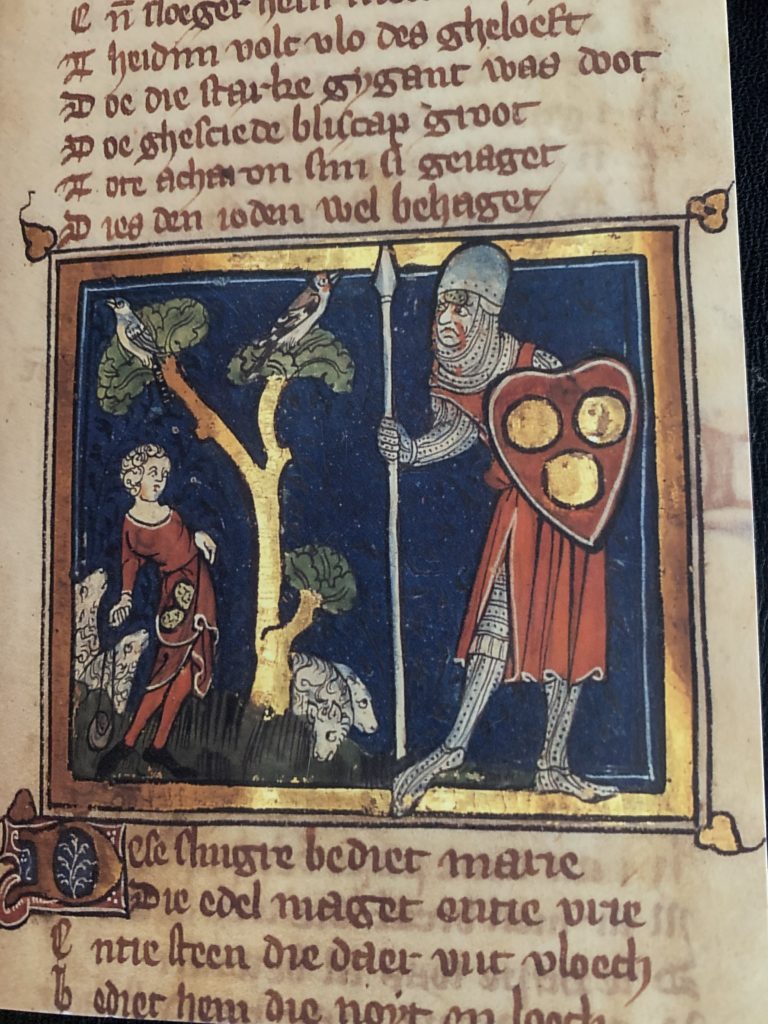
Illumination of David and Goliath in Antiquities of the Jews by Josephus. The manuscript was made in the Netherlands in AD 1332.

“I love you, O Lord my strength, O Lord my stronghold, my crag, and my haven. My God, my rock, in whom I put my trust.” (Psalm 18:1-2)

When David was a teen, before he was made king of Israel, he volunteered to fight the giant Goliath in single combat (read the Old Testament story in 1 Samuel 17). Goliath was approximately 10 feet tall, had 6 fingers on each hand, and was rumored to be descended from the giants (these details are reported in 1 Chronicles 20:6). Goliath also had bronze armor and a 19 pound iron spear, which was unusual at that time. He was a formidable opponent. But, as the well known story reports, David selected 5 stones from a riverbed and was able to kill Goliath with a stone from his slingshot. He then cut off Goliath’s head to prove his victory and sang Psalm 18 in celebration (see also the report in 2 Samuel 22).

At the Kiss of Peace during the celebration of the Divine Liturgy in the Orthodox Church, the priest quietly recites the first verses of this psalm. The exchange of the Kiss, reconciling the participants and celebrating their mutual forgiveness before singing the consecration prayers and receiving Holy Communion, is like the stone David let fly from his slingshot: it slays the enemy of the People of God. The division and animosity of anger and holding grudges are among the most powerful weapons of Evil and Death; the fury and refusal to accept fellowship with others is a foretaste of Death and mutual forgiveness anticipates the Resurrection in which we experience the re-establishment of harmony between God and humanity, between God and the entire creation, between each of us with each other and the creation as well. The early preachers and teachers of the Church understood the power of the Antichrist to be precisely this division, animosity, and chaos.

Goliath is a personification of all that opposes God and His creation. The stone from David’s slingshot anticipates the Cross, the weapon by which the Enemy is slain. The Kiss of Peace reveals the power of the Cross in the live of the community assembled to celebrate the Eucharist. We are able to embrace one another, call even those who hate us “Brother!” and forgive all by the power and joy of the Resurrection. The Kiss of Peace, the stone in our slingshot in our battle with the Enemy, is more than a simple gesture or chance to greet our friends. It is one of our most effective weapons against Death and the Devil (“the divider” and “the adversary”).

During this time when we may not be able to exchange the Kiss of Peace during the liturgical celebration, it is especially important that we continue to forgive and metaphorically embrace those we may harbor animosity against. Now, more than ever, we must celebrate the Resurrection in every manner available to us.
Our Lady of Good Health

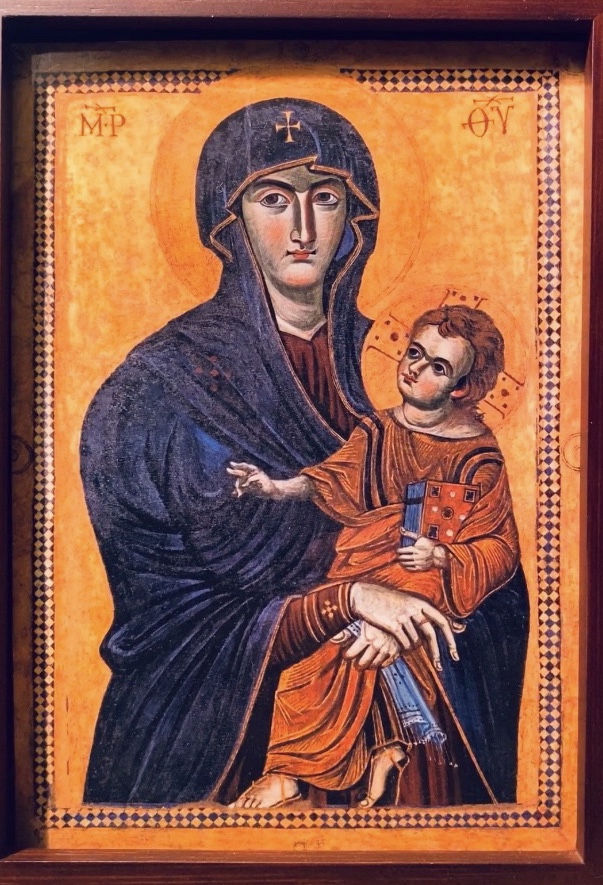
The icon of Salus Populi Romani is found in the Lady Chapel of the basilica known as St. Mary Major in Rome and has long been considered a wonderworking image, especially in times of plague or epidemics.

Pope Gregory the Great welcomed the image now known as Salus Populi Romani (“Salvation/Health of the Roman People”) in AD 593 and placed it in the basilica known as St. Mary Major. He had the icon carried throughout Rome and prayed for an end to the Black Plague. Pope Gregory XVI also venerated the image in 1837 to pray for the end of a cholera epidemic.

The Mother of God is shown with a ceremonial embroidered handkercheif in her right hand, an indication that she is the Queen of Heaven (another popular title for the image). For several centuries, both she and Christ also wore metal crowns which were attached to the icon but which have been removed and are now kept in the sacristy of St. Peter’s Basilica in the Vatican. The stars on the cloak of the Mother of God also indicate that she was a vrigin before-during-after the birth of her Son (the stars said to be the last glimmers of heavenly light that filled the cave in Bethlehem when Christ was born, seen in the folds of her cloak by the midwives when they finally arrived–too late).

The image of Salus Populi Romani is related to the church in Venice, Our Lady of Good Health, which was built in thanksgiving for the end of a plague there. You can read more about the church in Venice here.

40 Martyrs of Sebaste

The feast of the Forty Martyrs falls on March 9. There is an intentional play on the number forty being both the number of martyrs and the days in the fast. Because the celebration of the 40 Martyrs falls during Great Lent, the endurance of the martyrs serves as an example to the faithful to persevere to the end (i.e. throughout the forty days of the fast) in order to attain heavenly reward (participation in the Resurrection).

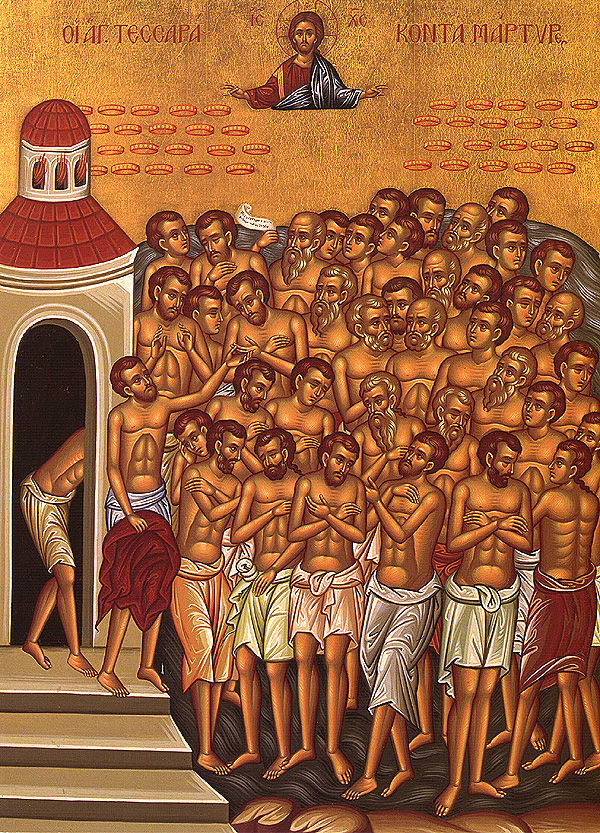
The Forty Martyrs of Sebaste were a group of Roman soldiers in the Legio XII Fulminata (“Armed with Lightning”) whose martyrdom in AD 320 for the Christian faith is recounted in traditional collections of records of the martyrs.

They were killed near the city of Sebaste, in a region known as Lesser Armenia (the present-day Sivas region of Turkey), victims of the persecutions of Licinius, who after AD 316, persecuted the Christians of the Eastern half of the Roman Empire. The earliest account of their martyrdom is given by St. Basil the Great (AD 370–379) in a homily he delivered on their feast day (March 9). The celebration of the Forty Martyrs is thus older than Basil himself, who preached about them only fifty or sixty years after their deaths.

According to St. Basil, forty soldiers who had openly admitted that they were all Christians were condemned by the prefect and sentenced to be exposed naked upon a frozen lake near Sebaste on a bitterly cold night so that they would freeze to death unless they renounced their Christian faith; if they renounced their faith, they would be welcome to warm themselves in the hot baths on the lakeshore. One of the soldiers yielded and, leaving his companions, sought the warm baths near the lake which but one of the guards who was set to keep watch over the martyrs saw a brilliant light surrounding the naked soldiers on the lake and he stripped off his clothes and announced that he was now a Christian. He joined the remaining thirty-nine and so the number of forty remained complete. (The soldier who denied his faith was killed, however, by the shock of the warm water after being so cold out on the ice. The icon above shows the apostate soldier entering the bathhouse while the newly-converted guard strips off his clothes to join the other 39 soldiers out on the ice.)

At daybreak, the stiffened bodies of the confessors, which still showed signs of life, were burned and the ashes cast into a river. Christians, however, collected the precious remains, and the relics were distributed throughout many cities; in this way, veneration of the Forty Martyrs became widespread, and numerous churches were erected in their honor.

There is a pious custom of baking “skylarks” (pastries shaped like skylarks) on this day, because people believed that birds sing at this time to announce the arrival of spring