Dragons, Dragons Everywhere

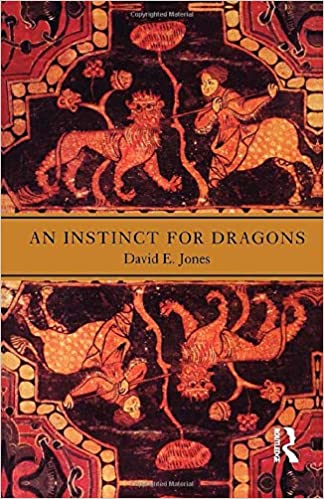
Every culture has dragon folktales and these dragons share the same characteristics. David Jones reaches fascinating conclusions about our fear and fascination with these creatures, including that we are essentially “hardwired” to believe in them. Get a copy here.

Dragons are not just fairy tale creatures who like to eat an occasional princess or fight a knight or two. Dragons are mythic-poetic creatures used in tales or sermons to make sophisticated points. Perhaps rooted in early human experience of three major predators–lions, eagles, and large serpents–dragons both warn of danger and show how to escape that danger.

Although we think of dragons as fire-breathing serpents with legs and wings, the oldest stories report that dragons had a foul, poisonous breath, the stench of which could kill anything that inhaled it. Dragons are Chaos. Dragons are spiritual and emotional energy that is out of control. Unfocused. Wild. They are in stories or texts what horses with loose, untied tails are in icons.

In the New Testament (Revelation 12:3) we read about a vision of a Great Red Dragon with seven heads, ten horns, seven crowns, and a massive tail, an image which is clearly inspired by the vision of the four beasts from the sea in the Book of Daniel and the Leviathan described in various Old Testament passages. This dragon is the enemy of the woman clothed with the sun, with the moon beneath her feet, and a crown of 12 stars upon her head: the Church. The dragon attacks the Church at the End of Days and slays the martyrs as Judgement Day approaches. In the lives of the saints–such as SS. Margaret or George–a dragon is the enemy of the saint or of specific persons now, during history.

In the story of St. Margaret, she is swallowed alive by a dragon in her jail cell but she makes the sign of the Cross and the dragon’s stomach explodes… allowing her to step out, unharmed. (Not unlike Red Riding Hood and her grandmother stepping unharmed from the wolf’s stomach.) In the story of St. George (whose horse’s tail is always tied in a knot), the dragon is attacking a town and is about to devour a princess as its most recent victim but George is able to kill it; in some versions, he wounds it so that it becomes a tame beast and he can lead it into the town with a leash made of the princess’ belt.

St. Margaret is clearly attacked by the enemies of God but is able to overcome them by her faith in Christ, crucified and risen. The princess (soul) is attacked by the passions–anger, jealousy, greed, etc.–but is able to either overcome them by the help of the saints and the Cross of Christ (the wooden spear of St. George). In the versions where the dragon is wounded, it means the soul is able to redirect its energy away from destructive desires into constructive desires, such as righteous anger on behalf of the oppressed, desire to care for the needy, or peace-making between enemies.

Dragons are the great enemy both at the End of Time and now, as history plays itself out. They are the spiritual energy that we can channel to come close to God or that we can let it create chaos in our lives to destroy us. We can embrace the dragon within or we can tame it. The choice is ours.
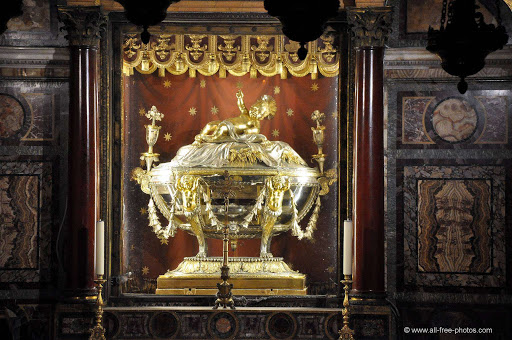
St. Mary Major and the Miracle of the Snow

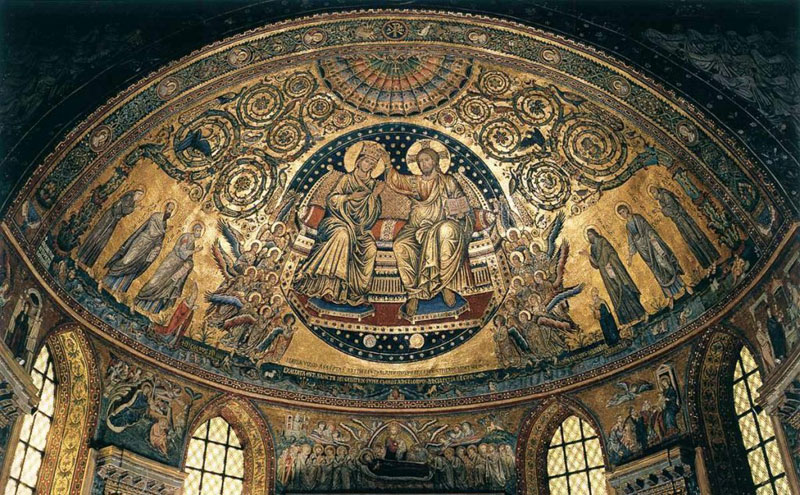
The mosaics found in Santa Maria Maggiore (St. Mary Major) are among the oldest representations of the Virgin Mary. One scholar writes that “… the iconographic depiction of the Virgin Mary was chosen at least in part to celebrate the affirmation of Mary as Theotokos (bearer of God) by the third ecumenical Council of Ephesus in AD 431.”
Under the high altar of the basilica is the Crypt of the Nativity or Bethlehem Crypt, with a crystal reliquary said to contain wood from the Holy Crib (manger) of the nativity of Jesus in Bethlehem. In the crypt is also the burial place of St. Jerome who translated the Bible into Latin in the 4th century.

Who doesn’t need a miracle right about now? Although the miracle of St. Mary Major and the snow occurred in Rome during early August, I don’t think we need to wait until August to appreciate it.

According to the story, a rich Roman and his wife wanted to leave their estate to the Church in order to build a new church but they were uncertain where it should be built. They were promised in a dream that a miracle would show them the place to have the church built. A few days later, on August 5 in the mid-late 4th century, a miraculous snowfall occurred atop one of the hills of Rome. The couple understood this to be the miracle they had been told to expect. (Other versions of the story say that the Pope had chosen the site for a new church but his decision met with resistance; he marked the area to be excavated for the church foundations and had the dream promising a miracle to vindicate his choice of location. The next day the snow fell exactly–and only!–within the area he had marked for excavation.)

The legend is still commemorated by dropping white rose petals from the dome of the church during the celebration of the Mass on August 5th, similar to the red roses that are dropped from the dome of the Pantheon at Pentecost.

The mosaics in the church are among the most stunning examples of early Christian art and iconography. They illustrate events in the life of the Mother of God and of Christ and events from the Old Testament that are understood to be allusions or anticipations (types) of the events in the life of Christ and His mother.

The church is known as St. Mary Major because it is the most important of all the churches in Rome dedicated to the Mother of God; it is also sometimes called Saint Mary of the Crib (Sancta Maria ad Praesepe), a name it was given because of the relic of the crib or manger of the Nativity of Christ: four boards of sycamore wood believed to have been brought to the church, in AD 640–649. The Pope traditionally celebrates the Mass three times on Christmas Day; one of these celebrations is held at St. Mary Major because of the relic there.

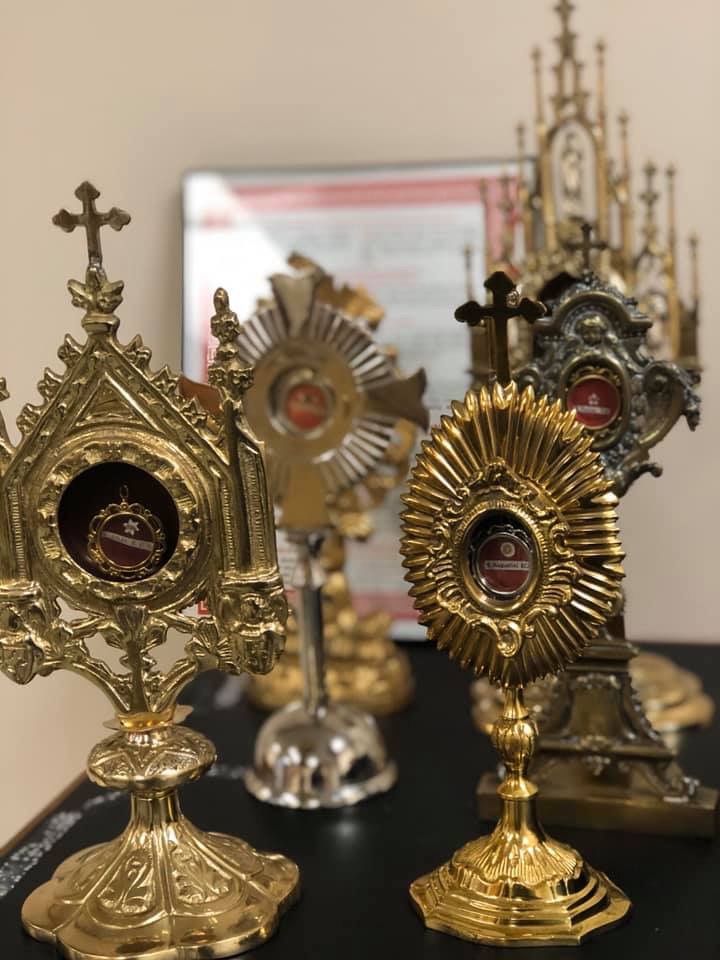
Witnesses of the Resurrection

Relics of the martyrs (lit. “witnesses”) whose lives and deaths testify to the power of Christ’s Resurrection, even in the midst of affliction and death. “You let people ride over our heads; we went through fire and water, but you brought us to a place of abundance.” (Psalm 66:12)

In ancient Greece, a martyr was a witness who testified in court. When Christians were arrested and asked to testify in court about their religious beliefs, they were therefore called “martyrs.” But that testimony would usually result in their execution for refusing to practice one of the legitimate religions of the Greco-Roman world; the Church has continued to call those who were executed for their testimony martyrs; their faith, even as they were tortured and killed, was a testimony to the power of Christ’s Resurrection.

After the martyrs were executed, other members of the Church would come collect the corpses or fragments of their tortured bodies for burial. They would gather at the tombs and burial places of the martyrs to celebrate the Eucharist. The bodies were treated with great care and devotion because they had been washed with the waters of baptism, anointed with holy oil, had tasted Holy Communion, and were simply one aspect of the deceased’s existence: a person is made of a body and soul together. Often, portions of the bodies–called “relics,” from the Latin for “remains”–would be placed in new altars, as described in the New Testament, “When the Lamb broke the fifth seal, I saw under the altar the souls of all who had been martyred for the word of God and for being faithful in their testimony.” (Rev. 6:9)

One of the earliest sources that describes the power of relics is found in 2 Kings 13:20–21:

20 Elisha died and was buried. Now Moabite raiders used to enter the country every spring. 21 Once while some Israelites were burying a man, suddenly they saw a band of raiders; so they threw the man’s body into Elisha’s tomb. When the body touched Elisha’s bones, the man came to life and stood up on his feet.

Another often cited passage is Acts 19:11–12, which says that Paul’s handkerchiefs were imbued with healing power by God.

Relics are typically divided into three categories:

First-Class Relics: items directly associated with the events of Christ’s life (manger, cross, etc.) or the physical remains of a saint (a bone, a hair, skull, a limb, etc.). Traditionally, a martyr’s relics are often more prized than the relics of other saints. Parts of the saint that were significant to that saint’s life are more prized relics.

Second-Class Relics: items that the saint owned or frequently used, for example, a crucifix, rosary, book, etc. Again, an item more important in the saint’s life is thus a more important relic. Sometimes a second-class relic is a part of an item that the saint wore (a shirt, a glove, etc.).

Third-Class Relics: any object that has been in contact with a first- or second-class relic. Pilgrims would often bring home these Third-class relics as a remembrance of a pilgrimage to a shrine.

For a post about the blood relic of St. Januarius (San Gennaro), first published in 2015, click here.