Jezebel and the Nicolaitans

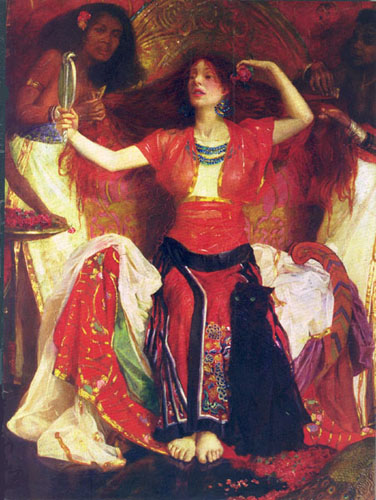
Israel’s most accursed queen carefully fixes a pink rose in her red locks in John Byam Liston Shaw’s “Jezebel” from 1896. Jezebel’s reputation as the most dangerous seductress in the Bible stems from her final appearance: her husband King Ahab is dead; her son has been murdered by Jehu. As Jehu’s chariot races toward the palace to kill Jezebel, she “painted her eyes with kohl and dressed her hair, and she looked out of the window” (2 Kings 9:30). Image: Russell-Cotes Art Gallery and Museum, Bournemouth, UK/Bridgeman Art Library.

“Nevertheless, I have this against you: You tolerate that woman Jezebel, who calls herself a prophet.” (Apocalypse 2:20)

There is a woman in Thyatira who is a rival of St. John the Apostle. She teaches a group known as the Nicolaitans. She–and her followers–reject the authority of the St. John and disobey his teaching. He compares her to the Old Testament queen, Jezebel.

Jezebel appears in the Old Testament (2 Kings). She is the archenemy of the prophet Elijah. She teaches the people to commit adultery and practice sorcery. Tyconius–the first Biblical scholar to write a commentary on the Apocalypse–says that the figure of Jezebel in the Apocalypse “stands for the whole fallen order.” She is everything that stands in opposition to God. Always and everywhere, whatever opposes God is “Jezebel.” Tyconius also says that her followers, her “children,” can be seen as Goliath, who refused to admit the truth: that Israel’s God is the true God and that David was the one chosen by God to protect the people. Jezebel’s followers refuse to admit the truth: that the Apostle John is the authentic teacher chosen by God and serves as the protector of the Christian communities, as David was in the Old Testament.)

The woman in Thyatira that St. John was concerned was an “antinomian.” (That’s a fancy word that means “against the rules.” Antinomian groups always object to having to follow any rules.) She taught her followers that it didn’t matter what they ate or who they slept with or if they denied Christ when arrested by the Romans and were facing execution. (There was an antinomian faction among the Christians in Corinth, as well–people thought it didn’t matter what they ate or who they slept with.)

“Jezebel” in Thyatira told her followers to just blend in with mainstream society. St. John did not want the Christians to assimilate at all with the society in which they lived. “How much assimilation is acceptable?” was a difficult question that different Christian teachers answered in different ways in different places at different times.
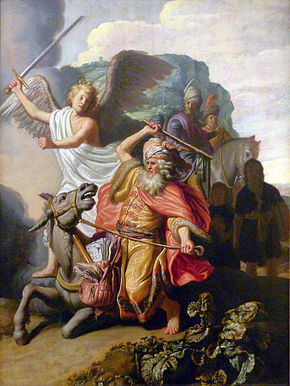
Balaam and the Nicolaitans

“There are some among you who hold to the teaching of Balaam, who taught … the Israelites to sin so that they ate food sacrificed to idols and committed sexual immorality.” (Apocalypse 2:14)

The gentile prophet Balaam appears in the Old Testament book of Numbers, chapters 22-24. He is hired by a pagan king to curse the Israelites before they can conquer the pagan king’s territory. Balaam warns the king that he cannot do anything the gods do not approve of; the king hires him anyway. Balaam attempts to curse the Israelites three times but each time his words become blessings for the Israelites. The king is furious.

The three blessings that Balaam pronounced over the Israelites were understood by the Israelites to refer to the Messiah, especially the third blessing: “A star will rise out of Jacob, a scepter shall rise out of Israel.” Christians often read this story at Christmas and Epiphany.

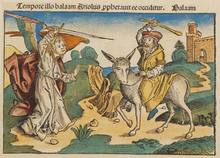
The story of Balaam and his donkey reports that as Balaam was going to a cliff that was near the Israelite camp–he wanted to look out over the Israelites as he tried to curse them–the donkey he was riding suddenly refused to walk any further. Balaam kept hitting the donkey, trying to force it to go forward. At least the donkey turned to him and said, “Don’t you see the angel blocking the road ahead?!” Shocked that the donkey spoke, he looked ahead and DID see the angle blocking the road. But the angel withdrew and allowed the donkey and Balaam to go forward although Balaam never was able to curse the Israelites. (Balaam’s donkey is one of the only two animals who are ever reported to speak in the Bible; the other one is the serpent in Eden.)

But in Numbers 25, we are told that the Israelites abandoned the true God and ate non-kosher food and engaged in a wide variety of sexual misbehavior. Later in Numbers, we read that Balaam and the pagan king taught the Israelites to do these things; they hoped that God would abandon the people if they disobeyed the commandments they had been given. (Since the king couldn’t get Balaam to curse the people, he tried this as a Plan B.) The plan worked: God struck the Israelites with a plague because of their disobedience. But they repented and eventually conquered the pagan king’s territory anyway.

The heretics in Asia Minor–false Christian teachers who instruct their followers to behave in ways St. John thinks are sinful–are compared to Balaam who taught the Israelites to disobey God even after he had blessed them and promised that the Messiah would appear among them.

Blessed is the one who reads

“Blessed is the one who reads aloud the words of this prophecy, and blessed are those who hear it and take to heart what is written in it, because the time is near.” (Apocalypse 1:3)

St. John tells us that whoever reads the words of the Apocalypse is “blessed.” This is the first of seven times a person or a group is pronounced “blessed” in the Apocalypse. These seven beatitudes (Rev. 1:3, 14:13, 16:15, 19:9, 20:6, 22:7, 14) are similar to the Beatitudes announced in the gospels during the Sermon on the Mount.

The term rendered as “blessed” in English is a Greek word that can mean both “happy” and “blessed by God;” it has become common to find English translations of the gospels that render the Beatitudes as “Happy are those who mourn… Happy are those who hunger and thirst after righteousness… Happy are the merciful… Happy are the poor in spirit….” This translation is true on one level: those who live in such a way do find happiness but that idea of “happiness” is probably better thought of as “joy.” “Happy” can sound flip and lighthearted, a fleeting emotion that has no roots or stability. To be “blessed by God” certainly contains the idea of joy but also has an austere edge to it: this way of life is difficult but worthwhile and demands self-sacrifice from those who practice it.

Church Slavonic also uses the word “blessed” as a way to describe those the world deems “foolish, crazy, or insane.” The fools-for-Christ (ex. 1 Cor. 4:10) are called “blessed.” The merciful, the poor in spirit, those who hunger and thirst after righteousness are all crazy. Foolish. Insane. Because living like that will always arouse the animosity of “the world,” the fallen order that opposes God.

In the beginning of the Apocalypse, the “blessed” are those who read aloud the words that St. John has written. Reading aloud is a liturgical act. The text that St. John sends to the churches is to be read aloud during the celebration of the Eucharist just as the letters of the Apostle Paul were read aloud during the celebration of the Eucharist. This introduction of the Apocalypse establishes the liturgical context of the whole book. This “reading aloud”–just as the phrase, “I was in the spirit on the Lord’s Day,” i.e. was attending the celebration of the Eucharist on Sunday–make clear that the Apocalypse is best understood as a pastoral letter and a commentary on the Eucharist itself.

The epistle to the Hebrews is the other “liturgical commentary” in the New Testament; it is interesting to note that the two texts that were most problematic in the establishment of the New Testament canon–the epistle to the Hebrews and the Apocalypse–are the two commentaries on the liturgical practice of the early Church.