Joy of all who sorrow

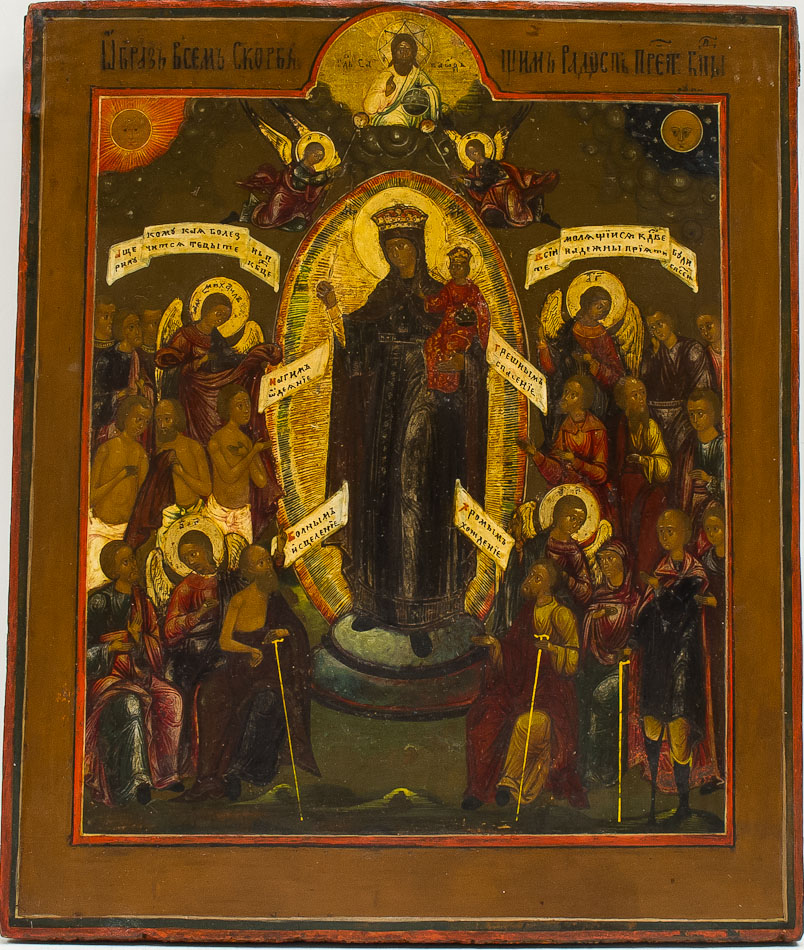
This Russian icon of the Mother of God, the “Joy of all who sorrow,” depicts the Mother of God holding Christ in one arm while holding a scepter aloft with her right hand. She receives the prayers of various groups of the needy, those in distress or sorrow: the elderly, the poor, the hungry, those naked and cold. They pray, certain that she and her Son will provide what they need. They receive these gifts from her and from the Church.

“You have stolen my heart, my sister, my bride.” (Song of Songs 4:9)

“I think that the expression, You have stolen my heart, means the same as You have given us life or You have put heart in us. For the sake of clarity … I will call on the divine Apostle for an explanation of these mysteries. For he tells us, in writing to the Ephesians, about the great economy of salvation through the epiphany of God in the flesh, that the Church–the bride of Christ–reveals the manifold wonders and wisdom of God to the race of angels as well as to the human race…. If the Church is Christ’s body and he is the head of the Church, then it is his face we see on her. Perhaps this is what the friends of the Bridegroom saw when they were given heart: in her they see clearly what is otherwise invisible…. So the friends of the Bridegroom see the Sun of Justice by looking upon the face of the Church as though it were a pure mirror. Thus, the Bridegroom can be seen by his reflection.” (St. Gregory of Nyssa, On the Song of Songs)

Christ, the image (lit. icon) of the invisible God is seen in both his Body–the Church–and in his most holy mother. He continues to act in this world through both his mother–who gave him flesh–and his body, the community sustained by his Body and Blood.

It is too easy to forget that everything human about Christ comes from his mother Mary. His flesh is her flesh, his blood is her blood, his DNA is her DNA. When we see her, we see her Son; when we see him, we see his mother. And when we see him, we see the whole Christ–that includes his body throughout time and space. Wherever Christ is, there his whole body is. When we encounter him–whether in personal prayer at home or in liturgical prayer at church–we encounter ALL of him.

And when we encounter all of him, our hearts are stolen.
“I am wounded with love”

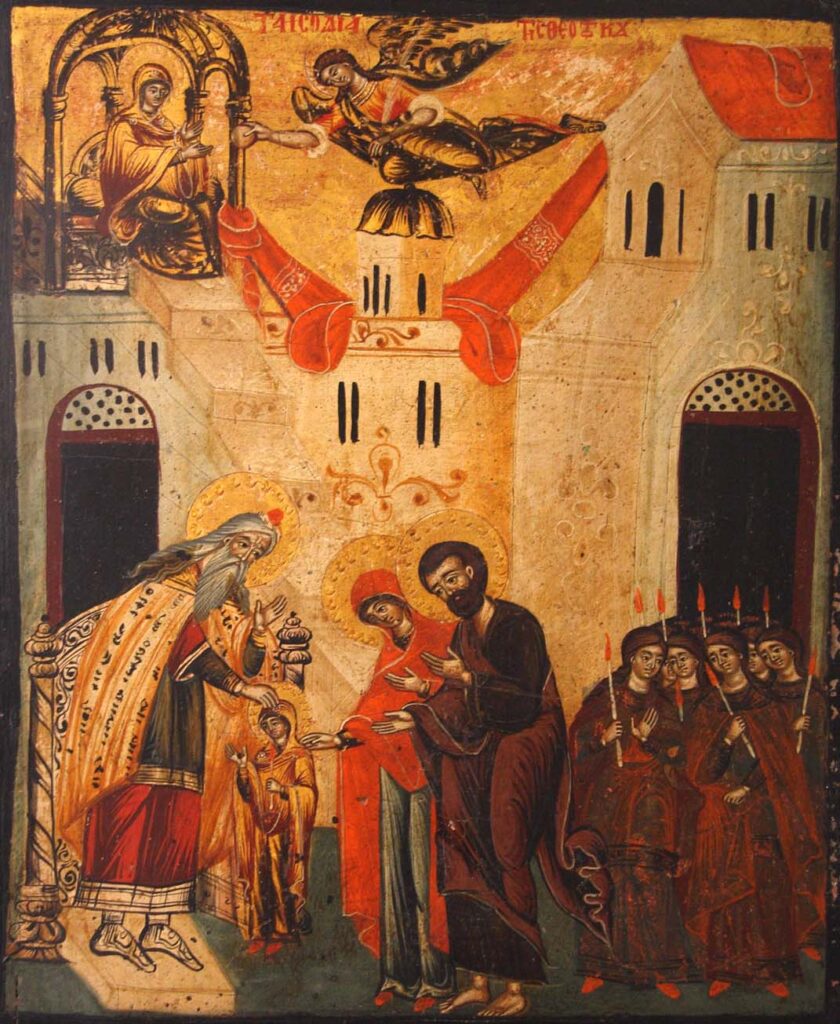
Painter: Greek School 17/18th Century Medium: Tempera on panel Location: National Museum of Fine Arts, Valletta, Malta

The bride says: “I am wounded with love.” (Song of Songs 2:5) She explains that the dart has gone right through her heart and the Bowman is love. We know that God is love (1 John 4:8) and that he sends forth his only begotten Son as his chosen arrow (Isaiah 49:2) to the elect, dipping … its tip in the Spirit of life. The arrow’s tip is faith and unites to the Bowman whomsoever it strikes. (St. Gregory of Nyssa, On the Song of Songs)

The bride in the Song is wounded by the arrow shot by the divine Bowman. The arrow, whose tip is dipped in the Spirit of life rather than the venom or poison common in the ancient world, binds her to the one who shot the arrow: God, the Father. Christ is the arrow and—unlike most arrows we are familiar with—this arrow’s wound does not kill; it causes the bride to live. Forever. Bound by faith and love to the Bowman who shot the arrow into the world, she shares the divine life of the Bowman (the Father), the arrow (Christ), and the Spirit.

The Mother of God, brought to the Temple when she was three years old, is presented by her parents to be brought up serving the Lord in his house. We see in the upper left hand corner of the icon the angel that brought her bread from heaven each day; this is a pictorial way of saying that she trusted in the Lord for her sustenance and support and so was capable of conceiving the one who is the true bread come down from heaven. This bread that she received from the angel united her in love to the giver of the Living Bread just as the arrow united the bride to the Bowman. The bread brought by the angel is spiritual sustenance just as the arrow’s point was said to be anointed with the Spirit.

Annunciation is the only time we read of in the Bible when the first words out an angel’s mouth were not “Don’t be afraid! Fear not!” The daily visitation of the angel to bring bread to the Mother of God is also a way to explain why she was not shocked to see the angel Gabriel although she was shocked at the angel’s announcement.

Mother of God as Fortress and Incense

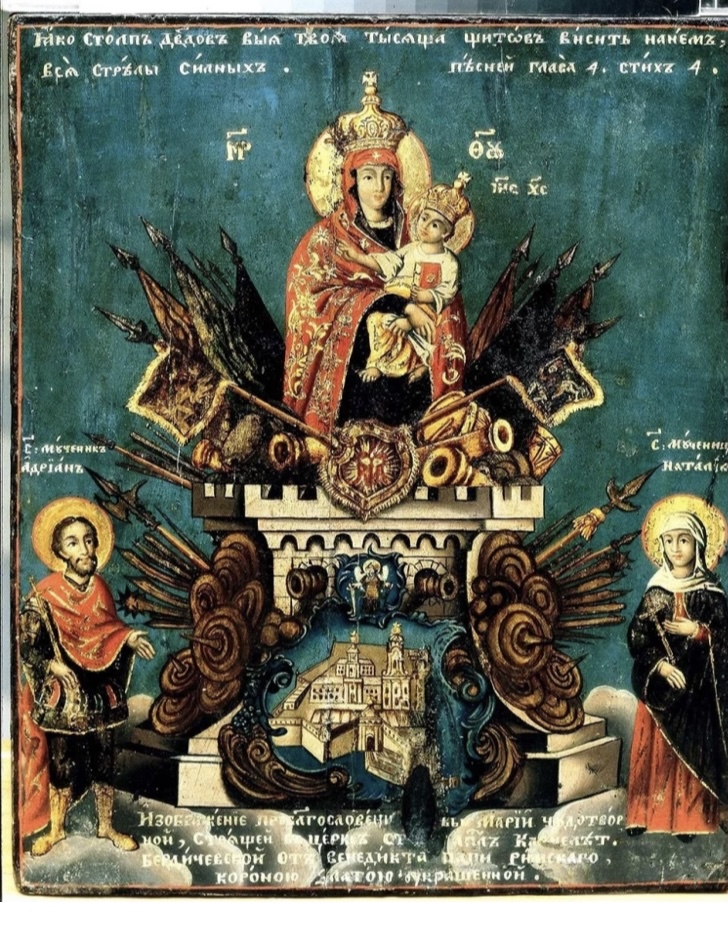
This icon, similar to the icon in Rome of the Mother of God known as “Health/Salvation of the Roman People,” illustrates the Song of Songs 4:4, which reads, “Like the Tower of David is your neck … a thousand shields hang upon it, all arrows of the mighty.”

“Who is she that goes up from the desert, as a pillar of smoke of aromatic spices–of myrrh and frankincense and all the perfumer’s powders?” (Song of Songs 3:6)

The friends of the groom are surprised by what they see, St. Gregory of Nyssa tells us. They know she is beautiful more splendid than gold or silver. But now they see her ascending and are struck with amazement and compare her beauty and virtue to not just a simple, single variety of incense but to a mixture of frankincense and myrrh together.

“One aspect of their praise is derived from the association of these two perfumes: myrrh is used for burying the dead and frankincense is used in divine worship…. a person must first become myrrh before being dedicated to the worship of God. That is, a person must be buried with Christ who assumed death for our sake and must mortify themselves with the myrrh–understood as repentance–which was used in the Lord’s burial.” (St. Gregory of Nyssa, On the Song of Songs)

A person must embrace ongoing self-examination and repentance; only then is it possible to then possible to enter the presence of God as the frankincense which is offered by the angels before the throne of God (Rev. 8:4).

Another of the spices used by perfumers was cinnamon. It was thought to have several remarkable properties, such as stopping putrefaction or infection and would cause a sleeping person to answer questions truthfully. So the application of “spiritual cinnamon” would stop anger, induce honest/truthful self-examination, and calm the anxious.

Myrrh and cinnamon were therefore metaphors for attitudes and practices that would protect a person from sin. In the Song, the bride–who was a type of the Mother of God–was not only myrrh and cinnamon but a protective fortress as well. The bride–in patristic sermons, the Mother of God–is a fortress with shields hanging from the battlements. The walls of the fortress are impervious to spears. The early fathers took this to mean that the prayers of the Mother of God could protect Christians from the darts and arrows of temptation. The fortress could also be seen as the Church herself, steadfast and immoveable on the rock of faith.

There were 18th century icons to illustrate this idea of the Mother of God as fortress; the inscription at the top of these icons was commonly:

“Like the Tower of David is your neck, built on courses of stone; a thousand shields hang upon it, all arrows of the mighty.” (Song of Songs 4:4)

In the example of this kind of icon seen above, the two saints appearing at the sides are additions generally not found in other versions.  They are the Martyr Adrian and the Martyr Natalia.  Some examples have instead the military saints such Alexander Nevsky at left, and George at right, but many have no saints added to the main image.

Much thanks to the Icons and Their Interpretation blog for information about this icon.