“I hold the keys of Death and Hades …”

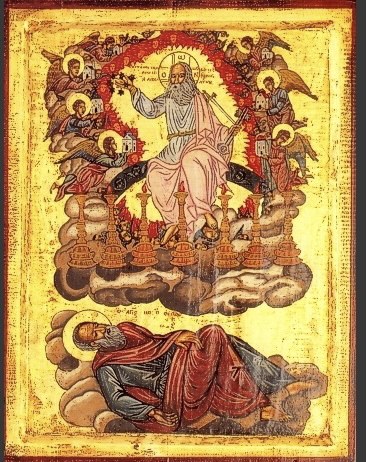
St. John, in the cave on Patmos, experiences his vision of Christ who holds 7 stars and the keys of Death and Hades-Hell as he is enthroned among the 7 candlesticks. The angels of the 7 churches offer the parishes they protect to Christ.

“Do not be afraid. I am the First and the Last. I am the Living One; I was dead, and–behold!–I am alive for ever and ever! Amen. And I hold the keys of Death and Hades.” (Apocalypse 1:17-18)

In the opening chapter of the Apocalypse, the phrase “I am the First and the Last” is a refrain that occurs several times. First and Last, beginning and the end, alpha and omega (the first and last letters of the Greek alphabet). The original phrase seems to have been “the first and the last, the alpha and the omega;” the words “beginning and the end” seem to have been added in the Latin manuscripts to explain what “alpha” and “omega” were to readers who didn’t know Greek. The phrase is also similar to the famous Ego emi… (“I Am….”) phrases in the Gospel According to St. John: I am the true bread… I am the good shepherd… I am the true vine… etc.

“I am the Living One” is also reminiscent of the Old Testament identification of “the Living God” (Deut. 5:26, Joshua 3:10, Isaiah 37:4, 17). The one who appears to St. John in Patmos is the same Divine Person who revealed himself to Moses at the Burning Bush and repeatedly to the kings and prophets of Israel.

Death and Hades-Hell (Sheol, in some versions) can be understood as two names for the same thing (the experience of separation from God). Hebrew poetry is built on this repetition of ideas and experiences. Many of the psalms repeat themselves in this way.

But Death and Hades are also personified in Apoc. 6:8 as one of the famous Four Horsemen: the fourth rider, who rides a pale horse, is named “Death and Hades.” Early Christian preaching–reflected in the Gospel of Nicodemus–identified Death and Hades as two distinct personages who oversee the land of the dead; they argue as Christ approaches and are overthrown as Christ leads their prisoners to freedom through the gates he has smashed during his Descent into Hell. Some early Christian poetry identify “Death” as a person whiles “Hades” is the place where Death reigns.

Gregory Nanzianzus, commonly known as Gregory the Theologian, thought that the two names Death and Hades referred to the physical and spiritual aspects of death–the result of separation from God. A person can die spiritually many years before they experience death physically–Adam and Eve are examples of people who die spiritually long before their bodies die. Likewise, in baptism people can experience spiritual resurrection before they experience physical resurrection.

Many Faces of Antichrist

The figure of the Antichrist appears in several places in the New Testament before he appears in the Apocalypse (Book of Revelation). In the first epistle of St. John, we read Children, it is the last hour; and as you have heard that antichrist is coming, so now many antichrists have come; therefore we know that it is the last hour.” (1 John 2:18) The antichrists are those who oppose the apostle’s teaching. They are the heretics (lit. “the choosers”) who choose a different teaching and place themselves in opposition to the Church.

In the 2nd epistle to the Thessalonians, the antichrist is the “man of lawlessness” (2 Thess. 2:3-10) who opposes peace, order, and harmony–both civil and ecclesiastical. The seven-headed, ten-crowned dragon of the Apocalypse is typically identified with this “man of lawlessness,” the Antichrist. The dragon deceives and destroys, confusing and laying waste to the Church and the known world.

St. Paul makes the cryptic remark: “… the mystery of lawlessness is already at work; only he who now restrains it will do so until he is out of the way.” (2 Thess. 2:7) Who restrains the Antichrist? St. Paul seems to presume that his readers know but later readers have had to surmise. Even St. Augustine threw up his hands and exclaimed, “I admit that the meaning of this completely escapes me.” (City of God, Book 20, chapter 19)

St. John Chrysostom considered the Antichrist to be the personification of chaos and destruction. It was the power of Rome (even in her pagan days) that kept complete anarchy and destruction at bay. Chrysostom thought of himself as a “Roman” living in the “New Rome” of the ongoing Roman Empire that continued to constrain the Antichrist. Many early fathers and preachers agreed with him and would probably say that “that which restrains the Antichrist” continued to do so until 1917-1918, when Austro-Hungary and imperial Russia–the last two governments to see themselves as the continuation of the Roman Empire–finally collapsed or were overthrown.

The idea that imperial rule kept the world safe from evil is ancient. In the Old Testament, it seems that the ancient Israelites thought the kings of Israel were the “first line of defense” against the evil angels. (For more about this, see Margaret Barker‘s book, The Last Prophet.)

Proskynesis and Apocalypse

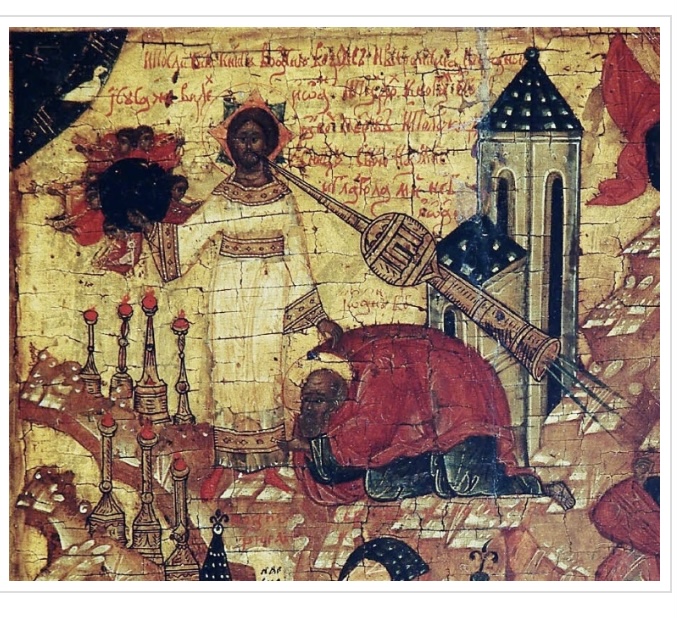
We see Jesus standing with an 8-pointed star behind his head, emblematic of “eternity,” in this iconographic depiction of the first chapter of the Apocalypse. Christ appears in gleaming white priestly vestments, shining more brightly than the sun much as he is described as appearing at the Transfiguration on Mt. Tabor. Transfiguration, in patristic sermons, is seen as an anticipation of the End and a foretaste of the Apocalypse. Transfiguration reveals the goal and intended destination of humanity in communion with God. St. John, who saw Christ transfigured on Tabor, recognizes Christ transfigured again on Patmos.

The Apostle John makes a proskynesis (“prostration “) before Christ. Christ’s voice, which is described as sounding like a trumpet blast, is depicted by the elaborate trumpet coming from his mouth. We see the seven lamps depicted as candlesticks at Christ’s side. It became customary in the Christian West to always have seven candlesticks on the altar when the bishop celebrates the Eucharist.

The proskynesis, or “prostration,” is a gesture that appears many times throughout the Old and New Testaments. The prophet Daniel makes a proskynesis (Daniel 8:17; 10:7-9) while Joshua made a proskynesis to an angel (Joshua 5:14) and when King Solomon dedicated the Temple, the priests all make a proskynesis when the glory of God fills the newly-dedicated Temple.

Proskynesis is frequently translated “worship” in English Bibles but—according to the 7th ecumenical council—technically speaking proskynesis is precisely not worship. It is an act of honor, of reverence, of veneration. But not worship. Proskynesis is an act of veneration appropriate to make towards holy things—the altar, relics, icons—but it is not worship which is appropriate to offer only to God. Worship may include an act of proskynesis but proskynesis is not limited to acts of worship.