Libra (September 23 — October 22)

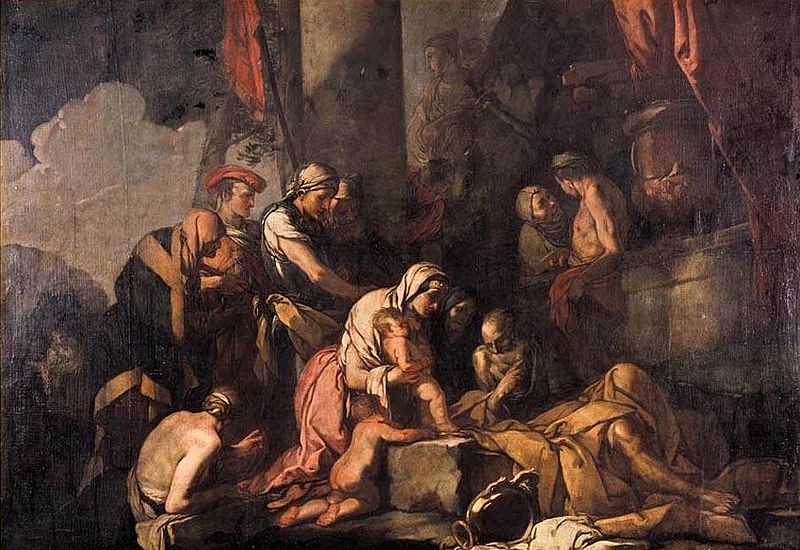
The infant Narcissus is presented to the aged prophet Tiresias. Tiresias the prophet was placed in the sky as the constellation Libra by Hera.

The infant Narcissus is presented to the aged prophet Tiresias. Tiresias the prophet was placed in the sky as the constellation Libra by Hera.

Libra, the scales of justice, is the astrological sign that governs those born September 23 to October 22 each year.

Libras are first and foremost focused on others and how they relate to them. For a Libra, everything is better if it’s done as a pair. Libras are good when paired up, too, since they epitomize balance, harmony and a sense of fair play. While they are true team players at work, their favorite partnership is at home: marriage. Libras feel most complete when they are coupled up with their lover, forever.

It’s the Scales that symbolize Libra, and just like that balancing mechanism wants to stay even, Libras want to be on an even keel. Think of the Scales of Justice and how they work at striking the right balance. Likewise, Libras are objective, just and want to do what’s best for everyone. It’s possible, though, that this penchant for fairness is for a different reason: Libras abhor conflict. The scales study every possible angle in the hopes of achieving peace and harmony, so much so that others may see them as fickle and indecisive. If that’s what it takes to avoid a confrontation, that’s fine with the Scales. The Libra-born are keen strategists, organizing groups with poise and getting the job done. Further, you can expect the Scales to be companionable, sociable folks.

Libra is ruled by Venus. In ancient Roman mythology, Venus was a smooth seductress who was at her best amid pleasurable excess and Libras are certainly carrying the torch for her today. The Scales are cultured, refined and love beautiful things. Most of all, they love beautiful people, which is why Libras do so well at cocktail parties or at the theater, opera or ballet. Those born under this sign always have the right thing to say.

You can expect the Scales to make a fair argument, too, since they live by the principles of diplomacy and compromise. When this approach doesn’t work, however, Libras are not above using their persuasive charms to get their way. Libras are polite and don’t like to fight, far preferring to talk things through.

The great strength of the Libra-born is their quest for fairness, peace and harmony. That the Scales are the great diplomats of the zodiac further helps their case.
Michaelmas

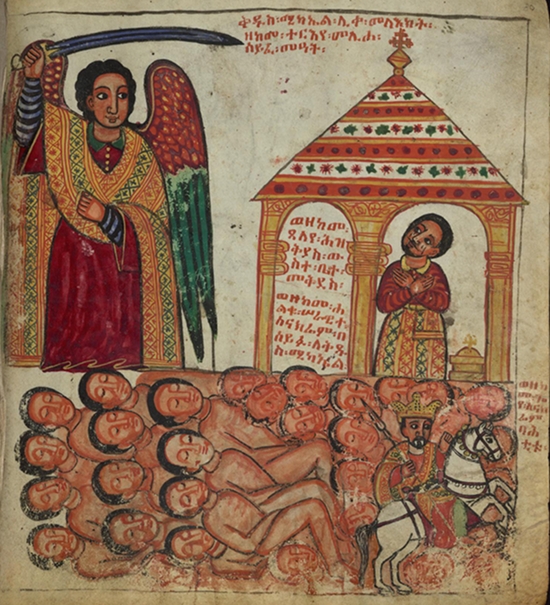
This 17rh century Ethiopian manuscript illumination shows the Archangel Michael helping Hezekiah, king of Judah, defeat Sennacherib of Assyria.

This 17rh century Ethiopian manuscript illumination shows the Archangel Michael helping Hezekiah, king of Judah, defeat Sennacherib of Assyria.

Michaelmas, the feast of Saint Michael the Archangel (also called the Feast of Saint Michael and All Angels) is a day in the Western Christian calendar which occurs on 29 September. Because it falls near the equinox, it is associated in the northern hemisphere with the beginning of autumn and the shortening of days. In medieval England, Michaelmas marked the ending and beginning of the husbandman’s year.

The Archangel Michael is the greatest of all the Archangels and is honoured for defeating Lucifer in the war in heaven. He is one of the principal angelic warriors, seen as a protector against the dark of night, and the administrator of cosmic intelligence. Michaelmas has also delineated time and seasons for secular purposes as well; in the United Kingdom and Ireland, “Michaelmas term” is still the first quarter of the academic year.

On manors, it was the day when a reeve was elected from the peasants. Traditional meal for the day includes goose (a “stubble-goose”, i.e. one prepared around harvest time) and a special cake called a St Michael’s bannock.

According to an old legend, blackberries should not be picked after this date. This is because, so folklore goes, Satan was banished from Heaven on this day, fell into a blackberry bush and cursed the brambles as he fell into them. In Yorkshire, it is said that the devil had spat on them. According to Morrell (1977), this old legend is well known in all parts of the United Kingdom, even as far north as the Orkney Islands. In Cornwall, a similar legend prevails, however, the saying goes that the devil urinated on them.

Mabon, the Autumnal Equinox

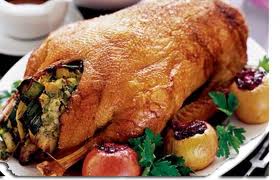
Goose and apples are traditional foods for the celebrations of the autumnal equinox, Mabon, and Michaelmas.

Goose and apples are traditional foods for the celebrations of the autumnal equinox, Mabon, and Michaelmas.

In many cultures, the September equinox is a sign of fall (autumn) in the northern hemisphere. In Greek mythology fall is associated with when the goddess Persephone returns to the underworld to be with her husband Hades. It was supposedly a good time to enact rituals for protection and security as well as reflect on successes or failures from the previous months.

In the Celtic pracitce, the autumnal equinox, is also known as ‘Mabon,’ the Welsh God who symbolized the male fertilizing principle in the Welsh myths. Some mythologists equate him as the male counterpart for Persephone.

Mabon ap Modron is a figure of Welsh mythology, the son of Modron. Both he and his mother were likely deities in origin, descending from a divine mother–son pair. His name is related to the Romano-British god Maponos, whose name means “divine son”; Modron, in turn, is likely related to the Gaulish goddess Dea Matrona.

Mabon was a common name in medieval Wales, and it is difficult to determine whether the various references to Mabons in poetry and the Triads are to the same character. The most important appearance of Mabon ap Modron is in the prose tale Culhwch and Olwen, associated with the Mabinogion and perhaps authored around 1100. King Arthur’s men must recruit Mabon to fulfill the demands of Ysbaddaden the giant before he will allow his daughter Olwen marry the protagonist Culhwch. Mabon is the only one who can hunt with the dog Drudwyn, in turn the only dog who can track the great boar Twrch Trwyth.

However, Mabon has been missing since he was three nights old, when unknown intruders stole him from between his mother and the wall. Arthur determines that he and his men will find and rescue Mabon. Mabon’s whereabouts are unknown even to Britain’s oldest and wisest animals, but finally Arthur’s followers are led to the Salmon of Llyn Llyw, the oldest animal of all. The enormous salmon carries Arthur’s men Cei and Bedwyr downstream to Mabon’s prison in Gloucester; they hear him through the walls, singing a lamentation for his fate. The rest of Arthur’s men launch an assault on the front of the prison, while Cei and Bedwyr sneak in the back and rescue Mabon. Mabon subsequently participates in the hunt for the Twrch Trwyth.