Santa Claus is Coming to Town — on December 6! Christmas is Coming!

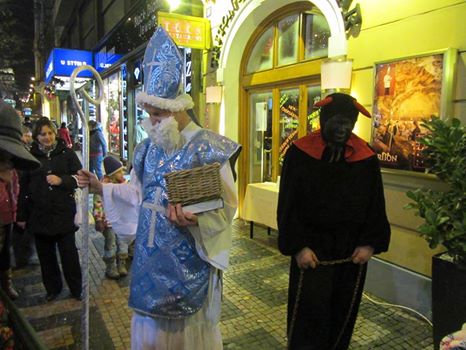
St. Nicholas and a devil in Wenceslas Square (Dec 6, 2014).
St. Nicholas and a devil in Wenceslas Square (Dec 6, 2014).

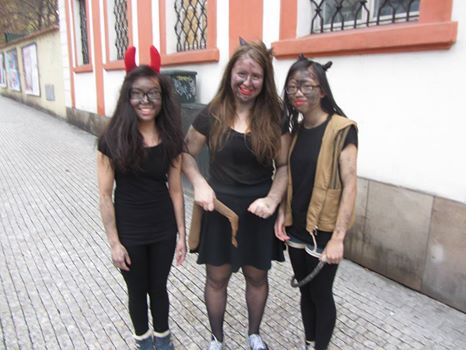
Devils on Stepanaska Street in Prague (Dec 2014).
Devils on Stepanaska Street in Prague (Dec 2014).

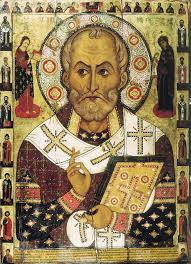
St. Nicholas, the 4th century bishop of Myra (in modern-day Turkey)often brings gifts to Dutch-speaking children on December 6, his feast.

St. Nicholas, the 4th century bishop of Myra (in modern-day Turkey)often brings gifts to Dutch-speaking children on December 6, his feast.

St. Nicholas, whom most Americans now recognize as “Santa Claus,” was a 4th century bishop in Turkey who was imprisoned for objecting to the imposition of Arian beliefs on local churches by local civil authorities. He was famous for his acts of charity, especially toward youth. He is said to have raised 3 young men from the dead after they had been slaughtered by an innkeeper who was already salting their corpses to use as meat to feed the inn’s guests. St. Nicholas is also said to have thrown 3 bags of coins into the garden of his poverty-stricken neighbor, thus providing dowries for the man’s 3 daughters and saving them from lives of spinsterhood or prostitution.

According to another legend, during a great famine that Myra experienced in 311–312, a ship was in the port at anchor, which was loaded with wheat for the Emperor in Constantinople. Nicholas invited the sailors to unload a part of the wheat to help in time of need. The sailors at first disliked the request, because the wheat had to be weighed accurately and delivered to the Emperor. Only when Nicholas promised them that they would not suffer any loss for their consideration, the sailors agreed. When they arrived later in the capital, they made a surprising find: the weight of the load had not changed, although the wheat removed in Myra was enough for two full years and could even be used for sowing.

He is now said to bring gifts to children across the world — sometimes on his feast (December 6), as in the Netherlands, sometimes on Christmas Day (as in the United States). In many European countries, he brings gifts to the “good children” and coal to the “bad children.” But he is also said to often carry away the bad children in his large sack (now empty of gifts) or is even accompanied by a devil or servant who binds and takes away the children undeserving of a gift.

(Photos of 2014 celebration of St. Nicholas’ Day in Prague taken from the Prague Post, the English-language newspaper of Prague and the Czech Republic.)

“Trick or Treat!”

This trio of jack o' lanterns adorn my neighbors' door. The term jack-o'-lantern is in origin a term for the visual phenomenon ignis fatuus (lit., "foolish fire") known as a will-o'-the-wisp in English folklore. Used especially in East Anglia, its earliest known use dates to the 1660s. The term "will-o'-the-wisp" uses "wisp" (a bundle of sticks or paper sometimes used as a torch) and the proper name "Will": thus, "Will-of-the-torch." The term jack-o'-lantern is of the same construction: "Jack of [the] lantern."

This trio of jack o’ lanterns adorn my neighbors’ door. The term jack-o’-lantern is in origin a term for the visual phenomenon ignis fatuus (lit., “foolish fire”) known as a will-o’-the-wisp in English folklore. Used especially in East Anglia, its earliest known use dates to the 1660s. The term “will-o’-the-wisp” uses “wisp” (a bundle of sticks or paper sometimes used as a torch) and the proper name “Will”: thus, “Will-of-the-torch.” The term jack-o’-lantern is of the same construction: “Jack of [the] lantern.”

Pumpkin season has arrived! Pumpkin pies are appearing in grocery stores and pumpkin coffee has been at Dunkin’ Donuts for weeks, as have pumpkin doughnuts and muffins — MMM! And pumpkins have been appearing on doorsteps in anticipation of Hallowe’en, carved into both simple and elaborate patterns and lit with flickering candles inserted into the hollowed shell of the pumpkin.

How did “Jack’s” name get associated with the carved pumpkin lanterns? The story of the Jack-O’-lantern comes in many variants and is similar to the story of Will-o’-the-wisp, with variations in the folklore of Norway, Sweden, England, Ireland, Wales, Germany, Italy and Spain. An old Irish folk tale from the mid-19th Century tells of Stingy Jack, a lazy yet shrewd blacksmith who uses a cross to trap Satan. One story says that Jack tricked Satan into climbing an apple tree, and once he was up there Jack quickly placed crosses around the trunk or carved a cross into the bark, so that Satan couldn’t get down. Another of the story says that Jack was getting chased by some villagers from whom he had stolen, when he met Satan, who claimed it was time for him to die. However, the thief stalled his death by tempting Satan with a chance to bedevil the church-going villagers chasing him. Jack told Satan to turn into a coin with which he would pay for the stolen goods (Satan could take on any shape he wanted); later, when the coin (Satan) disappeared, the Christian villagers would fight over who had stolen it. The Devil agreed to this plan. He turned himself into a silver coin and jumped into Jack’s wallet, only to find himself next to a cross Jack had also picked up in the village. Jack had closed the wallet tight, and the cross stripped the Devil of his powers; and so he was trapped.

In both folktales, Jack only lets Satan go when he agrees never to take his soul. After a while the thief died, as all living things do. Of course, his life had been too sinful for Jack to go to heaven; however, Satan had promised not to take his soul, and so he was barred from hell as well. Jack now had nowhere to go. He asked how he would see where to go, as he had no light, and Satan mockingly tossed him an ember from the flames of Hades, that would never burn out. Jack carved out one of his turnips (which were his favorite food), put the ember inside it, and began endlessly wandering the Earth for a resting place. He became known as “Jack of the Lantern”, or Jack-o’-lantern.

Jack-o-lanterns were also a way of protecting your home against the Undead. People used them specifically to ward away vampires. It was said that the Jack-o-lantern’s light was a way of identifying vampires and, once their identity was known, they would give up their hunt for you

Samhain

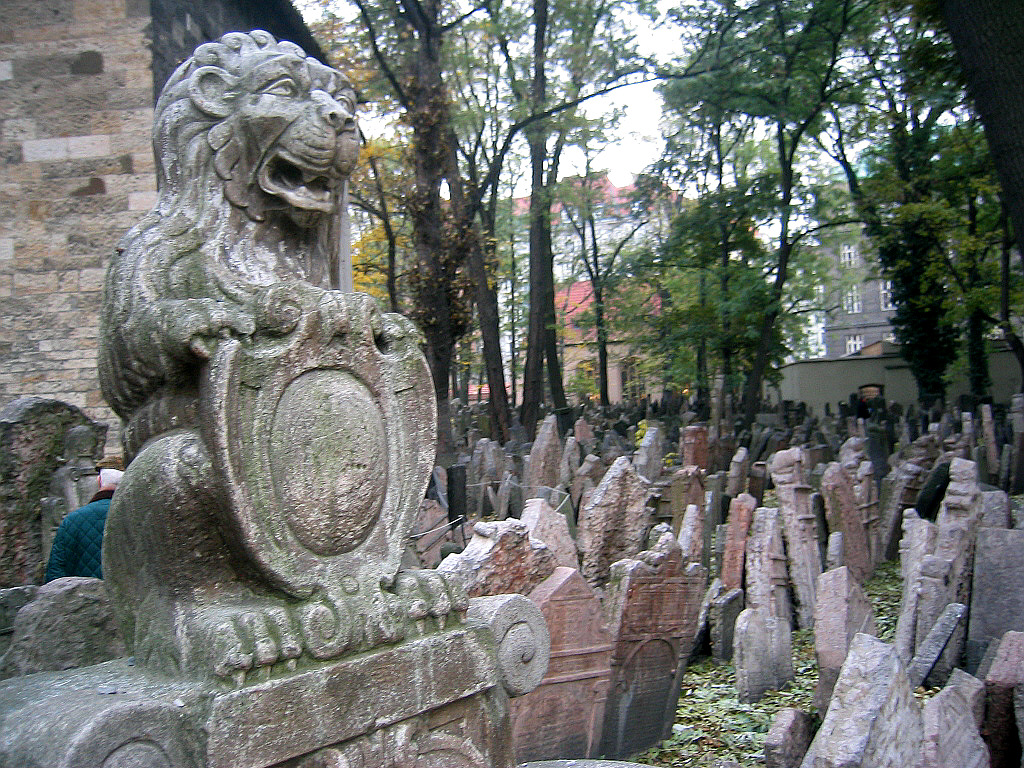
The Jewish Cemetery in Prague. The doorways between the living and the dead were thought to open on the Celtic feast of Samhain.

The Jewish Cemetery in Prague. The doorways between the living and the dead were thought to open on the Celtic feast of Samhain.

“Winter is coming!” Samhain, the Celtic festival more commonly known as “Hallowe’en,” was considered the first day of winter in the Middle Ages and Renaissance. Marking the day halfway between the autumnal equinox and the Winter Solstice, Samhain marked the beginning of the sun’s descent into darkness and the world’s embrace by the growing cold. Both these trends would be reversed at the Winter Solstice, marking the “midpoint” of the Winter season.

Like Beltane, on April 30-May 1, Samhain was seen as a time when the ‘door’ to the Otherworld opened enough for the souls of the dead, and other beings such as fairies, to come into our world. The souls of the dead were said to revisit their homes on Samhain. Lewis Spence described it as a “feast of the dead” and “festival of the fairies”. However, harmful spirits and fairies were also thought to be active at Samhain. People took steps to allay or ward-off these harmful spirits/fairies, which is thought to have influenced today’s Halloween customs. The practice of lighting bonfires during Hallowmas may have been a Christianized one, as the Celts lit bonfires during Samhain as well.

I am currently working on a novel set in Ireland, Earth to Earth, Ashes to Ashes, that picks up on loose ends from Part 2 of the Come Hell or High Water trilogy. Earth to Earth involves the Celtic goddesses of battle and death, mortals from this world abducted to the Otherworld, and the Celtic holidays of Samhain and Imbolc or Ostara.