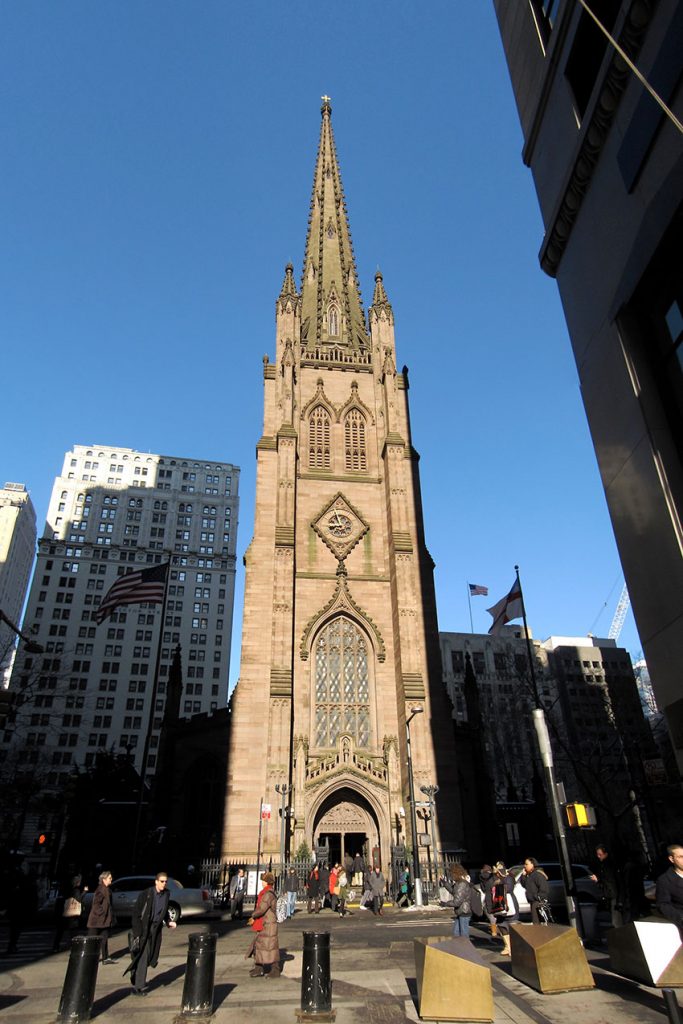
Wall Street leads directly to the front door of Trinity Church in New York City. Trinity Church is an Episcopal church that was founded by royal charter in 1697. The first church was on Wall Street facing the Hudson River.
When Trinity Church was destroyed by the Great New York City Fire of 1776, services moved over to St. Paul’s Chapel until the new church was finished in 1790.
The rebuilt Trinity Church was destroyed by the snowstorms of 1838 – 1839.
The current Trinity Church was completed in 1846. It was the tallest building in the United States until 1869 when a church in Chicago took the title. Trinity Church remained the tallest structure in New York City until it was surpassed by the Brooklyn Bridge towers in 1883.
Two dozen merchants and brokers established the New York Stock Exchange on May 17, 1792. In good weather they operated under a buttonwood tree on Wall Street. In bad weather they moved inside to a coffeehouse to conduct business.
Previously securities exchange had been intermediated by the auctioneers who also conducted more mundane auctions of commodities such as wheat and tobacco. On May 17, 1792 twenty four brokers signed the Buttonwood Agreement; the agreement had two provisions:
1) the brokers were to deal only with each other, thereby eliminating the auctioneers, and
2) the commissions were to be 0.25%.
The earliest securities traded were mostly governmental securities such as War Bonds from the Revolutionary War and First Bank of the United States stock. In 1817 the stockbrokers of New York operating under the Buttonwood Agreement instituted new reforms and reorganized. After re-forming as the New York Stock and Exchange Board the broker organization began renting out space exclusively for securities trading, which previously had been taking place at the Tontine Coffee House. Several locations were used between 1817 and 1865, when the present location was adopted.
The location of the stock market, a building on Wall Street, is shorthand for referring to the entire financial system. There are varying accounts about how the Dutch-named “de Waalstraat” got its name. A generally accepted version is that the name of the street was derived from a wall (actually a wooden palisade) on the northern boundary of the New Amsterdam settlement, built to protect against Native Americans, pirates, and the British. When the British did take control of New Amsterdam and it became New York, the New York City Common Council made Wall Street the city’s first official slave market for the sale and rental of enslaved Africans and Indians in 1711. The slave market operated from 1711 to 1762 at the corner of Wall and Pearl Streets. It was a wooden structure with a roof and open sides, although walls may have been added over the years and could hold approximately 50 men. The city directly benefited from the sale of slaves by implementing taxes on every person who was bought and sold there.
Much of Wall Street itself is owned by Trinity Church; the land along the northern wall of the fort was a gift from Queen Anne to the parish.