
St. Brigid’s Day 2016

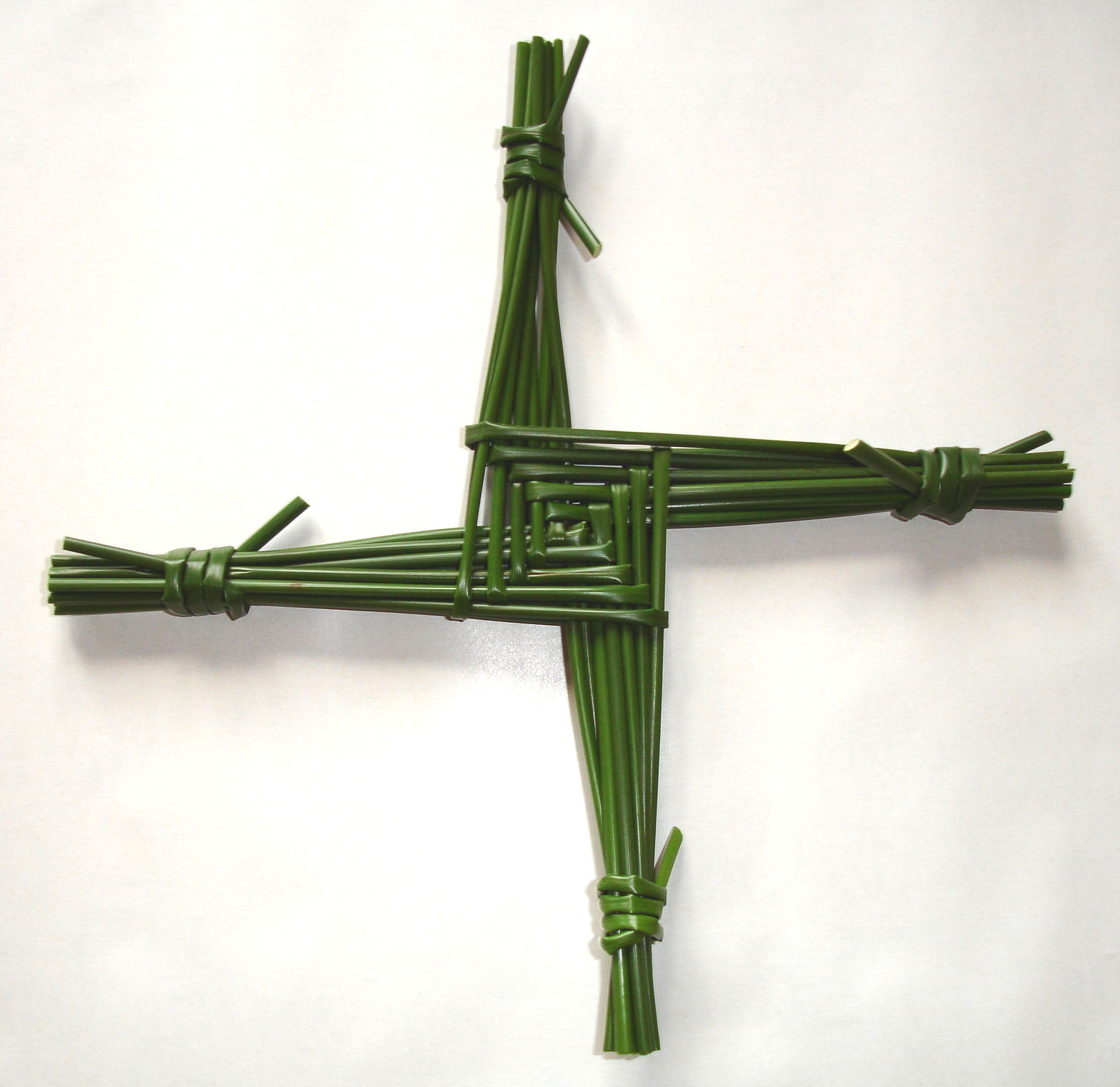
Legend says that while St. Brigit sat alongside a dying man one night, she picked up a handful of rushes from the floor and wove a cross, explaining the Gospel to the dying man as she made the cross. Nowadays many make similar crosses and hang them up to protect their house or barn until the next February.

Legend says that while St. Brigit sat alongside a dying man one night, she picked up a handful of rushes from the floor and wove a cross, explaining the Gospel to the dying man as she made the cross. Nowadays many make similar crosses and hang them up to protect their house or barn until the next February.

Saint Brigit of Kildare or Brigid of Ireland (c. 451–525) is one of Ireland’s patron saints, along with Patrick and Columba. Irish hagiography makes her an early Irish Christian nun, abbess, and founder of several monasteries of nuns, including that of Kildare in Ireland, which was famous and was revered. Her feast day is 1 February, which was formerly celebrated as a pagan festival (Imbolc) marking the beginning of spring and the lambing season.

Once a leprous woman asked her for milk, but there was none available so St. Brigid gave her cold water instead. The water turned into milk and when she had drunk it, the woman was healed.

Like her mentor St. Patrick, Brigid was fond of ale and is reputed to have been the best brewer in the land. She supplied beer out of one barrel to eighteen different churches. This single barrelful not only supplied these eighteen different churches, but each church had enough ale to last from Maundy Thursday until Trinity Sunday.

One of the most prettiest legends concerning Saint Brigid tells us that another version of her name was “Bride” and as “St. Bride” she was the patroness of the Knights of Chivalry. They began the custom of calling the girls they each married their own “brides” or “Brigits;” and that from the Knights of Chivalry the word bride came into general usage in the English language.

In very traditional homes, two devout practices are still observed on the Eve of St. Brigid’s Feast Day (February 1st). A strip of cloth called “brat Bhride” (Brigid’s mantle) is hung outside the door. A loaf of oat bread baked in the shape of a cross and a sheaf of straw are left on the windowsill. For on that night, Brigid travels through the land with her red-eared cow bestowing blessings on those who keep the old ways.
The 3 Hierarchs

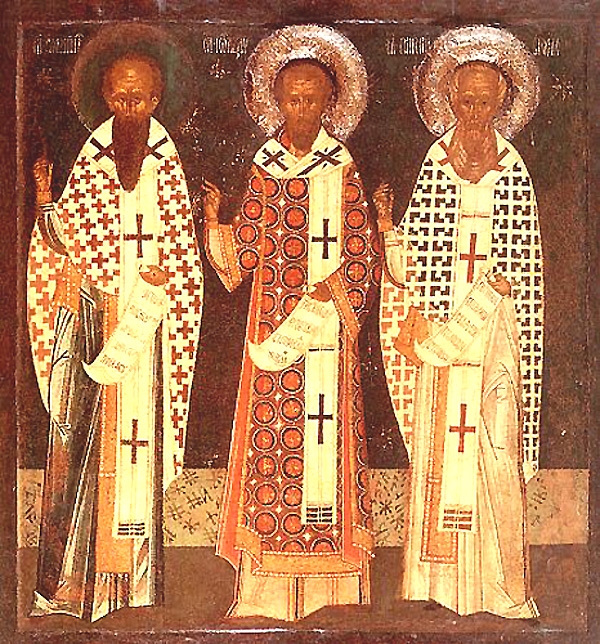
An icon depicting the three hierarchs: Basil the Great, John Chrysostom, and Gregory the Theologian.

An icon depicting the three hierarchs: Basil the Great, John Chrysostom, and Gregory the Theologian.

In “The Song of Roland,” the hero Roland wields a sword said to contain within its golden hilt one tooth of Saint Peter, blood of Saint Basil (one of the 3 hierarchs), a hair of Saint Denis, and a piece of the raiment of the Blessed Virgin Mary; the sword is therefore reported to be the sharpest sword in all existence.In the poem, Roland uses the sword to hold off a hundred-thousand-strong Muslim army — the perennial enemies of Byzantium as well — long enough for Charlemagne’s army to retreat into France.

Roland attempted to destroy the sword to prevent it from being captured by the attacking Saracens and created La Brèche de Roland in the Pyrenees in the process. But the sword proved indestructible, so he hid it beneath his body along with the oliphant, the horn used to alert Charlemagne.

Local folklore claims that the sword still exists, preserved in Rocamadour, France, embedded in a cliff wall. In the twelfth century, the monks of Rocamadour claimed that Roland threw the sword at the cliff rather than hid it beneath himself.

The Three Hierarchs of Eastern Christianity refers to Basil the Great (also known as Basil of Caesarea), Gregory the Theologian (also known as Gregory of Nazianzus) and John Chrysostom. They were highly influential bishops of the early church who played pivotal roles in shaping Christian theology. In Eastern Christianity they are also known as the Three Great Hierarchs and Ecumenical Teachers, while in Roman Catholicism the three are honored as Doctors of the Church. The three are venerated as saints in Eastern Orthodoxy, Catholicism, Anglicanism and other Christian churches.

Weight Watchers and Fairy Tales

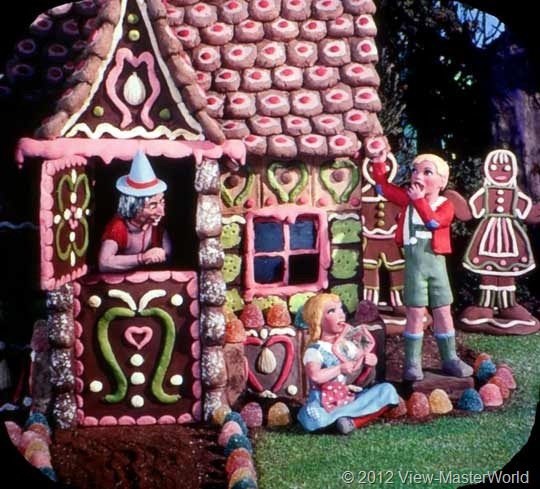
The Viewmaster depiction of Hansel and Gretel, the witch, and her gingerbread house were among my favorite childhood illustrations of one of my favorite fairy tales.

The Viewmaster depiction of Hansel and Gretel, the witch, and her gingerbread house were among my favorite childhood illustrations of one of my favorite fairy tales.

I started the Weight Watchers program in late November because I refuse to buy new clothes — everything I own was getting too snug! I had always refused to dignify weight loss efforts in the past by going to Weight Watchers but this time I finally capitulated. It couldn’t hurt to give it a shot, right? So far, I have lost about 25% of my excess weight on the Weight Watchers program and aim to keep losing more until I reach my “goal” weight — and all my clothes fit properly again.

The “fat and jolly old elf” of A Visit From St. Nicholas is a kindly old gentleman who is well-disposed toward others. But he is the exception.Overweight people appear in fairy tales but the image of “overweight,” often tied to “jolly,” is not always so innocent. Overweight people, in the world that give rise to fairy tales, were often wealthy and their weight indicated just how wealthy — and lazy? they had too many servants as well as too much food — they were.

But sometimes being overweight as a code word for “greedy.” The giants in fairy tales (such Jack and the Beanstalk or Jack the Giant-killer, etc.) were also greedy and lazy as well as large and heavy.

Hansel and Gretel wanted to eat the witch’s house and were rewarded for their efforts by her attempts to eat them! Hansel hid his obesity from the witch by using an old, dry chicken(?) bone he found at the bottom of his cage rather than his own finger when she wanted to check his growing weight.

Hansel and Gretel were not the only ones to discover the dangers of eating the food of a witch. Folk tales from all over the world warn that eating the food of a witch, a demon, a djinn, a troll, an ogre, or the faeries can be a dangerous proposition. You might owe your youngest child in return, or be bound to your host for the rest of your life.

Hopefully, the Weight Watchers program will save me from all these possible fates. Fingers crossed — but all bets are off if I find a gingerbread house in Central Park!