D-Day … and Lidice

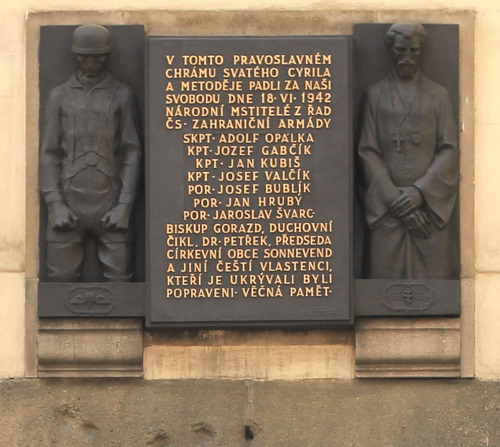
Memorial plaque for Lidice at the Orthodox cathedral of SS. Cyril and Methodius in Prague. A Gestapo report suggested Lidice was the hiding place of the assassins, since several Czech army officers exiled in England were known to have come from there.

The commemoration of the 75th anniversary of D-Day was all over the news this past week. This 75th anniversary has brought the horrors of the Nazi regime and the struggle of World War II to the consciousness of many people who are otherwise forgetful of what happened. Another anniversary of another event, also important in the struggle against the Nazi evil, is still often forgotten but deserves to be remembered.

June 10, 1942 – In one of the most infamous single acts of World War II in Europe, all 172 men and boys over age 16 in the Czech village of Lidice were shot by Nazis in reprisal for the assassination of SS leader Reinhard Heydrich. The women were deported to Ravensbrück concentration camp where most died. Ninety young children were sent to the concentration camp at Gneisenau, with some later taken to Nazi orphanages if they were German looking. The village was then completely leveled until not a trace remained.

The Nazis destroyed the town by first setting the houses on fire and then razing them to the ground with plastic explosives. They did not stop at that. Instead, they proceeded to destroy the church and even the last resting place – the cemetery. In 1943 all that remained was an empty space. Until the end of the war, the site was marked by notices forbidding entry. The news of the destruction of Lidice spread rapidly around the world.

But the Nazi intention to wipe the little Czech village off the face of the Earth did not succeed. Several towns throughout the world took the name of Lidice in memory of the Czech village that met such a horrific fate. Also, many women born at that time were named Lidice. The once tranquil village Lidice continued to live in the minds of people all over the world and after the war the Czechoslovak government decided to build Lidice again.

You can read the story of the assassination and the reprisals here. A recent movie is an excellent depiction of the historic events.
St. Boniface of Mainz

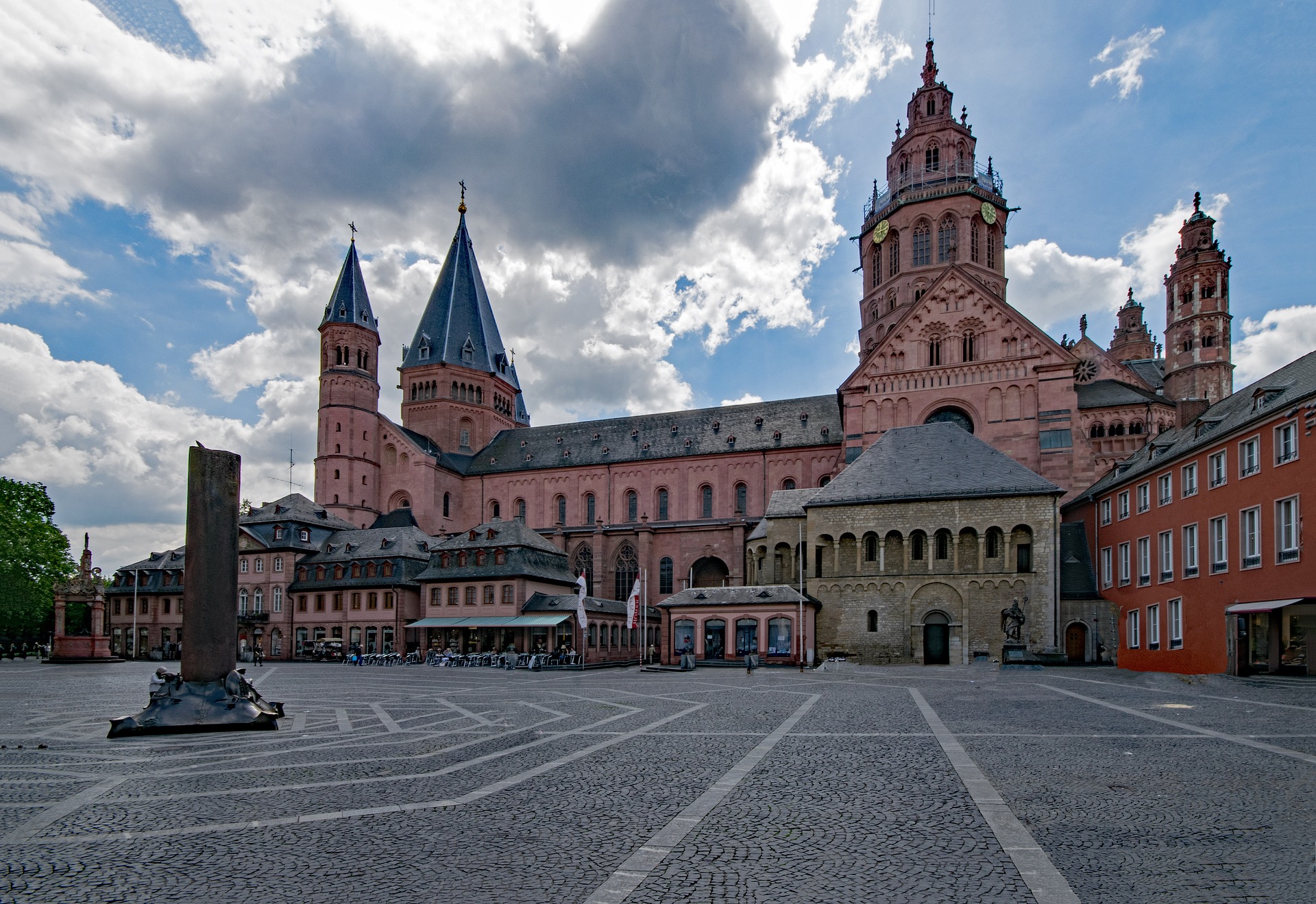
The cathedral of Mainz became the ecclesiastical center north of the Alps, through the work of St. Boniface. It acquired the title of “Holy See” during the 10th century. The columnin the plaza is from the Roman period of the area; its base is adorned with small monuments to four different periods of the city’s history.

St. Boniface of Mainz was born in England and was a leading figure in the Anglo-Saxon mission to the Germanic parts of the Frankish Empire during the 8th century. He organized significant foundations of the Church in Germany and was made archbishop of Mainz by Pope Gregory III. He was martyred on June 5, AD 754, along with 52 others, and his remains were returned to Fulda, where they rest in a sarcophagus which became a site of pilgrimage. He became the patron saint of Germania, known as the “Apostle of the Germans.”

St. Boniface is said to have been killed by pagans as he was chopping down one of the sacred trees they worshipped, thinking it was sacred to Odin or Thor. Boniface was known for cutting down the sacred trees and groves to demonstrate how powerless the old pagan gods were to defend their trees. He is sometimes given credit for inventing the Christmas tree as a further demonstration that the old gods were vanquished: not only could they not prevent the Christians from chopping down the sacred trees but the Christians were able to bring the trees indoors–something no devout pagan would ever do!–and use the trees to celebrate the birth of Christ.

The cathedral in Mainz, first built shortly after St. Boniface was killed, was one of the most important medieval churches north of the Alps. Besides Rome, the diocese of Mainz is the only diocese in the world with an episcopal see that is called a Holy See (sancta sedes). The Archbishops of Mainz traditionally were primas germaniae, the substitutes of the Pope north of the Alps. During the Middle Ages, the Archbishop of Mainz also had the right to crown German kings (and queens). The crowning in Mainz awarded the monarch the kingdom of Germany, and a subsequent in Rome granted him the Holy Roman Empire (this was simply a technical distinction). Once crowned in Mainz, the monarch had claim to rule Western Europe.

During the Nazi period, the Bishop of Mainz, Albert Stohr, formed an organization to help Jews escape from Germany.

May 29: A Day of Contrasts

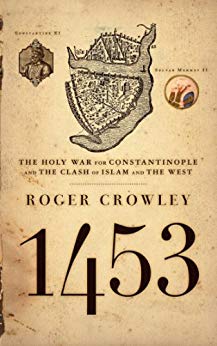
The fall of Constantinople in 1453 signaled a shift in history and the end of the Byzantium Empire. Roger Crowley’s readable and comprehensive account of the battle between Mehmet II, sultan of the Ottoman Empire, and Constantine XI, the 57th emperor of Byzantium, illuminates the period in history that was a precursor to the current conflict between the West and the Middle East.

May 29? A day of infamy and a day of celebration!

May 29, 1453 – The city of Constantinople was captured by the Turks, who renamed it Istanbul. This marked the end of the Byzantine Empire as Istanbul became the capital of the Ottoman Empire.

May 29, 1660 – The English monarchy was restored with Charles II on the throne after several years of a Commonwealth under Lord Protector Oliver Cromwell.

Known as “Black Monday,” the day that Constantinople fell to the Turks, was a tragedy of epic proportions. The Ottoman Empire, established in the newly-conquered territory, allowed Jews and Christians to practice their religion but with great difficulty. Many were killed for their faith. The treatment of the Greeks and the Armenians by the Ottomans is said to have inspired Hitler’s plans for the Final Solution; “Who speaks today of the extermination of the Armenians?” Hitler asked, just a week before the September 1, 1939 invasion of Poland. An excellent study of the heartbreaking events of Black Monday can be found here.

King Charles I, the Martyr, was King of England, Scotland and Ireland from 1625 until his execution on 30 January 1649 by Oliver Cromwell, a stern and rigid Puritan. Cromwell ruled until his death from natural causes in 1658 and was buried in Westminster Abbey. The Royalists returned to power along with King Charles II in 1660, and they had Cromwell’s corpse dug up, hung in chains, and beheaded. Charles II was one of the most popular and beloved kings of England, known as the Merry Monarch in reference to both the liveliness and hedonism of his court and the general relief at the return to normality after over a decade of rule by Cromwell and the Puritans.

Also on May 29, 1913 – Igor Stravinsky’s ballet score The Rite of Spring receives its premiere performance in Paris, France, provoking a riot.